
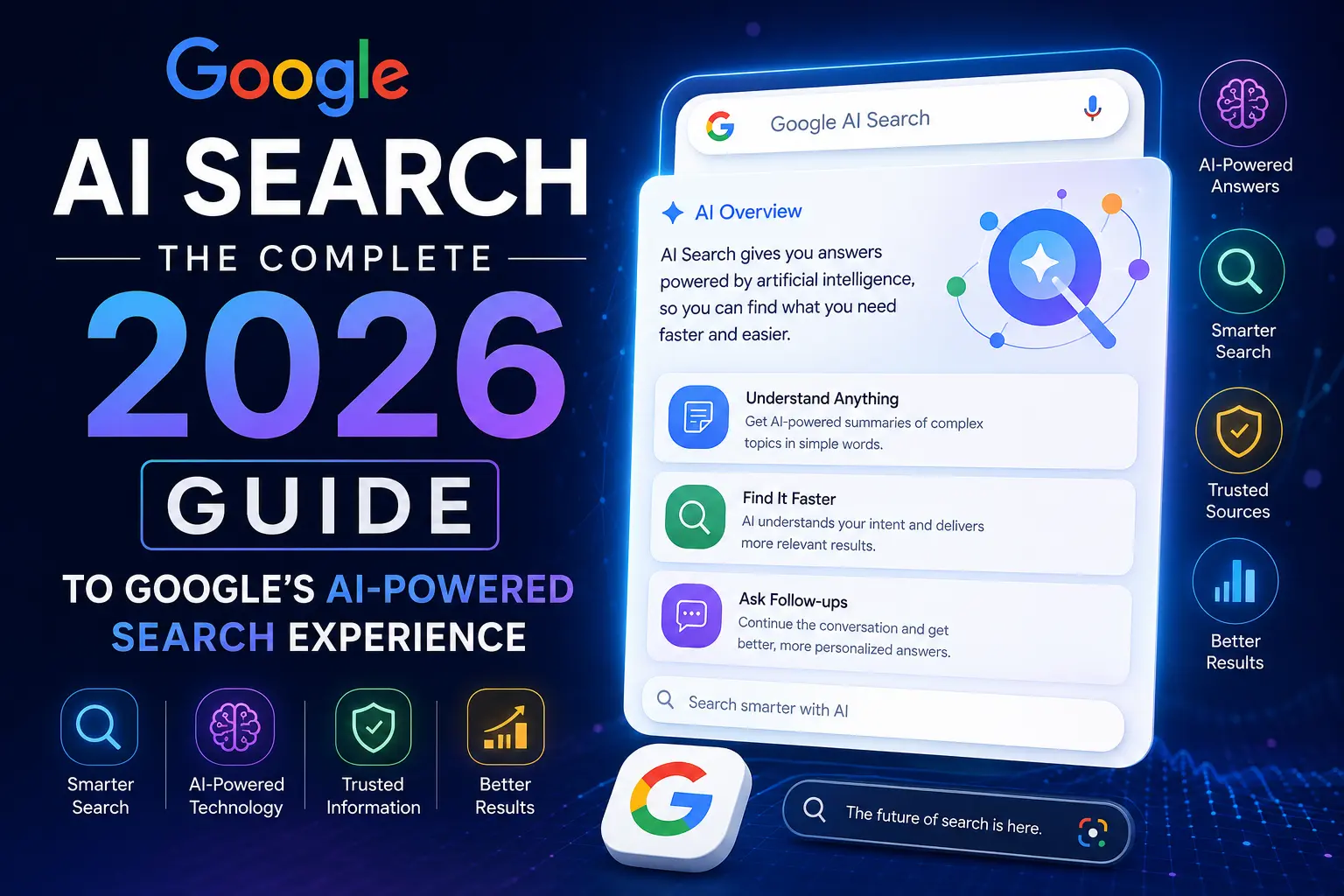
Google AI Search is transforming how people discover information online. Instead of simply displaying a list of web pages, Google now uses advanced artificial intelligence to understand user intent, summarize information, and provide more accurate, contextual answers. This shift is changing the way users search and how website owners create content.
Whether you’re a business owner, blogger, marketer, or SEO professional, understanding Google AI Search is essential for staying competitive in search results.
What Is Google AI Search?
Google AI Search is Google’s next-generation search experience powered by artificial intelligence. It combines traditional search indexing with advanced AI models capable of understanding language, context, intent, and relationships between topics.
Rather than matching keywords alone, Google AI Search analyzes the meaning behind a query and generates helpful responses while still linking users to trusted websites for additional information.
This creates a faster and more informative search experience.
How Google AI Search Works
Google AI Search combines several technologies:
- Artificial Intelligence
- Machine Learning
- Natural Language Processing (NLP)
- Knowledge Graph
- Ranking Systems
- Real-time Web Indexing
When a user submits a question, Google:
- Understands the search intent.
- Finds authoritative sources.
- Evaluates content quality.
- Generates an AI-powered overview when appropriate.
- Displays supporting websites for deeper reading.
The result is a search experience focused on answering questions rather than simply listing links.
Key Features of Google AI Search
1. AI-Powered Summaries
Google can generate concise overviews that summarize information from multiple authoritative sources.
2. Better Understanding of Intent
Instead of focusing only on exact keywords, Google understands:
- synonyms
- context
- user goals
- follow-up questions
3. Conversational Search
Users can ask:
Which laptop is best for students under $1000?
Then continue with:
Which one has the best battery?
Google maintains context between questions.
4. Visual Search
Users can search using:
- images
- screenshots
- camera input
- text
This creates a more natural search experience.
5. Personalized Results
Depending on permissions and context, Google can provide more relevant recommendations.
Benefits of Google AI Search
Google AI Search offers several advantages:
- Faster answers
- Better search accuracy
- More relevant results
- Improved multilingual understanding
- Better product discovery
- Enhanced local search
- Easier research
- More natural conversations
How Google AI Search Changes SEO
Traditional SEO still matters, but optimization has evolved.
Instead of optimizing only for keywords, websites should focus on:
- expertise
- authority
- trustworthiness
- topical depth
- factual accuracy
- helpful content
Google increasingly rewards pages that genuinely solve users’ problems.
SEO Best Practices for Google AI Search
Write for People First
Create content that answers real questions instead of stuffing keywords.
Cover Topics Completely
Comprehensive guides outperform thin articles because they satisfy multiple related intents.
Add Clear Headings
Use descriptive H2 and H3 headings so both readers and AI systems can understand your structure.
Include FAQs
Question-and-answer sections increase the chances of appearing in AI-generated responses.
Demonstrate Expertise
Support claims with examples, original insights, statistics where appropriate, and practical advice.
Improve Page Experience
Focus on:
- fast loading speed
- mobile responsiveness
- secure HTTPS
- clean navigation
GEO (Generative Engine Optimization) Tips
Generative engines look for content that is:
- easy to understand
- factually accurate
- well organized
- authoritative
- updated regularly
To optimize for GEO:
- Answer questions directly.
- Use short, informative paragraphs.
- Include comparison tables where relevant.
- Explain technical terms.
- Add real-world examples.
- Keep content fresh.
AEO (Answer Engine Optimization) Tips
Answer engines prioritize concise, structured responses.
Best practices include:
- Answer the main question within the first 100 words.
- Use numbered steps.
- Add FAQ sections.
- Use bullet lists.
- Keep definitions clear and precise.
- Use descriptive headings.
Does Google AI Search Replace Traditional Search?
No. Traditional search results remain important.
AI-generated responses often cite and recommend high-quality websites, meaning publishers can still earn valuable traffic by producing trustworthy, comprehensive content.
How Businesses Should Adapt
Businesses should:
- Publish original research.
- Create in-depth guides.
- Demonstrate expertise.
- Update older articles regularly.
- Build topical authority.
- Improve technical SEO.
- Earn quality backlinks.
- Strengthen brand credibility.
Common Mistakes to Avoid
Avoid:
- Keyword stuffing
- AI-generated content without human review
- Thin articles
- Misleading titles
- Duplicate content
- Outdated information
- Poor user experience
Frequently Asked Questions
Is Google AI Search free?
Yes. Google AI Search is available to users without an additional fee in supported regions and experiences.
Does Google AI Search affect website traffic?
It can change how users interact with search results, but websites with high-quality, trustworthy content can continue to attract valuable traffic.
Is traditional SEO still important?
Absolutely. Technical SEO, content quality, internal linking, page experience, and authority remain essential.
What type of content performs best?
Comprehensive tutorials, expert guides, original research, comparisons, and content that answers real user questions tend to perform well.
Conclusion
Google AI Search represents a major evolution in online search. Success is no longer about targeting individual keywords alone—it is about creating authoritative, trustworthy, and genuinely helpful content that answers users’ questions better than anyone else. By combining traditional SEO with GEO and AEO strategies, publishers can improve their visibility in both classic search results and AI-powered search experiences.
Invest in expert content, maintain technical excellence, build topical authority through internal linking, and keep your articles updated. These practices will position your website for long-term success as Google AI Search continues to evolve.