
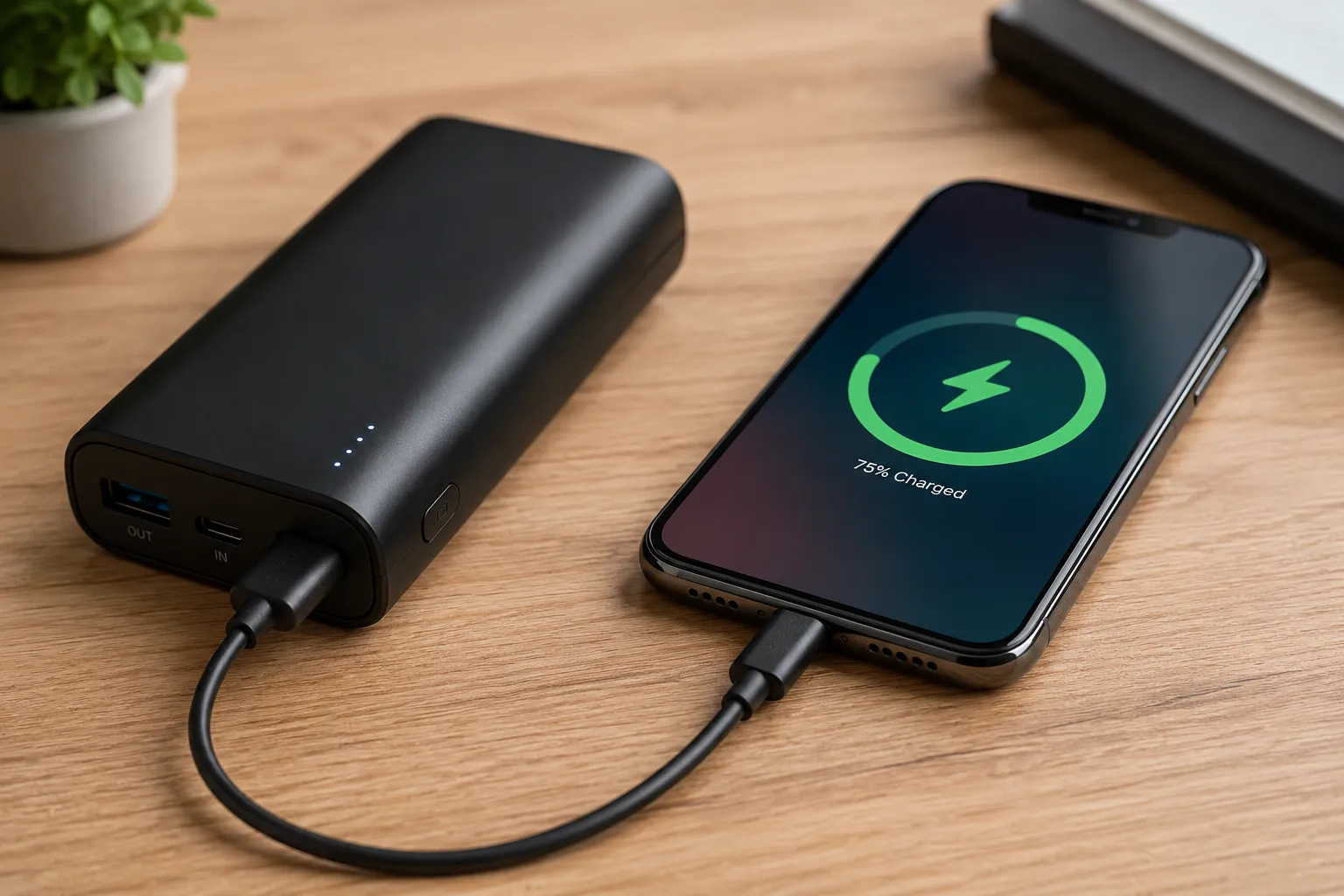
Power banks and spare lithium batteries must normally travel in your carry-on baggage—not your checked suitcase.
The Federal Aviation Administration states that portable chargers must remain with the passenger in the aircraft cabin. If your carry-on bag is checked at the gate, you must remove the power bank before handing over the bag.
Battery capacity also matters. Power banks rated at no more than 100 watt-hours are generally permitted without advance airline approval. Units between 101 and 160 watt-hours usually require airline approval, while devices above 160 watt-hours are generally prohibited on passenger aircraft.

In This Guide
Table of Contents
Can You Take a Power Bank on a Plane in 2026?
Yes, most ordinary consumer power banks are permitted—but they must be carried in the aircraft cabin.
| Power Bank Capacity | Carry-On Baggage | Checked Baggage | Airline Approval |
|---|---|---|---|
| Up to 100 Wh | Generally permitted | Not permitted | Normally not required |
| 101–160 Wh | May be permitted | Not permitted | Usually required |
| Above 160 Wh | Generally prohibited | Prohibited | Normally cannot be approved as passenger baggage |
| Damaged or recalled | Normally prohibited | Prohibited | Contact the airline before travelling |
These are general safety limits. Individual airlines, airports and national aviation authorities can impose stricter requirements.
Gate-check warning: If an airline takes your cabin bag at the gate, remove every power bank and spare battery before the bag enters the cargo hold.
Why Are Power Banks Banned From Checked Baggage?
Power banks contain lithium-ion cells. A damaged, defective or short-circuited cell can overheat and enter a process known as thermal runaway.
Thermal runaway can produce:
- Intense heat
- Smoke
- Flammable gases
- Fire
- Repeated ignition between nearby cells
A battery incident is easier to identify and respond to in the passenger cabin. Cabin crew can see smoke, use appropriate equipment and monitor the affected device.
A fire inside an inaccessible checked suitcase may be more difficult to detect and control.
The FAA’s lithium-battery guidance therefore requires portable chargers, spare batteries, electronic cigarettes and similar devices to remain accessible in the cabin.
Understanding the 100 Wh and 160 Wh Limits
Airline battery rules are based on watt-hours, written as Wh. Watt-hours measure stored energy more accurately than milliamp-hours alone.
Power Banks Up to 100 Wh
Most power banks designed for phones, tablets and small laptops fall within this category.
Common examples include:
- 5,000 mAh phone chargers
- 10,000 mAh power banks
- 20,000 mAh power banks
- Many 26,800 or 27,000 mAh travel chargers
These are generally allowed in carry-on baggage without advance airline approval, provided the battery is undamaged and its rating can be verified.
Power Banks Between 101 and 160 Wh
Larger laptop chargers and compact portable power stations may fall into this range.
They normally require approval from the airline before travel. The FAA also limits passengers to two spare batteries in this larger capacity category.
Power Banks Above 160 Wh
Large power stations and generator-style battery packs above 160 Wh are generally not allowed in passenger baggage.
Transporting one may require specialized dangerous-goods shipping arrangements. Airline check-in approval does not normally override the passenger-aircraft limit.
How to Calculate Your Power Bank’s Watt-Hour Rating
Check the label first. Reputable manufacturers normally print the Wh rating directly on the casing.
If only milliamp-hours and voltage are shown, use this formula:
Watt-hours = (mAh ÷ 1,000) × voltage
Example: 20,000 mAh Power Bank
If the internal battery voltage is 3.7 volts:
(20,000 ÷ 1,000) × 3.7 = 74 Wh
A correctly labelled 20,000 mAh power bank using a 3.7-volt internal cell would therefore be below the usual 100 Wh threshold.
Common Capacity Estimates
| Advertised Capacity | Nominal Cell Voltage | Approximate Energy | General Category |
|---|---|---|---|
| 5,000 mAh | 3.7 V | 18.5 Wh | Below 100 Wh |
| 10,000 mAh | 3.7 V | 37 Wh | Below 100 Wh |
| 20,000 mAh | 3.7 V | 74 Wh | Below 100 Wh |
| 26,800 mAh | 3.7 V | 99.16 Wh | Close to 100 Wh |
| 30,000 mAh | 3.7 V | 111 Wh | May require airline approval |
| 40,000 mAh | 3.7 V | 148 Wh | Airline approval normally required |
| 50,000 mAh | 3.7 V | 185 Wh | Generally prohibited |
These calculations are illustrations, not substitutes for the manufacturer’s rating. Power banks may use different internal voltages and cell arrangements. Use the Wh value printed by the manufacturer whenever available.
Why a Missing Battery Label Can Cause Problems
Airport or airline personnel need to confirm that a battery is within the permitted capacity.
A power bank may be rejected if:
- The capacity label is missing
- The numbers have worn away
- The casing appears counterfeit
- The stated rating is inconsistent
- The battery has been modified
- Staff cannot determine its watt-hour capacity
Do not attach a homemade label or alter the manufacturer’s rating. If the original information is unreadable, replacing the charger before travel may be the safest option.
Video: Why Airlines Restrict Lithium Batteries
This news report covers FAA warnings about lithium-battery incidents aboard aircraft.
How to Pack a Power Bank for a Flight
1. Put It in Your Carry-On Bag
Pack the charger in a cabin bag or personal item that remains with you throughout the flight.
Do not place it inside a suitcase destined for the cargo hold.
2. Protect the Ports and Terminals
Prevent metal objects from contacting exposed connectors.
You can use:
- The original protective case
- A separate battery pouch
- A small individual bag
- Non-conductive terminal protection where appropriate
Do not store a loose power bank beside coins, keys, tools or other metal objects.
3. Prevent Accidental Activation
Pack the unit so its button cannot be continuously pressed. Disconnect charging cables when the device is not in use.
4. Keep the Capacity Label Visible
A security officer or airline representative may ask to inspect the watt-hour rating.
5. Keep It Accessible
Do not bury the charger beneath everything else in an overhead bag. You may need to remove it during screening, gate checking or an in-flight safety incident.
Can You Use a Power Bank During the Flight?
Permission to carry a power bank does not automatically mean you may use or charge it during the flight.
Some airlines prohibit:
- Using a power bank during the flight
- Charging the power bank from an aircraft outlet
- Placing it in an overhead compartment
- Leaving it connected while sleeping
- Using a device that becomes unusually warm
Other carriers permit normal use if the power bank remains visible and accessible.
Check the operating airline’s policy before departure and follow cabin-crew instructions. On a codeshare journey, the rules of the airline operating the aircraft are especially important.
Why Airline Power Bank Rules May Be Stricter
The FAA rules establish general safety limits for flights under its jurisdiction. Airlines can adopt additional restrictions.
An airline may impose rules concerning:
- The maximum number of power banks
- Where they must be stored in the cabin
- Whether they can be used in flight
- Whether charging is permitted
- Approval procedures for batteries above 100 Wh
- Required markings or safety certifications
International journeys may also involve several national aviation authorities.
For example, a journey from Pakistan to Europe through the Middle East could involve:
- The departure airport’s security procedures
- The operating airline’s baggage policy
- Transit-airport restrictions
- The destination country’s aviation rules
- Different rules on the return flight
Check every operating carrier when an itinerary includes multiple airlines.
Power Banks on Flights From Pakistan
Passengers departing from Pakistan should follow the airline’s published dangerous-goods and cabin-baggage rules.
Before travelling:
- Check the policy of PIA or the international airline operating the flight.
- Confirm restrictions for connecting airlines.
- Keep the power bank in hand baggage.
- Make sure the watt-hour rating is readable.
- Do not carry an inflated, cracked or overheating unit.
- Allow extra time if carrying a battery above 100 Wh.
Airport security may refuse an item even when a traveller believes it is within the general limit. The decision can depend on labelling, physical condition and the airline’s rules.
Damaged, Swollen and Recalled Power Banks
A damaged lithium battery presents a greater fire risk and should not be taken aboard an aircraft.
Warning Signs
- Swelling or bulging
- A cracked or separating casing
- Unusual heat during normal use
- A chemical or sweet smell
- Hissing or popping sounds
- Leaking material
- Burn marks or melted plastic
- Damage caused by dropping or crushing
The FAA states that damaged or recalled batteries likely to spark or generate dangerous heat must not be carried on an aircraft unless they have been made safe under an accepted procedure.
Check the manufacturer and relevant product-safety authority for active recalls before travelling.
Do Not Put a Swollen Battery in Household Trash
Isolate the unit from flammable materials without puncturing or crushing it. Follow local hazardous-waste or battery-recycling instructions.
What to Do If a Power Bank Overheats on a Plane
If a battery becomes hot, expands, smokes or produces an unusual smell:
- Stop using it immediately.
- Disconnect it from other devices if this can be done safely.
- Do not place it back inside a bag.
- Notify cabin crew immediately.
- Follow crew instructions.
- Do not attempt to hide the problem.
Cabin crew receive procedures for responding to battery incidents. Quick reporting gives them more time to manage the situation.
Are Laptops and Phones Treated Like Power Banks?
A battery installed inside a phone, tablet, camera or laptop is treated differently from a spare battery or portable charger.
Many installed-battery devices may be placed in checked baggage under general rules, but airlines and safety authorities strongly prefer that valuable electronics remain in the cabin.
If an electronic device is placed in checked baggage, it should normally be:
- Completely switched off
- Protected against accidental activation
- Protected from damage
- Packed according to airline instructions
Power banks are classified as spare batteries because their primary function is supplying power to another device. That is why they must remain in carry-on baggage.
Rules for Smart Luggage
Smart suitcases may contain removable or permanently installed lithium batteries used for tracking, charging or electronic locks.
If the bag is checked, the battery may need to be removed and carried into the cabin. A suitcase with a non-removable battery can be refused.
Before buying smart luggage, confirm:
- Whether the battery is removable
- Its watt-hour rating
- How it can be safely disconnected
- Whether your usual airlines accept that design
Power Bank Flight Checklist
- Confirm the power bank is no more than 100 Wh where possible.
- Request airline approval for a unit between 101 and 160 Wh.
- Leave units above 160 Wh at home.
- Check that the manufacturer’s rating is readable.
- Inspect the casing for swelling, cracks or heat damage.
- Place the charger in carry-on baggage.
- Protect it from keys, coins and other metal objects.
- Remove it if your cabin bag is checked at the gate.
- Check whether your airline permits in-flight use.
- Tell cabin crew immediately if the battery overheats.
Passengers can verify current US guidance through the FAA’s PackSafe lithium-battery page.
For more practical journey planning, visit the ZOBUZ travel section and explore the latest travel-safety guides.
Final Takeaway
The safest rule is straightforward: keep every power bank and spare lithium battery with you in the aircraft cabin.
Choose a clearly labelled charger below 100 Wh, protect it from damage and check the operating airline’s policy before departure.
Never travel with a swollen, recalled or overheating battery. If your carry-on bag is moved to the cargo hold, remove the portable charger before surrendering the bag.
Aviation requirements can change and airlines may impose stricter limits. Always verify the latest rules with the operating carrier and relevant aviation authority.
Frequently Asked Questions
Can a power bank go in checked luggage?
No. Power banks are treated as spare lithium batteries and must normally remain in carry-on baggage inside the aircraft cabin.
Is a 20,000 mAh power bank allowed on a plane?
Most 20,000 mAh power banks are below 100 Wh and are generally allowed in carry-on baggage. Confirm the watt-hour rating printed on the unit.
Is a 30,000 mAh power bank allowed on a flight?
A 30,000 mAh unit may exceed 100 Wh depending on its internal voltage. It may require advance airline approval. Check the printed Wh rating rather than relying only on mAh.
How many power banks can you take on a plane?
Rules vary by airline. The FAA places a two-battery limit on larger spare lithium-ion batteries between 101 and 160 Wh. Airlines may also limit smaller power banks.
Can you use a power bank during a flight?
It depends on the airline. Some carriers permit use while others prohibit charging or require the battery to remain visible and accessible.
What happens if a power bank has no capacity label?
Airline or security personnel may reject it because they cannot confirm that it falls within the permitted watt-hour limit.
Are power banks above 160 Wh allowed?
Power banks exceeding 160 Wh are generally prohibited in passenger baggage and may require specialized dangerous-goods shipping.
What should you do if a power bank becomes hot on a plane?
Stop using it and inform cabin crew immediately. Do not hide it, return it to a bag or attempt to manage a smoking battery without assistance.