
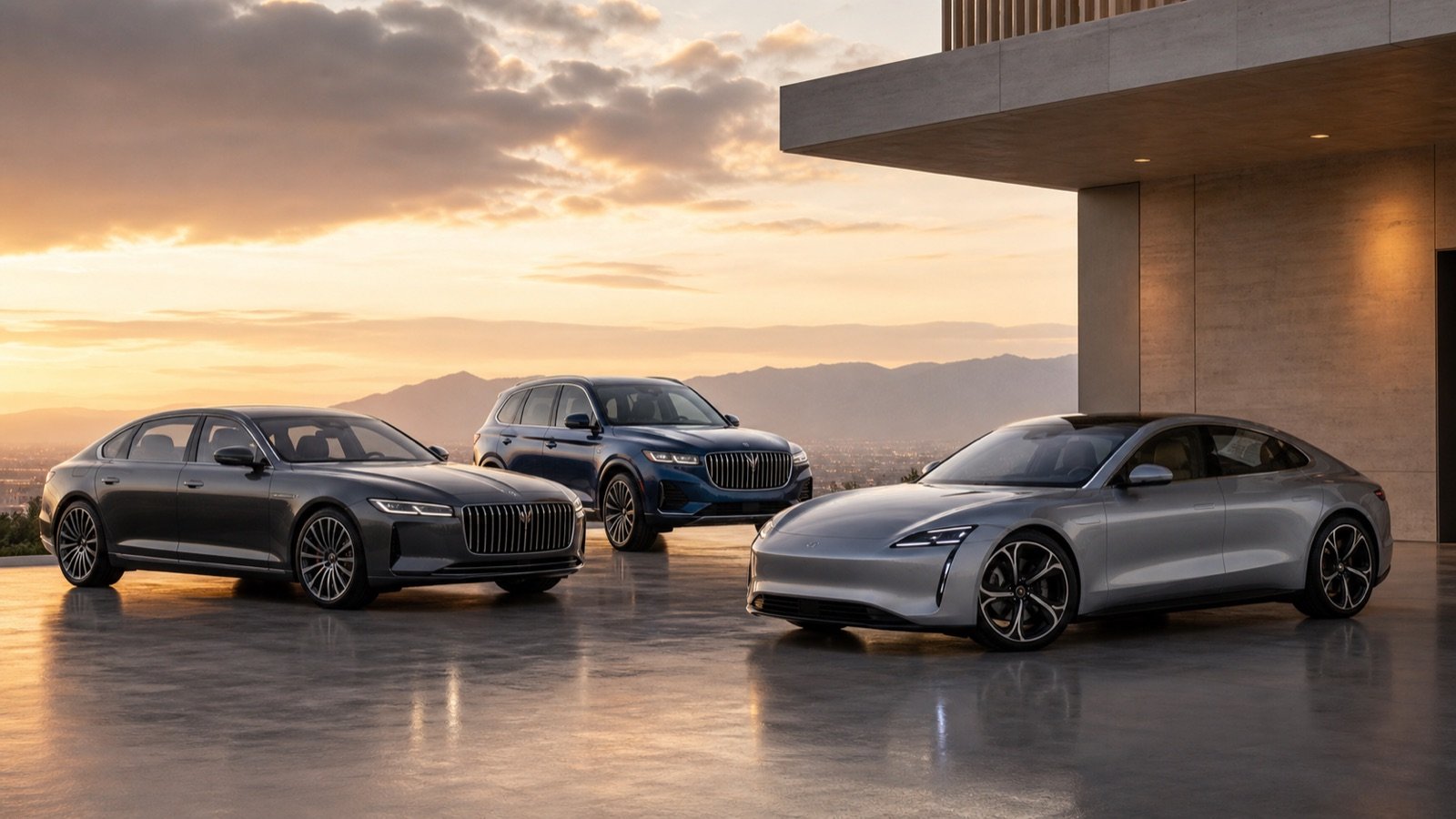
A high-end vehicle should do more than look impressive in a showroom. The right choice must fit the roads you drive, the people and cargo you carry, the way you charge or refuel, and the amount you are prepared to spend after the purchase.
Start with the vehicle category and ownership requirements, then compare specific models on safety, comfort, usability, operating cost and dealer support. A careful test drive and a complete out-the-door quote are more useful than choosing from a generic “best luxury cars” list.
Choose the type of high-end vehicle first
| Category | Usually suits | Trade-offs to check |
|---|---|---|
| Luxury sedan | Comfortable commuting, highway travel and rear-seat passengers | Lower cargo flexibility and ground clearance than an SUV |
| Luxury SUV | Families, cargo, towing and poor-weather versatility | Higher weight, tire cost and energy use |
| Grand tourer or sports car | Responsive handling and occasional leisure driving | Limited rear seats, cargo space and daily comfort |
| Luxury EV | Quiet driving, home charging and lower tailpipe emissions | Charging access, cold-weather range and repair-network considerations |
| Performance hybrid | Drivers seeking electrified response without relying entirely on public charging | Powertrain complexity, battery packaging and real-world efficiency |
| Full-size flagship | Maximum cabin space, ride comfort and available technology | Purchase price, depreciation, parking and running costs |
Examples such as the Mercedes-Benz S-Class or BMW 7 Series illustrate the flagship-sedan category, while the Range Rover and Porsche Cayenne illustrate luxury SUVs. A Porsche 911 is a very different proposition from either. Model names help build a shortlist, but specifications, trims and standard equipment can change by model year and market. Verify the exact vehicle rather than relying on a broad reputation.
Set a realistic total ownership budget
The purchase price is only the first line of a luxury-car budget. Estimate financing or lease charges, taxes, registration, insurance, energy, maintenance, tires, parking and likely depreciation. Large wheels, high-performance brakes, air suspension and complex options can materially increase service costs.
- Ask your insurer for a quote using the exact vehicle identification number when possible.
- Price a full set of the fitted tires and check whether they are staggered or run-flat.
- Review scheduled maintenance through the expected ownership period.
- Identify the nearest qualified service center and normal appointment lead time.
- Compare warranty, roadside-assistance and prepaid-maintenance terms.
- Estimate resale value conservatively rather than treating it as guaranteed.
Insurance structure matters on an expensive vehicle. Zobuz’s explanation of insurance deductibles can help you compare how much risk remains with the policyholder, but obtain advice and quotes for your circumstances.
Evaluate comfort with your own routine
Luxury is personal. A soft ride may feel isolated to one driver and composed to another. Firm sport seats may be supportive for an hour but uncomfortable on a long trip. Bring the people and everyday items that matter to the decision.
- Test entry and exit for front- and rear-seat passengers.
- Fit child seats and check the remaining passenger space where relevant.
- Load normal luggage, mobility equipment, golf bags or work gear.
- Drive over rough pavement as well as a smooth demonstration route.
- Check visibility, mirror coverage and camera performance at night.
- Listen for tire and wind noise at highway speed.
- Use the climate, seat, audio and navigation controls while stationary.
Do not assume every trim rides the same. Wheel diameter, tire construction, suspension package and seat design can change the experience substantially within one model line.
Treat technology as a usability question
Large screens and long option lists do not automatically improve ownership. Test the functions you will use repeatedly: phone pairing, navigation, voice control, physical shortcuts, driver profiles and over-the-air updates. Confirm whether connected services require a subscription after an introductory period.
Driver-assistance features require particular care. Learn which functions are warnings, which can intervene, and what attention the driver must maintain. Names such as “pilot,” “assist” or “autopilot” do not make a vehicle self-driving. The National Highway Traffic Safety Administration provides official explanations of driver-assistance technologies, safety ratings and recall checks.
Check safety by model year and configuration
Safety evidence should be vehicle-specific. Search NHTSA’s ratings and recall tools by year, make and model, and use the VIN for an individual used vehicle. A model’s size, price or prestige does not replace crash-test data or an open-recall check.
Compare the availability and behavior of automatic emergency braking, blind-spot monitoring, lane support, adaptive cruise control, driver monitoring and surround-view cameras. During the test drive, make sure alerts are understandable and not so intrusive that you expect to disable useful systems.
For an EV, audit charging before acceleration
A luxury EV can deliver quiet, immediate performance, but the ownership experience depends on charging. Confirm whether you can install a suitable home charger, the electrical-upgrade cost, charging speed at home and on road trips, and the networks available on your usual routes.
- Compare the official efficiency and range for the exact wheel and powertrain configuration.
- Ask how temperature, highway speed, towing and cabin heating affect range.
- Check the battery and electric-drive warranty terms.
- Understand the charging connector and access to compatible fast chargers.
- Test the route planner and battery preconditioning process.
- Price home equipment and installation before signing the order.
The U.S. Department of Energy and Environmental Protection Agency provide a vehicle-comparison tool at FuelEconomy.gov. Use official figures as a consistent comparison point, while recognizing that individual driving conditions affect results.
New, certified pre-owned or used?
A new vehicle offers the latest specification, full factory warranty and the ability to choose options, but often carries the greatest early depreciation. A manufacturer-backed certified pre-owned vehicle may combine a lower price with inspection and warranty coverage. A conventional used vehicle can offer more value but requires careful condition, history and warranty checks.
For a used luxury car, arrange an independent pre-purchase inspection by a technician familiar with the brand. The inspection should cover diagnostic codes, suspension, brakes, tires, fluid leaks, body repairs, electronic systems and high-cost options. For an EV or plug-in hybrid, ask what battery-health information is available.
The Federal Trade Commission’s used-car guidance explains the dealer Buyers Guide, vehicle-history reports, independent inspections, warranties and written promises. Rules and consumer rights can also vary by state.
Compare quotes without losing the details
Request an itemized out-the-door price in writing. It should separate the vehicle price, destination charge, taxes, registration, dealer fees, accessories, protection products, trade-in and financing terms. Compare the same configuration and avoid negotiating only from a monthly payment.
Review every option. Some features that sound essential may duplicate standard equipment; others can affect ride quality or resale. Confirm whether accessories are factory-installed, port-installed or dealer-added and whether they carry the same warranty.
Use a structured test-drive scorecard
| Area | Questions to score |
|---|---|
| Driving | Steering, braking, visibility, ride and low-speed control |
| Cabin | Seat comfort, noise, materials, storage and passenger space |
| Technology | Control logic, phone integration, cameras and subscriptions |
| Practicality | Cargo fit, parking, ground clearance and weather suitability |
| Ownership | Insurance, service access, warranty, tires and energy cost |
| Evidence | Safety ratings, recalls, history and independent inspection |
Score vehicles immediately after each drive using the same route and priorities. Zobuz’s broader car-care and ownership guide can help new owners identify maintenance questions to raise before purchase.
Frequently asked questions
Which luxury-car brand is the most reliable?
Reliability can vary by model, powertrain, model year and maintenance history. Review evidence for the exact vehicle and obtain an inspection rather than applying one reputation to an entire brand.
Is leasing better than buying a high-end vehicle?
Leasing may suit drivers who prefer a predictable term and regularly change vehicles, but mileage, wear, acquisition and disposition charges matter. Buying can suit longer ownership and unrestricted mileage. Compare the complete after-tax cost under realistic use.
Are large wheels worth choosing?
They can change appearance and handling, but may reduce ride comfort, increase tire cost and affect efficiency or range. Test the exact wheel-and-tire combination before ordering.
The practical answer
The best high-end vehicle is the one that continues to make sense after the showroom appeal fades. Define the job, total the ownership cost, verify safety and warranty information, test the exact configuration and compare written offers. That process produces a better decision than treating any badge or current ranking as universally best.