
TSMC has paired a record quarter with its largest new U.S. manufacturing pledge, underscoring how the artificial-intelligence boom is moving from software models into expensive physical infrastructure.
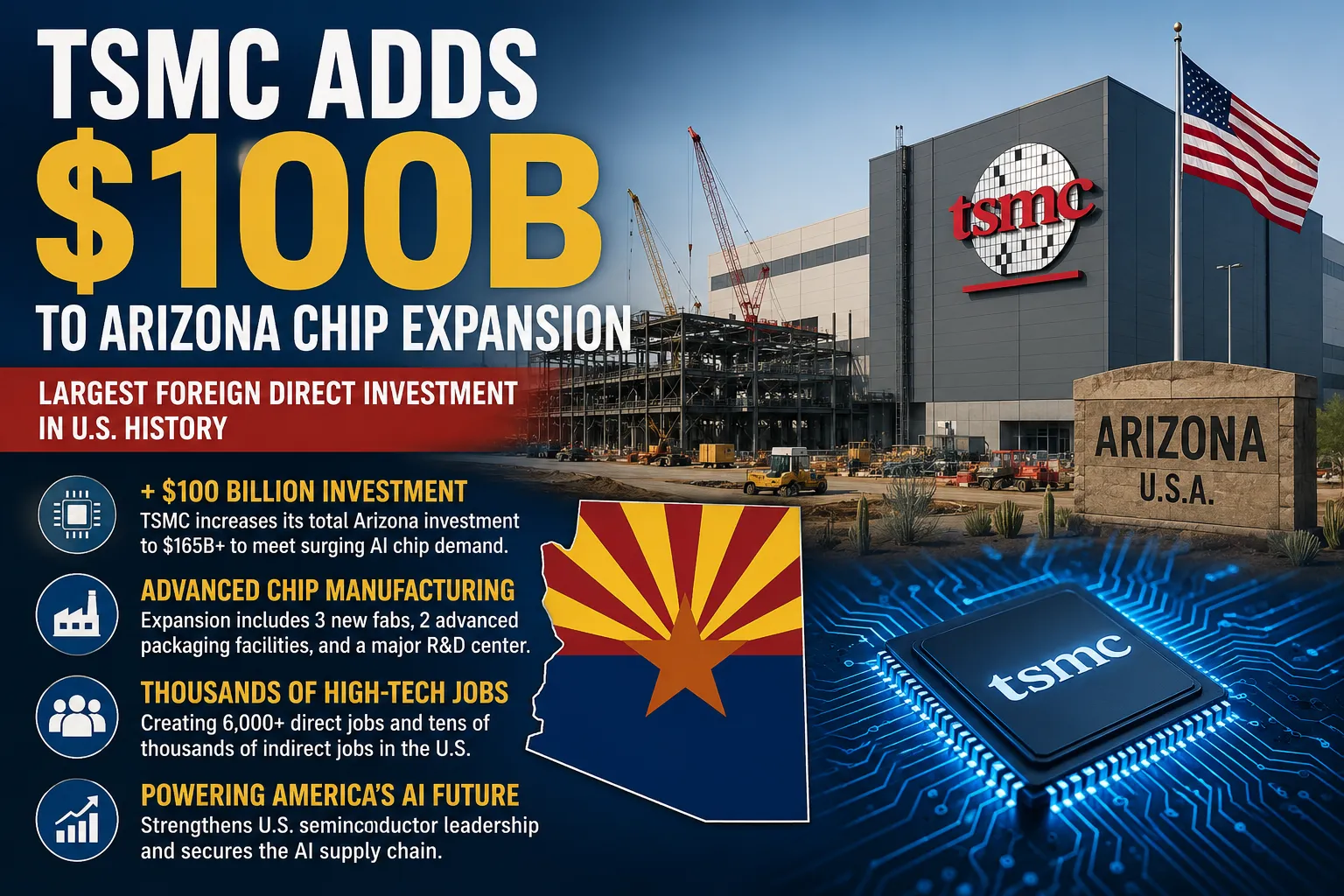
TSMC said on July 16 that it plans to invest another $100 billion in Arizona. The expansion would take the company’s planned Arizona investment to about $265 billion and add four more advanced fabrication plants, according to the Arizona Commerce Authority. The announcement came as TSMC reported second-quarter net profit of NT$706.6 billion (about $22 billion), up 77% from a year earlier, on revenue of NT$1.27 trillion.
The two announcements are linked. TSMC is committing capital because demand for leading-edge processors remains unusually strong, while customers and governments want more of those chips produced closer to end markets. The result is a larger, more geographically distributed semiconductor network—but also a more complicated and expensive one.
Record earnings are translating into physical capacity
TSMC is the world’s largest contract chipmaker, manufacturing processors designed by companies including Nvidia and Apple. Its second-quarter results provide an important read-through on the AI hardware cycle because the company sits upstream of data-center accelerators, networking silicon and advanced consumer processors.
Revenue rose 36% year over year, while net profit reached a record. TSMC also lifted its 2026 revenue-growth outlook to slightly above 40%, compared with its earlier forecast of more than 30%, Reuters reported. The company’s own quarterly-results page lists second-quarter revenue of $40.2 billion, at the top of its previous guidance range.
Those figures do not prove that every AI investment will earn an attractive return. They do show that the immediate demand for advanced manufacturing capacity has remained strong enough for TSMC to expand spending rather than pause for a potential correction.
What the Arizona expansion includes
The Arizona Commerce Authority said the new pledge covers four additional fabs designed for 2-nanometer or more advanced production. TSMC’s planned Arizona footprint would reach 10 fabs, two advanced-packaging facilities and a research-and-development center.
That mix matters because manufacturing is only one part of the AI-chip bottleneck. Advanced packaging connects multiple dies and high-bandwidth components into systems that can be used in data centers. Building packaging capacity alongside wafer fabs can shorten some supply-chain steps, but it also requires specialized equipment, trained technicians, reliable power and large volumes of ultra-pure water.
The expansion therefore represents more than a factory announcement. It is an attempt to reproduce, in Arizona, an industrial ecosystem that has developed over decades in Taiwan. The site will still depend on TSMC’s global engineering organization and supplier network, but a larger local footprint could reduce exposure to shipping disruptions and geopolitical shocks.
Why the investment matters to the AI economy
AI systems require enormous amounts of computing power. Training and serving those systems depends on processors built with advanced nodes, packaging technologies and high-speed memory. When capacity is constrained, the limiting factor is not always chip design; it can be the ability to manufacture enough wafers and package them at scale.
TSMC’s investment is a market signal that the company and its customers expect computation demand to keep growing into the second half of the decade. It also gives U.S. policymakers a visible example of supply-chain localization after years of concern about the concentration of leading-edge production in Taiwan.
The trade-off is cost. Arizona manufacturing is more expensive and operationally more difficult than producing at TSMC’s established Taiwanese campuses. The company will need to maintain yields, staff facilities and coordinate suppliers while its customers continue to push for faster product cycles. Local production can improve resilience, but it does not eliminate the economic pressure to keep factories highly utilized.
The unresolved questions
The announcement is a commitment, not a completed build-out. Permits, construction schedules, workforce development, equipment installation and customer qualification all determine when additional capacity becomes commercially useful. The scale also raises questions about electricity, water and public infrastructure in the Phoenix region.
Investors will watch whether TSMC can preserve its margins as it expands into a higher-cost operating environment. Customers will watch whether Arizona-made chips reach the same quality and volume as those produced in Taiwan. Governments will watch whether incentives produce durable jobs and a broader domestic supplier base rather than an isolated cluster of imported expertise.
There is also a strategic question for Taiwan. More overseas capacity may strengthen TSMC’s relationships with its largest customers and reduce pressure on the company to relocate entirely. But every additional advanced fab outside Taiwan changes the geography of a capability that has become central to the island’s economic and security position.
Conclusion
TSMC’s record quarter and new $100 billion Arizona pledge show that the AI boom is still demanding real factories, not only new software. The investment could make the U.S. semiconductor supply chain more resilient and give chip customers a larger domestic manufacturing option. Delivering that promise will depend on execution: high yields, skilled labor, infrastructure and enough sustained demand to justify one of the world’s most capital-intensive expansion programs.