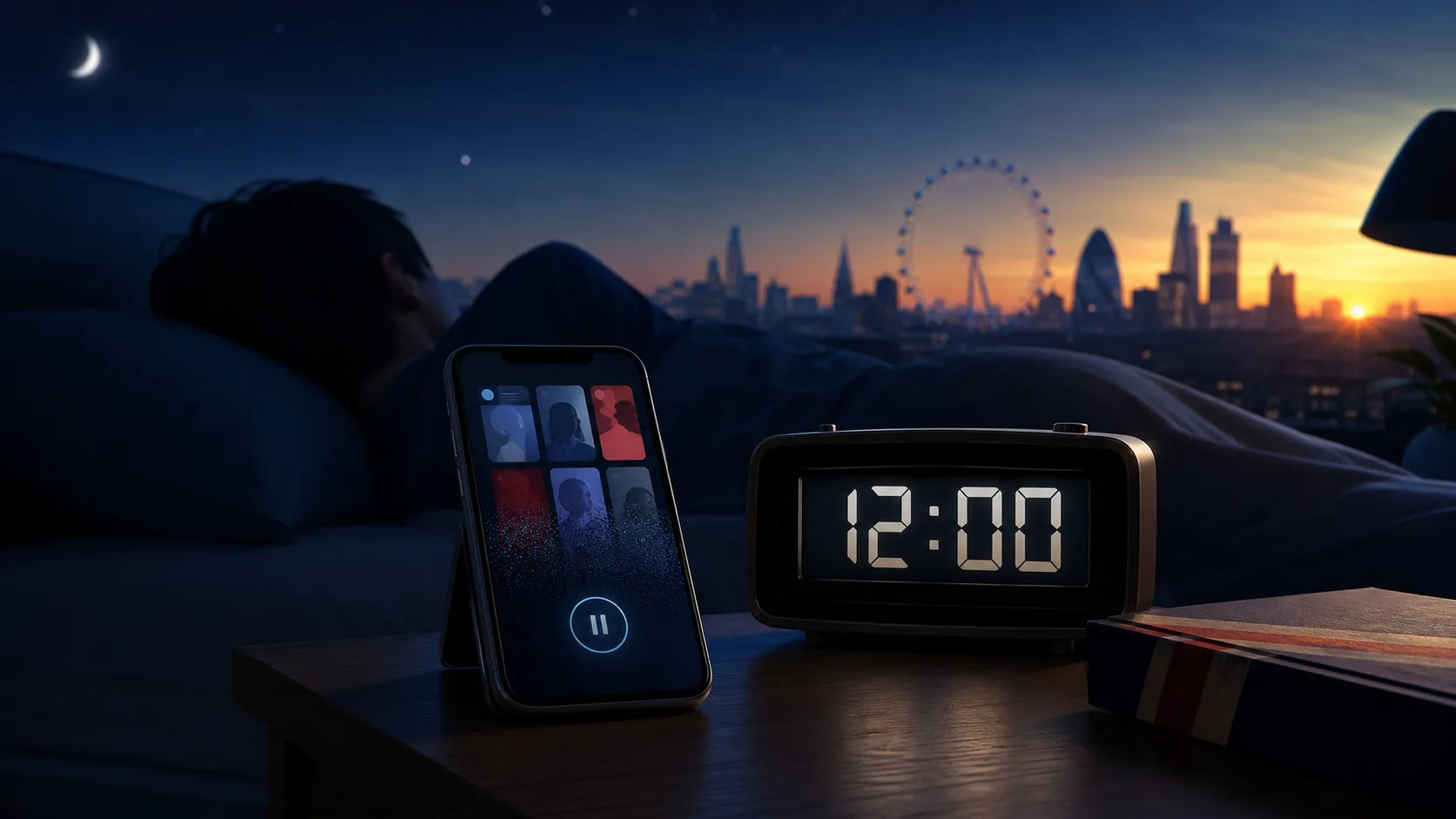
The United Kingdom plans to require social-media services to place 16- and 17-year-olds into a default overnight curfew from midnight to 6 a.m. The new protections will also switch off features designed to prolong use, including autoplay and continuously personalized feeds, unless an older teenager chooses to change the settings.
Announced by the Department for Science, Innovation and Technology on July 15, the measures are intended to prevent a sudden loss of safeguards when young people turn 16. They form part of a broader British policy package that is expected to restrict social-media access for children under 16 from spring 2027.
What is the UK social media curfew?
The curfew is a protective default, not a total legal ban on phone use after midnight. Social-media apps will be expected to limit access or use between midnight and 6 a.m. for accounts belonging to 16- and 17-year-olds. Notifications are also included in the planned nighttime limits.
Older teenagers will retain more choice than younger children. The government says 16- and 17-year-olds will be able to change their own settings, while the defaults are designed to make the safer option automatic. That distinction matters: the policy uses the power of interface design rather than treating every late-night login as an offence.
The same approach will apply to engagement features. Autoplay, infinite or continuously refreshed feeds, and personalized recommendations that encourage users to keep scrolling will be switched off by default. Other planned protections for this age group include restrictions on livestreaming and communication from strangers, including on some gaming services.
When will the new rules take effect?
The first regulations are expected to be laid before Parliament by the end of 2026. The government says implementation and enforcement are planned for spring 2027. Until the regulations are published, important operational details—including the exact services covered, the technical standard for a curfew and the compliance timetable—remain subject to the legislative process.
The curfew sits alongside a planned prohibition on social-media services offering accounts to children under 16. A government fact sheet on the wider rules says the under-16 model is expected to cover major services such as Instagram, YouTube, TikTok, Snapchat, Facebook and X, while excluding messaging services such as WhatsApp and Signal. Final coverage will depend on the regulations.
Why the government chose protective defaults
Defaults influence behavior because many people leave preselected settings unchanged. The policy is therefore aimed at the architecture of a service, not only at individual willpower or parental supervision.
New research from the communications regulator supports that logic. Ofcom’s July 2026 trial of protective defaults found strong support and high retention across children and adults when safer settings were preselected. Ofcom cautioned that a mock platform cannot reproduce every real-world influence, including peer pressure and social norms, but the result suggests that default design can materially shape choices.
A separate government-commissioned pilot involved 309 families and tested a 15-minute daily app limit, a 9 p.m.-to-7 a.m. curfew and the removal of designated apps. The published qualitative research was designed to examine feasibility and families’ experiences rather than prove a clinical effect. That is an important limit: reported improvements in routines do not by themselves establish that a nationwide rule will produce the same outcome.
How age checks become the practical test
A default for teenagers works only if a platform can reliably identify which users are 16 or 17. The policy therefore depends on age assurance—the mix of account history, verified credentials, facial age estimation and other methods used to estimate or confirm age.
Ofcom reported on July 15 that the proportion of children who encountered highly effective age checks when asked to prove their age rose from 25% in July 2025 to 43% in January 2026. However, the regulator also expressed doubts about whether some age-inference methods used by popular services are strong enough for an under-16 restriction.
This creates the central implementation tension. Weak checks can be bypassed, but intrusive checks can create privacy and accessibility concerns. Regulators and platforms will have to show that their systems are effective, proportionate and capable of protecting personal data. The answer is unlikely to be a single universal method.
What the rules mean for platforms and families
For social-media companies, compliance will require more than adding a bedtime reminder. Services may need age-aware account states, notification controls, feature-level restrictions, auditable settings and clear routes for teenagers to exercise the choices the law preserves. Product teams will also have to determine how a curfew follows users across time zones and devices without creating obvious loopholes.
For families, the policy does not eliminate the need for conversations about sleep, schoolwork, privacy and online behavior. Protective defaults can reduce friction, but teenagers may still change them. Families looking at the broader relationship between screens and development can also read Zobuz’s evidence-based guidance on early childhood screen time.
The planned rules also intersect with platform-specific privacy questions. Zobuz’s guide to Snapchat video privacy and responsible saving illustrates why consent and account safety remain relevant even when a service adds stronger default protections.
The policy extends beyond social media
The government also intends to develop child-safety measures for AI chatbots. Its announcement points to regular breaks for users under 18 and possible restrictions on services that give dangerous, misleading or unverified mental-health advice. Ministers say they will consider stronger action against chatbots that present a serious threat to children.
These proposals are less developed than the social-media curfew and should not be treated as final rules. They do, however, show that British online-safety policy is shifting from regulating harmful content alone toward regulating product features, recommendation systems and patterns of use.
Frequently asked questions
Is social media banned after midnight for UK teenagers?
No. The announced midnight-to-6 a.m. restriction is a default setting for 16- and 17-year-olds, and the government says older teenagers will be able to change their settings. Separate rules are planned to prevent under-16s from using covered social-media services.
Which features will be switched off?
The government identifies autoplay and feeds that continually deliver personalized content. Nighttime notifications, livestreaming and communication from strangers are also among the planned restrictions for older teenagers.
When will the UK social media curfew start?
The government expects the first regulations by the end of 2026 and implementation in spring 2027, subject to Parliament and the final regulatory framework.
Will adults have to verify their age?
Some users may need an age check, but the government says many established or previously verified adult accounts may not need to repeat the process. The final system will depend on the regulations and Ofcom’s implementation rules.
Conclusion
The UK social media curfew is best understood as a product-design rule: put safer settings in place automatically at the age when full access would otherwise begin. Its effectiveness will depend less on the headline hours than on reliable age assurance, enforceable technical standards and whether platforms design the defaults to work consistently. Families will see more detail before spring 2027, but the direction is already clear—online-safety regulation is moving deeper into the mechanics that keep people scrolling.