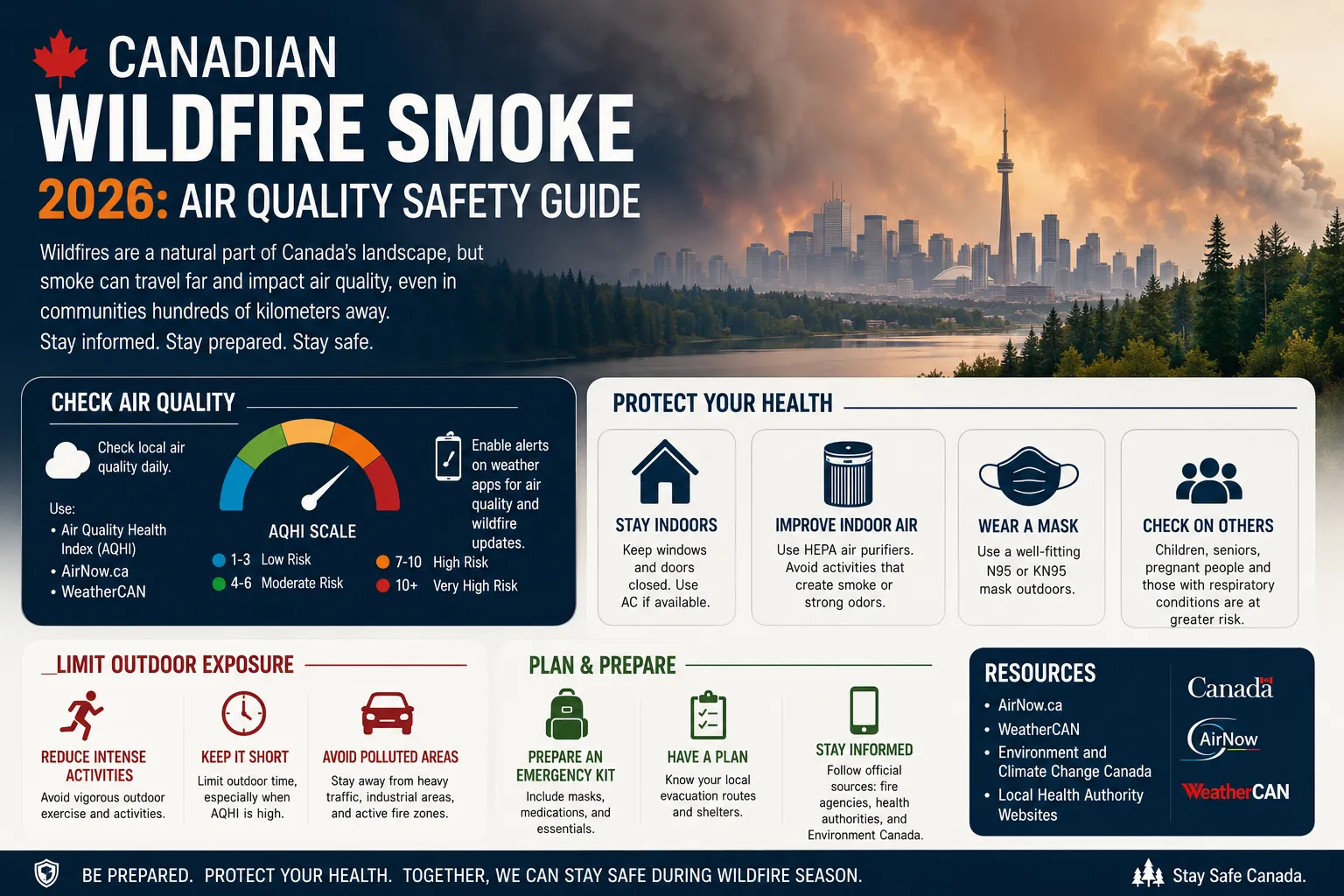
Smoke from Canadian wildfires is again affecting air quality across parts of the United States, producing hazy skies and elevated levels of fine-particle pollution.
Air quality alerts have affected areas of the Midwest, Mid-Atlantic and Northeast. Conditions can change quickly as wind direction, rainfall and fire activity move smoke between regions.
The visible haze is only part of the problem. Wildfire smoke contains microscopic particles capable of traveling deep into the lungs. People with asthma, heart disease or other existing conditions face greater risk, but heavy smoke can affect anyone.
The most useful response is not panic. It is checking reliable air-quality information, reducing exposure and keeping indoor air as clean as reasonably possible.

Where Is Canadian Wildfire Smoke Affecting Air Quality?
Recent smoke has moved into several northern and eastern US states. The exact area affected changes as winds carry smoke away from active fires.
Some locations may experience only a hazy sky because the smoke remains high in the atmosphere. Other areas can record elevated ground-level concentrations of PM2.5, creating conditions that are unhealthy for sensitive groups or the wider population.
Air quality alerts have recently been issued in areas including parts of Illinois, Indiana, Maryland, New York, New Jersey and neighboring regions.
Local conditions should be checked before outdoor activity. A national headline cannot tell you what the air is like in your neighborhood.
The AirNow Fire and Smoke Map provides current PM2.5 readings, smoke information and sensor data for communities across the United States.
What Is in Wildfire Smoke?
Wildfire smoke is a changing mixture of gases and particles produced as trees, plants, buildings and other materials burn.
It can contain:
- Fine particulate matter known as PM2.5.
- Carbon monoxide.
- Volatile organic compounds.
- Nitrogen oxides.
- Water vapor.
- Other pollutants created by combustion.
The composition depends on the materials burning, the fire’s temperature, atmospheric conditions and the age of the smoke.
Fine particles are the primary public-health concern. The US Environmental Protection Agency’s wildfire health guidance explains that these microscopic particles can enter the respiratory system and worsen existing heart and lung conditions.
Why PM2.5 Is Dangerous
PM2.5 refers to particles with a diameter of 2.5 micrometers or smaller. They are far narrower than a human hair and can remain suspended in the air.
Because of their small size, these particles can bypass some of the body’s natural defenses and penetrate deep into the lungs.
Short-term exposure may cause:
- Burning or irritated eyes.
- A sore or scratchy throat.
- Coughing.
- Wheezing.
- Headaches.
- Chest tightness.
- Shortness of breath.
- Unusual fatigue during physical activity.
Exposure can also trigger asthma attacks and aggravate chronic obstructive pulmonary disease or cardiovascular illness.
Smoke does not have to smell strong to create a health risk. Odor and visibility are poor substitutes for an actual air-quality reading.
Understanding the Air Quality Index
The Air Quality Index, or AQI, converts pollution measurements into a scale that is easier to understand.
| AQI Range | Category | What It Means | Suggested Response |
|---|---|---|---|
| 0–50 | Good | Air pollution presents little risk | Normal outdoor activity |
| 51–100 | Moderate | Acceptable for most people | Unusually sensitive people should monitor symptoms |
| 101–150 | Unhealthy for sensitive groups | Higher risk for people with certain conditions | Reduce prolonged or intense outdoor activity |
| 151–200 | Unhealthy | Everyone may experience effects | Move strenuous activity indoors |
| 201–300 | Very unhealthy | Health alert for the entire population | Avoid outdoor exertion and remain in cleaner air |
| 301 and above | Hazardous | Emergency-level health warning | Stay indoors in filtered air and follow official instructions |
The AQI can rise or fall during the day. Check it before exercising, sending children outside, opening windows or planning an outdoor event.
Who Is Most Vulnerable to Wildfire Smoke?
Heavy smoke can affect healthy adults, but some people are more likely to develop serious symptoms.
Higher-risk groups include:
- People with asthma.
- People with chronic obstructive pulmonary disease.
- People with heart or blood-vessel disease.
- Older adults.
- Babies and children.
- Pregnant people.
- Outdoor workers.
- Athletes exercising outside.
- People without access to filtered indoor air.
Children breathe more air relative to their body size and are often physically active outside. Older adults are more likely to have an underlying condition that smoke can aggravate.
Outdoor workers may receive a much larger total exposure because they remain outside for several hours.
Video: Wildfire Smoke, Air Quality and Your Health
This educational video explains the health effects of wildfire smoke, who faces greater risk and what households can do to reduce exposure.
If the embedded player is unavailable, watch the wildfire smoke health video on YouTube .
How to Protect Yourself From Wildfire Smoke
Check the AQI Before Going Outside
Conditions visible through a window can be misleading. Use AirNow, a state environmental agency or a reliable local weather service to check current readings.
Pay attention to PM2.5 rather than relying only on ozone data. Wildfire smoke events are often driven by elevated fine-particle pollution.
Reduce Strenuous Outdoor Activity
Exercise increases breathing rate, causing a person to inhale more polluted air. Running, cycling and heavy outdoor work can substantially increase smoke exposure.
When the AQI is unhealthy, move exercise indoors or postpone it. Taking a shorter, slower walk is safer than completing a high-intensity workout in smoke.
Wear a Properly Fitted Respirator
A well-fitted N95 or equivalent respirator can reduce inhalation of fine particles when a person must go outside.
The respirator should fit closely against the face without obvious gaps. Facial hair can prevent a proper seal.
Surgical masks, loose cloth masks and bandanas do not provide the same level of protection against PM2.5.
A respirator does not remove all gases from wildfire smoke. It is an additional control, not permission to remain outside unnecessarily.
Keep Windows and Doors Closed
Close windows and exterior doors when outdoor air quality is poor. Limit how frequently people enter and leave the building.
Smoke will still enter through gaps and ventilation systems. Closing the building reduces infiltration but does not eliminate it.
How to Keep Indoor Air Cleaner
Staying indoors is useful only when the indoor environment is meaningfully cleaner than the air outside.
Use a HEPA Air Purifier
A portable HEPA purifier can remove a substantial portion of airborne fine particles. Select a unit designed for the size of the room where it will operate.
Place the purifier in the room where people spend the most time. If only one unit is available, prioritize a bedroom or a designated clean-air room.
Run the purifier continuously on the highest practical setting. A quiet but inadequate setting may not move enough air during a significant smoke event.
Upgrade the HVAC Filter
Homes with central heating or air conditioning may benefit from a MERV 13 filter, provided the system can safely accommodate it.
Set the system to recirculate indoor air. Disable settings that intentionally pull outdoor air into the building during a smoke event.
Not every HVAC system is designed for a high-efficiency filter. Check the manufacturer’s instructions or consult a qualified technician before installing a filter that could restrict airflow.
Create a Clean-Air Room
Choose a room with few windows and doors. Close it off from the rest of the building and operate a suitable portable purifier inside.
AirNow’s clean-air room guidance recommends this approach for households affected by smoke, particularly those containing people at greater risk.
Activities to Avoid Indoors
Some ordinary household activities create additional particles. During a smoke event, avoid making indoor air worse.
Limit or avoid:
- Smoking or vaping indoors.
- Burning candles or incense.
- Using a wood-burning fireplace.
- Frying or broiling food unnecessarily.
- Vacuuming without a HEPA-filtered machine.
- Using aerosol sprays.
- Operating unvented combustion appliances.
If cooking generates smoke or strong fumes, use an externally vented range hood when doing so will not draw more polluted outdoor air into the home.
Can a Box-Fan Filter Help?
A do-it-yourself air cleaner can be made by attaching a suitable furnace filter to a box fan. More advanced versions use several filters arranged around the fan.
These devices can reduce indoor particle levels when a commercial purifier is unavailable or unaffordable.
Basic safety rules include:
- Use a newer fan with recognized safety certification.
- Do not use a damaged fan or power cord.
- Keep the device away from water and flammable materials.
- Do not leave an unsafe or unreliable unit operating unattended.
- Replace filters when they become visibly dirty or airflow declines.
- Follow local fire-department and public-health instructions.
A DIY filter is not identical to a certified commercial purifier, but it can be a useful risk-reduction tool.
Should You Use an Air Conditioner?
Air conditioning may be necessary when wildfire smoke occurs during extreme heat. Turning it off without considering indoor temperature can create another health risk.
Central systems should generally be placed in recirculation mode during heavy smoke.
Many window air conditioners recirculate indoor air, but some have outdoor-air vents. Close the vent if possible and ensure the unit is sealed around its edges.
Portable units with a single exhaust hose may draw outdoor air through gaps in the building. Their effect will depend on the design and installation.
If a home becomes dangerously hot or cannot keep smoke out, consider spending time in a public clean-air or cooling center.
Protecting Children During Wildfire Smoke
Schools, camps and families should base outdoor activities on the AQI and the intensity of the planned exercise.
Short, low-intensity activity creates less exposure than competitive sports or endurance training.
Parents and caregivers should:
- Check the AQI before outdoor play.
- Follow the child’s asthma action plan.
- Keep prescribed medication available.
- Watch for coughing, wheezing or unusual tiredness.
- Move physical activity indoors when pollution is elevated.
- Contact a healthcare professional if symptoms worsen.
Masks designed for adults may not seal correctly on a child’s face. Fit and breathing comfort require particular attention.
Protecting Pets From Wildfire Smoke
Pets breathe the same polluted air as their owners. Keep animals indoors as much as possible when smoke levels are elevated.
Limit walks to essential bathroom breaks. Avoid running, long walks and vigorous outdoor play.
Watch for:
- Persistent coughing or gagging.
- Difficulty breathing.
- Unusual weakness.
- Eye irritation.
- Reduced appetite.
- Abnormal or noisy breathing.
Animals with heart or respiratory conditions may face additional risk. Birds are particularly sensitive to airborne pollutants.
Contact a veterinarian promptly if an animal has difficulty breathing or develops concerning symptoms.
When Should You Seek Medical Help?
Mild irritation may improve after moving into cleaner air. More serious symptoms should not be ignored.
Seek urgent medical care for:
- Severe difficulty breathing.
- Chest pain or pressure.
- Blue or gray lips.
- Confusion.
- Fainting.
- An asthma attack that does not respond to the prescribed rescue plan.
- A significant worsening of an existing heart or lung condition.
People with chronic medical conditions should follow the instructions provided by their healthcare professional.
This article provides general safety information and is not a substitute for individual medical advice.
Wildfire Smoke Preparation Checklist
| Item | Recommended Preparation |
|---|---|
| Air-quality information | Bookmark AirNow and local alert services |
| Respirators | Keep several properly fitting N95 respirators |
| Air purifier | Choose a HEPA unit sized for the intended room |
| HVAC filtration | Keep compatible replacement filters available |
| Medication | Refill essential prescriptions before an emergency |
| Clean-air room | Select and prepare one room in advance |
| Pet supplies | Keep food, water and medication indoors |
| Backup location | Identify a filtered public or family location |
How Long Will the Smoke Last?
No single national answer exists. Smoke conditions depend on fire activity, wind, atmospheric pressure, rainfall and the height of the smoke plume.
A city may experience unhealthy air for several hours, improve after a storm and then see smoke return when winds shift again.
Forecasts become less reliable farther into the future. Residents should check updated information each morning and again before prolonged outdoor activity.
Continue following Zobuz News for developing weather and public-safety coverage. Broader wellbeing guidance is available in the Zobuz Health section.
The Bottom Line
Canadian wildfire smoke is affecting air quality across parts of the United States, and conditions may continue to change with the weather.
Check the local AQI instead of judging risk by smell or visibility alone. Reduce strenuous outdoor activity when particle pollution rises. Use a properly fitted N95 respirator when exposure cannot be avoided.
Indoors, close windows, recirculate air and use effective filtration. A HEPA purifier or properly designed box-fan filter can help create a cleaner room.
People with heart or lung disease, children, older adults, pregnant people and outdoor workers should take additional precautions.
Wildfire smoke cannot be controlled by an individual household. Exposure can still be reduced through timely information, cleaner indoor air and sensible changes to outdoor activity.
Frequently Asked Questions
Is Canadian wildfire smoke dangerous?
Wildfire smoke can contain high levels of PM2.5, which may irritate the eyes and lungs, trigger asthma attacks and worsen existing heart or respiratory conditions.
What AQI level is unsafe?
An AQI above 100 may be unhealthy for sensitive groups. Above 150, air is considered unhealthy for everyone. Individual risk varies with health, exposure duration and physical activity.
Does an N95 mask protect against wildfire smoke?
A properly fitted N95 respirator can filter much of the fine-particle pollution in wildfire smoke. It does not filter every gas and cannot eliminate all exposure.
Should I run my air conditioner during wildfire smoke?
Air conditioning may be used when needed, especially during hot weather. Set central systems to recirculate indoor air and close outdoor-air vents where the equipment safely allows it.
Do HEPA air purifiers remove wildfire smoke?
HEPA purifiers can remove a substantial portion of airborne fine particles when the unit is appropriately sized and operated continuously. They do not remove every gas in wildfire smoke.
Can wildfire smoke affect pets?
Yes. Pets can experience eye and respiratory irritation. Keep them indoors, reduce outdoor exercise and contact a veterinarian if they develop breathing difficulty or unusual symptoms.