
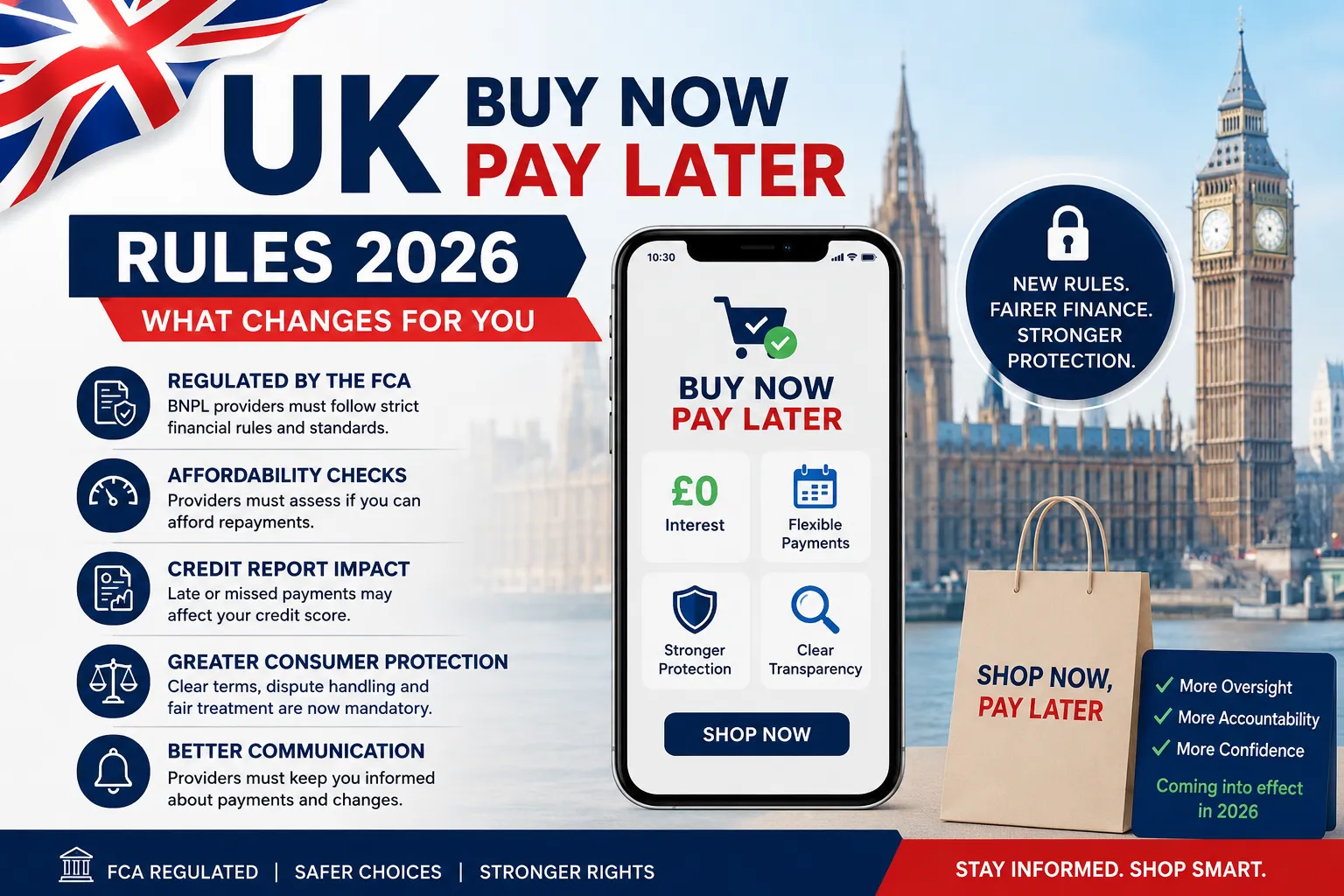
Buy Now Pay Later services have entered a new regulatory era in the United Kingdom.
Since July 15, 2026, many third-party Buy Now Pay Later lenders have come under the supervision of the Financial Conduct Authority. The changes introduce affordability assessments, clearer information, support for customers in financial difficulty and access to a formal complaints process.
The reforms affect services commonly used to split online and in-store purchases into several interest-free payments.
They do not make Buy Now Pay Later risk-free. They make regulated providers more accountable and give consumers stronger routes for challenging poor treatment.
Shoppers still need to understand that every BNPL transaction is a credit commitment, even when the checkout page presents it as a simple payment option.

What Changed on July 15, 2026?
The Financial Conduct Authority now regulates lenders providing qualifying Deferred Payment Credit agreements.
Deferred Payment Credit is the legal term used for many interest-free arrangements commonly marketed as Buy Now Pay Later.
According to the Financial Conduct Authority , the new regime is intended to give BNPL customers protections closer to those available with other regulated credit products.
Regulated lenders must now:
- Be authorised by the FCA or operate under temporary permission.
- Assess whether borrowers can afford repayments.
- Provide clearer and more timely information.
- Treat customers fairly under the Consumer Duty.
- Support borrowers experiencing financial difficulty.
- Maintain suitable complaint-handling procedures.
- Allow eligible unresolved complaints to reach the Financial Ombudsman Service.
UK BNPL Rules Before and After Regulation
| Consumer Issue | Before July 15, 2026 | Under the New Regime |
|---|---|---|
| Regulatory oversight | Many interest-free BNPL agreements operated outside FCA credit regulation | Qualifying third-party lenders come under FCA supervision |
| Affordability | Checks varied between providers | Providers must carry out proportionate assessments |
| Product information | Presentation and warnings varied | Information must support informed decisions |
| Financial difficulty | Support depended heavily on provider policies | Regulated firms must provide appropriate support |
| Complaints | Limited external escalation for unregulated agreements | Eligible disputes can reach the Financial Ombudsman Service |
| Consumer outcomes | No universal Consumer Duty protection | Firms must act to deliver good outcomes for retail customers |
Which Buy Now Pay Later Products Are Covered?
The rules primarily cover qualifying agreements offered by a third-party lender to finance goods or services supplied by a separate merchant.
A typical example is an online retailer allowing a customer to use an external BNPL company at checkout.
The FCA’s Deferred Payment Credit policy statement explains that covered products are generally interest-free and repayable in no more than 12 instalments within 12 months.
Product branding is not decisive. A company may call a service “Pay in 3,” “Pay in 4,” “Pay Later” or another marketing name. The legal structure of the agreement determines whether it falls within the new regime.
Which Arrangements May Not Be Covered?
Not every delayed-payment arrangement is regulated in exactly the same way.
Potential exclusions include:
- A retailer allowing customers to pay its own invoice later without an external lender.
- Certain interest-free instalment arrangements offered directly by a merchant.
- Products already regulated under other consumer-credit rules.
- Agreements that do not meet the legal definition of Deferred Payment Credit.
- Some business-to-business arrangements.
Consumers should not assume that every “pay later” button provides identical rights. Check the name of the lender, the pre-contract information and the agreement itself.
How Will Affordability Checks Work?
A regulated lender must make a proportionate assessment of whether a customer can afford the credit.
That does not mean every £30 purchase will require the same investigation as a mortgage. The check should reflect the amount, repayment period, customer circumstances and risk of financial harm.
A provider may consider information such as:
- Existing credit commitments.
- Repayment history.
- Information supplied during an application.
- Credit-reference data.
- The number and value of current BNPL plans.
- Previous missed or delayed payments.
Approval is no longer supposed to depend only on whether a provider expects to recover its money. The assessment must also consider whether repayments are likely to cause the borrower financial difficulty.
Could Shoppers Be Refused BNPL?
Yes. Stronger checks mean some customers who previously received instant approval may be declined or offered a smaller amount.
Consumer groups have warned that a significant number of existing users could lose access because of limited credit histories, existing debts or affordability concerns.
This is not automatically a defect in the rules. If a customer needs new credit to pay earlier BNPL instalments, approving another plan would deepen the problem.
However, lenders must avoid crude decision-making that unfairly excludes reliable borrowers simply because their circumstances do not fit a conventional credit profile.
The quality of affordability assessments—not merely their existence—will determine whether regulation works fairly.
Will a BNPL Application Affect Your Credit Score?
It may. The effect depends on the provider, the type of search performed and how the agreement is reported to credit-reference agencies.
A soft credit search generally does not affect the score viewed by other lenders. A hard search can appear on a credit report and may temporarily influence future lending decisions.
Missed payments and unresolved defaults may also damage a borrower’s credit history.
Before accepting a plan, check:
- Whether the provider performs a soft or hard search.
- Whether the account is reported to credit-reference agencies.
- How late or missed payments are recorded.
- Whether collection activity can appear on the credit file.
“Interest-free” does not mean “consequence-free.”
Video: Buy Now Pay Later Debt Explained
This MoneyHelper video explains how BNPL debt can accumulate and what consumers should consider when using services such as Klarna and Clearpay.
If the embedded player is unavailable, watch the MoneyHelper BNPL video on YouTube .
What Is the Consumer Duty?
The Consumer Duty requires regulated firms to act in ways designed to produce good outcomes for retail customers.
For BNPL lenders, that means paying attention to:
- Whether products meet the needs of their target customers.
- Whether charges and other terms provide fair value.
- Whether customers understand what they are accepting.
- Whether support is available before and after a payment problem.
The duty does not guarantee that every customer will avoid debt. It requires firms to design and operate their services without creating foreseeable harm through poor information, unreasonable barriers or unsuitable treatment.
Can You Complain About a BNPL Provider?
Customers covered by the new regime can make a formal complaint to the lender.
The complaint should explain:
- What happened.
- When it happened.
- Which purchase or agreement is involved.
- Why the customer believes the treatment was unfair.
- What resolution is being requested.
Keep copies of the credit agreement, payment schedule, order confirmation, merchant messages and communication with the lender.
If the provider does not resolve an eligible complaint within the required period, the customer may be able to take it to the Financial Ombudsman Service .
Does Section 75 Apply to Buy Now Pay Later?
Some covered BNPL agreements may provide Section 75 protection for qualifying purchases, generally where the cash price is more than £100 and no more than £30,000.
Section 75 can make the lender jointly responsible with the supplier when goods are misrepresented or a contract is breached.
The details matter. Protection depends on the legal structure of the credit and the connection between the customer, lender and supplier.
Do not assume every BNPL purchase automatically qualifies. Review the agreement and seek guidance for a specific dispute.
What Happens If You Miss a Payment?
The exact consequences depend on the lender’s agreement.
Possible outcomes include:
- The provider attempts the payment again.
- The account is temporarily frozen.
- The customer loses access to further BNPL credit.
- A late charge is applied where the agreement permits it.
- The missed payment is reported to a credit-reference agency.
- The debt is transferred to a collection process.
- Legal recovery action is taken for persistent nonpayment.
Contact the lender before the instalment is missed if payment difficulty is predictable. Early contact usually creates more options than ignoring reminders.
A regulated lender should provide appropriate support rather than placing unnecessary obstacles in the customer’s way.
Why BNPL Debt Is Easy to Underestimate
A single instalment may look small. The real problem begins when several small plans overlap.
Consider this example:
| Purchase | Monthly Instalment |
|---|---|
| Clothing | £40 |
| Mobile phone | £65 |
| Furniture | £80 |
| Concert tickets | £55 |
| Total monthly commitment | £240 |
Each checkout may have felt affordable in isolation. Together, the plans consume £240 from the monthly budget before rent, food, energy or transport.
This fragmentation is one of BNPL’s core risks. Consumers see the instalment, not the total debt across every provider.
A Safer Way to Use Buy Now Pay Later
Calculate the Total Commitment
Add every active BNPL instalment before accepting another plan. Do not evaluate only the new purchase.
Keep the Full Purchase Amount Available
If possible, use BNPL for payment timing—not because the full item is unaffordable.
Avoid Using Credit for Essentials
Regularly using BNPL for groceries, utility bills or other necessities may indicate that basic expenses have exceeded income.
Track Every Due Date
Maintain one calendar showing payments across all providers. Automatic payments do not remove the need to monitor the account balance.
Review Refund Procedures
Returning goods to the retailer may not automatically cancel the credit agreement. Confirm that the lender has adjusted or paused the payment plan.
Do Not Borrow to Make BNPL Payments
Using an overdraft, credit card or new BNPL plan to meet an existing instalment is a warning sign that the debt is no longer manageable.
BNPL Versus Credit Cards
| Feature | Buy Now Pay Later | Credit Card |
|---|---|---|
| Typical structure | Fixed instalments linked to a purchase | Reusable credit limit |
| Interest | Often interest-free for short plans | Interest may apply if the balance is not cleared |
| Application | Usually completed during checkout | Separate account application |
| Debt visibility | Can become fragmented across providers | Displayed within the card account |
| Minimum payment | Scheduled instalment normally required | Cardholder may make a smaller minimum payment |
| Overspending risk | Repeated checkout approvals | Reusable credit limit and revolving balance |
Neither product is automatically safer. The better option depends on fees, interest, repayment discipline, purchase protections and the borrower’s financial circumstances.
What the Rules Mean for Klarna, Clearpay and PayPal
Major providers offering covered products must operate within the FCA framework.
Consumers may notice:
- More detailed eligibility checks.
- Revised credit agreements.
- Stronger warnings before confirmation.
- Changes to complaint procedures.
- More questions about affordability.
- Reduced or refused spending limits.
The same company may offer several products with different legal treatment. Always check the terms of the specific payment option rather than relying on the provider’s brand.
Will the New Rules Stop BNPL Debt Problems?
No regulation can remove the consequences of spending beyond available income.
The new rules can reduce harm through better checks, clearer information, fairer treatment and external complaint rights.
They cannot make an unaffordable purchase affordable.
There is also a risk that rejected customers will move toward overdrafts, high-cost credit or unregulated services. Losing access to BNPL does not solve the underlying shortage of money.
Consumers repeatedly using short-term credit for essentials need a budget and debt solution—not another payment application.
What to Do If BNPL Debt Is Becoming Unmanageable
- Stop taking out new plans.
- List every outstanding balance and due date.
- Calculate essential monthly expenses.
- Contact providers before missing payments.
- Request an affordable arrangement where appropriate.
- Keep written records of every conversation.
- Seek free, independent debt guidance.
MoneyHelper provides free guidance on dealing with debt and finding suitable support.
Avoid businesses that demand large upfront fees for a debt solution without clearly explaining the risks, alternatives and total cost.
What Retailers Need to Do
Retailers offering third-party BNPL need to understand how the new regime affects their checkout experience, marketing and customer service.
Practical responsibilities include:
- Avoiding misleading claims that BNPL is not borrowing.
- Presenting total cost and repayment timing clearly.
- Coordinating refunds with the credit provider.
- Training customer-service staff.
- Reviewing promotional language.
- Confirming that external lenders have appropriate regulatory status.
Retailers should not design checkout pages that make deferred credit appear safer or less significant than paying immediately.
The Bottom Line
The UK’s new Buy Now Pay Later regime gives consumers stronger protections when using qualifying third-party Deferred Payment Credit products.
Regulated lenders must assess affordability, provide clearer information, support struggling borrowers and handle complaints under FCA standards.
These changes improve accountability, but they do not eliminate debt risk. Multiple small plans can combine into a substantial monthly obligation.
Before using BNPL, calculate the full purchase cost, review every active instalment and confirm how missed payments may affect your credit history.
Use BNPL as a controlled method of scheduling payments—not as a way to pretend an unaffordable purchase fits the budget.
Follow the Zobuz Finance section for more consumer-money coverage and Zobuz News for regulatory updates.
Frequently Asked Questions
When did the new UK Buy Now Pay Later rules begin?
The FCA’s new regulatory regime for qualifying Deferred Payment Credit products began on July 15, 2026.
Will BNPL providers check affordability?
Regulated providers must carry out proportionate assessments to determine whether customers can afford repayments without a significant risk of financial harm.
Can a BNPL application affect my credit score?
It can. The effect depends on whether the provider conducts a soft or hard credit search and how payments are reported to credit-reference agencies.
Can I complain to the Financial Ombudsman about BNPL?
Eligible complaints involving regulated products may be taken to the Financial Ombudsman Service after the customer has first completed the lender’s complaint process.
Are retailer-provided payment plans regulated?
Some arrangements offered directly by retailers may remain outside this particular regime. The legal structure of the agreement determines whether it is covered.
Is Buy Now Pay Later interest-free?
Many short-term BNPL products charge no interest when payments are made as agreed. Customers must still check for late charges, missed-payment consequences and other contractual terms.