
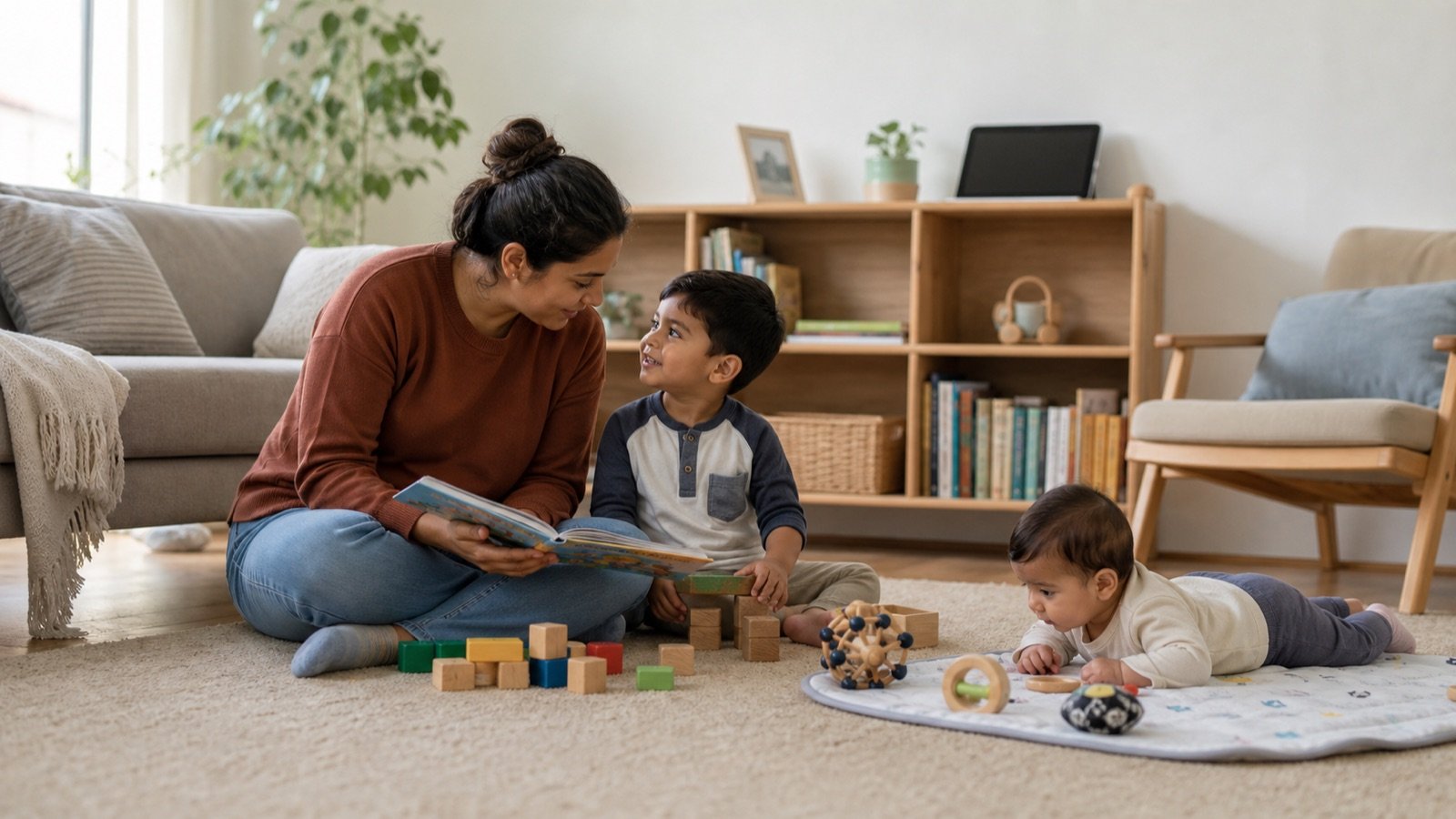
Screens are part of family life, but babies and preschoolers still learn primarily through responsive relationships, movement, sleep, conversation and hands-on play. The most useful question is not simply “How many minutes?” It is whether media is crowding out those developmental needs and how the child, content and caregiver interact.
For infants, prioritise face-to-face interaction and use screens mainly for supported video calls. As toddlers and preschoolers begin using media, choose high-quality content, watch or play together, protect sleep and meals, avoid background television, and keep plenty of time for active, social and imaginative play.
This article provides general education, not an individual developmental assessment. A paediatrician or other qualified child-health professional can adapt advice for a child’s health, development, disability, family circumstances and use of assistive technology.
What the evidence can—and cannot—prove
Research often finds associations between heavier or poorly timed screen use and outcomes involving sleep, language, attention, behaviour or social-emotional development. An association does not automatically mean that screens caused the outcome. Family stress, caregiver work, child temperament, sleep problems and access to safe play or childcare can influence both media use and development.
The American Academy of Pediatrics’ 2026 policy notes that much of the evidence is observational, which limits causal conclusions. It recommends looking beyond one number to the child, caregiver relationship, content design and wider digital environment. The practical goal is to reduce avoidable displacement and improve the quality and context of any use.
Age-based starting points
| Age | Practical starting point | What matters most |
|---|---|---|
| Birth to about 18 months | Prioritise real-world interaction; supported video calls are a common exception | Talking, singing, floor play, sleep, feeding and responsive care |
| 18 to 24 months | If introducing media, choose high-quality content and use it together | Connect what appears on screen to real objects, words and actions |
| 2 to 5 years | Use clear family limits and protect time for sleep, movement, reading and play | Quality, co-use, routine and what media displaces |
Different professional bodies express time guidance differently. WHO’s under-five movement guidelines recommend no sedentary screen time for infants and one-year-olds, and no more than one hour a day for two- to four-year-olds, with less being better. Current AAP guidance places additional emphasis on quality, context and conversation rather than treating a timer as the only measure.
These are population-level reference points, not a test of good parenting or a diagnosis. Video communication, disability-related technology and occasional use during travel or medical care are not equivalent to prolonged solo entertainment.
Do newborns benefit from watching television?
A newborn may turn toward light, movement or sound, but attention does not mean the baby understands or learns from a programme. The American Academy of Pediatrics advises that infants learn best from real-world interaction. Faces, voices, touch and back-and-forth responses are developmentally richer than passive viewing.
An occasional glimpse of a screen is not a reason to panic. The useful change is to avoid positioning a baby to watch television, turn off background media when nobody is actively using it, and give caregivers regular screen-free moments for feeding, play and soothing. Supported video calls can be different because a responsive adult helps make the exchange social.
How screens may affect language and learning
Young children learn words through joint attention and repeated conversation: a child looks or points, an adult responds, and both share meaning. Solo video cannot reproduce all of that timing and feedback. The greatest concern is often displacement—media replacing talking, reading, singing, pretend play and exploration.
Co-viewing can make age-appropriate media more useful. Pause, name what is happening, answer the child’s signals and repeat the idea away from the device. If a programme shows a red bus, find a red object afterward; if it includes a song, sing it together later. A child who cannot transfer anything from the screen to real life may be entertained without learning the advertised skill.
Be sceptical of an app that labels itself educational without independent evidence. Autoplay, rapid cuts, distracting rewards and advertising can keep attention without supporting understanding.
Attention and executive skills
Attention develops through many activities: listening to a short story, waiting for a turn, building, drawing, following a caregiver’s gaze and returning to a task after interruption. Some studies associate high exposure, fast-paced content or background television with attention difficulties, but the evidence does not justify predicting an individual child’s future from screen time alone.
Choose slower, understandable content and stop before the child is exhausted. Follow viewing with unstructured play rather than another stream of stimulation. If attention concerns appear across settings and interfere with daily life, discuss them with a clinician instead of assuming a device is the sole cause.
Emotional regulation and using a screen to calm
A screen can calm a child quickly by capturing attention. Occasional use during a flight, a painful procedure or an exceptional family situation is not the same as making it the only response to every difficult feeling. Repeated reliance can reduce opportunities to practise waiting, seeking comfort, naming feelings and recovering with a caregiver.
- First check hunger, tiredness, pain, overstimulation and the need for connection.
- Name the feeling in simple language and offer comfort.
- Use movement, a song, a familiar object, water, breathing or a quiet change of setting.
- If media is used, set the endpoint before starting and give a brief transition warning.
- Expect protest and stay calm; changing a routine takes repetition.
Seek professional support if distress is intense, frequent, unsafe, or accompanied by developmental regression, sleep disruption, feeding problems or caregiver exhaustion.
Sleep is a high-priority boundary
Evening media can delay bedtime through arousing content, negotiation and simple time displacement. Notifications or a television in the sleep space can create further interruptions. Build a predictable wind-down routine using lower light, washing, books, songs and quiet conversation.
- Keep devices out of the child’s sleep space where practical.
- Create a consistent screen-free period before bedtime.
- Turn off autoplay and notifications.
- Avoid frightening or highly stimulating content in the evening.
- Model the same boundary by putting adult devices aside.
Background television still changes the room
A television can interrupt play and caregiver conversation even when the child is not sitting directly in front of it. Adults may speak less or respond more slowly while checking a phone or following a programme. Turn background media off and use audio intentionally if the family wants music or a story.
Caregivers do not need perfect attention all day. Short, protected routines—feeding, the first minutes after reunion, bath, a book, outdoor play—can provide dependable periods of responsive connection.
How to identify higher-quality content
- It matches the child’s developmental level and language.
- The pace is understandable rather than frantic.
- It invites participation, conversation or real-world play.
- It avoids violence, frightening material and manipulative advertising.
- It has a clear end rather than an endless feed.
- Privacy settings and data collection are understandable.
- A caregiver has previewed it and can use it with the child.
The AAP’s 2026 digital ecosystems policy warns that engagement-based design can encourage prolonged use. Disable autoplay, personalised feeds and unnecessary notifications when controls permit.
A realistic family media plan
A workable plan describes when, where, what, with whom and how media ends. It should account for childcare, remote work, travel, siblings, disability and caregiver wellbeing. Sudden blanket bans often fail; consistent routines and fewer decision points are easier to maintain.
- Track two or three ordinary days without judgement.
- Identify what media is replacing: sleep, meals, movement, conversation or nothing important.
- Choose one protected routine, such as meals or the hour before bed.
- Select content in advance and turn off autoplay.
- Use a visible endpoint: one episode, one call or a timer the child understands.
- Prepare the next activity before the screen ends.
- Review the plan as the child and household change.
The AAP’s Family Media Plan can help families structure these decisions. WHO’s under-five movement and sleep guideline provides a complementary 24-hour perspective.
What to offer instead of a screen
Alternatives do not need to be expensive or elaborate. A box, wooden spoon, water cup, scarf, crayons, family photos, short walk, simple sorting task or repeated song can support exploration. Reading the same book again is valuable because repetition builds familiarity and language.
Older toddlers and preschoolers can make their own simple stories. Zobuz’s guide to student-made books in early learning offers one screen-light activity that combines drawing, language and shared attention.
When to talk with a paediatric professional
Ask for guidance if a child loses previously acquired skills, is not meeting expected communication or movement milestones, has persistent sleep or behaviour problems, becomes extremely distressed when media ends, or uses media in a way that repeatedly disrupts family life. Developmental screening and hearing or vision assessment may be appropriate depending on the concern.
Do not delay evaluation while trying to “fix” screen time first. Media habits can be addressed alongside a proper assessment. Families under stress can also ask about childcare, early-intervention, library, playgroup or caregiver mental-health supports.
Frequently asked questions
Is a video call the same as watching a cartoon?
No. A responsive video call can support a real relationship when an adult helps the baby or toddler engage. Passive entertainment does not provide the same back-and-forth exchange.
Can educational apps teach a toddler?
Some well-designed content can support learning, especially with an adult, but toddlers may struggle to transfer a screen lesson to real life. Test whether the child can use the idea away from the device.
Have parents harmed a child by allowing too much screen time?
A usage history cannot diagnose harm. Focus on present routines and development, make gradual changes, and discuss specific concerns with a paediatric professional rather than assigning blame.
The practical conclusion
Healthy early-childhood media use protects the experiences children need most. Keep infant use very limited, choose carefully as media is introduced, join the child, protect sleep and relationships, and judge success by what the day contains—not only by a screen-time total.