
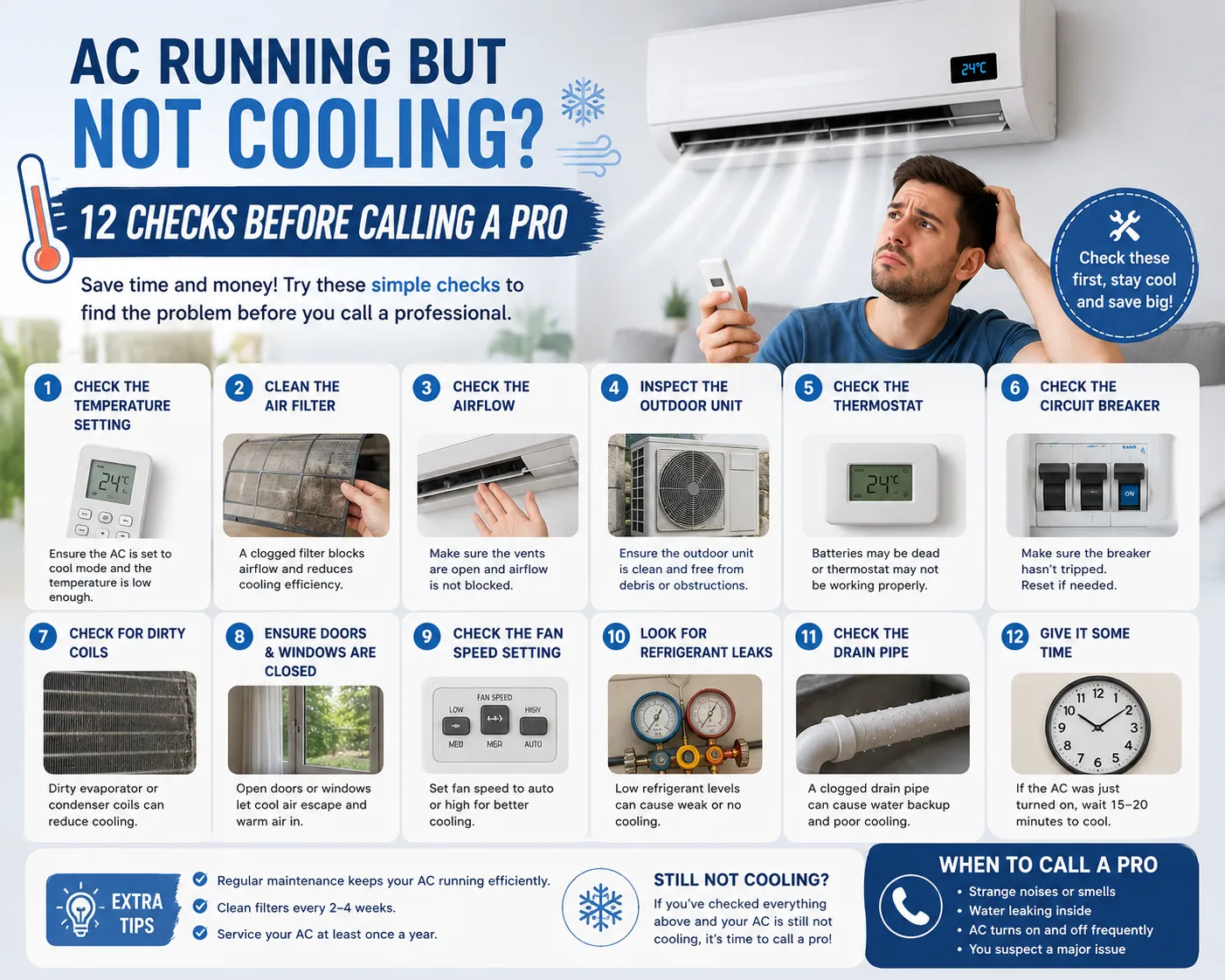
Your air conditioner is humming, air is coming through the vents, but the house keeps getting hotter. Before assuming the system needs an expensive repair, work through these simple checks.
Problems such as an incorrect thermostat setting, dirty filter, blocked outdoor unit, or closed vent can sometimes be corrected without special tools. Other symptoms—including ice, electrical odors, and refrigerant leaks—require professional attention.

Why Is the AC Running but Not Cooling?
An air conditioner cannot cool a home properly unless it can absorb indoor heat and release that heat outdoors. A restriction or failure anywhere in that process can leave the fan running while cooling performance disappears.
The most common causes include:
- An incorrect thermostat mode or temperature setting
- A clogged return-air filter
- Closed or obstructed supply vents
- A dirty or blocked outdoor condenser
- A frozen evaporator coil
- A tripped circuit breaker or failed outdoor unit
- Leaking or damaged ductwork
- Low refrigerant caused by a leak
- A failing capacitor, compressor, motor, or control board
- An undersized system or unusually high cooling demand
Quick Diagnosis: Match the Symptom to the Likely Cause
| What You Notice | Possible Cause | Recommended Action |
|---|---|---|
| Airflow is strong but not cold | Thermostat setting, outdoor-unit failure, or refrigerant problem | Check the thermostat and confirm the outdoor unit is operating |
| Airflow is weak in every room | Dirty filter, frozen coil, or blower problem | Inspect the filter and look for visible ice |
| Some rooms are hot | Closed vents, duct leakage, poor insulation, or system imbalance | Open vents and arrange a duct or airflow inspection if the problem continues |
| Indoor unit runs, but the outdoor unit is silent | Breaker, disconnect, capacitor, contactor, motor, or compressor problem | Check the breaker once; call a technician if it trips again |
| Ice appears on a refrigerant line or indoor coil | Restricted airflow or low refrigerant | Turn cooling off and allow the system to thaw |
| AC cools during the morning but struggles later | Extreme heat, solar gain, dirty equipment, or an undersized system | Reduce heat gain and have system performance evaluated |
| Water appears near the indoor unit | Frozen coil or blocked condensate drain | Turn the system off if water threatens surrounding materials |
12 Safe Checks to Make Before Calling an HVAC Technician
1. Confirm the Thermostat Is Set to “Cool”
Start with the simplest possibility. The thermostat should be set to Cool, with the target temperature below the current indoor temperature.
If the fan is set to On, it may run continuously—even while the compressor is not cooling. Change the fan setting to Auto for testing.
Also check for:
- A scheduled temperature change
- Weak thermostat batteries
- Vacation or energy-saving mode
- A thermostat located near a lamp, sunny window, or other heat source
2. Wait Five Minutes After Changing the Setting
Many systems include a built-in compressor delay. After lowering the temperature or restoring power, wait approximately five minutes before deciding that the AC has failed.
Avoid rapidly switching the system off and on. Short cycling can place unnecessary stress on the compressor.
3. Inspect the Air Filter
A heavily clogged filter restricts airflow across the indoor coil. That reduces cooling performance and can eventually cause the coil to freeze.
Remove the filter and hold it toward a light. If little or no light passes through, replace it with a compatible filter of the correct size.
The U.S. Department of Energy’s home-cooling guidance recommends routinely cleaning or replacing air filters. According to the department, this can reduce an air conditioner’s energy consumption by approximately 5% to 15%.
Do not automatically install the highest-rated filter available. A filter that is too restrictive for the system can reduce airflow. Follow the equipment manufacturer’s specifications.
4. Open and Unblock the Vents
Walk through the home and inspect every supply and return vent.
- Open supply registers fully
- Move furniture, curtains, and rugs away from vents
- Remove dust from register covers
- Keep large return grilles unobstructed
Closing too many vents does not reliably save energy. It can increase pressure inside the duct system and reduce overall performance.
5. Check Whether the Outdoor Unit Is Running
With the thermostat calling for cooling, go outside and listen to the condenser. You would normally expect to hear the compressor and see the top or side fan operating.
If the indoor blower runs but the outdoor equipment does not, the system may have an electrical or mechanical fault.
Do not remove access panels, touch capacitors, or reach through the fan grille. HVAC components may retain a dangerous electrical charge even after power is disconnected.
6. Look for a Tripped Breaker
Check the electrical panel for breakers labeled AC, condenser, heat pump, air handler, or furnace. A tripped breaker may sit between the fully on and off positions.
Reset it only once by moving it fully off and then back on. If it trips again, leave it off and call a qualified technician. Repeatedly resetting a breaker can conceal a serious electrical fault.
7. Clear Debris Around the Condenser
Leaves, grass clippings, weeds, and other debris can obstruct the outdoor coil and prevent the system from releasing heat efficiently.
Turn the system off before clearing loose material around the unit. Maintain open space around the condenser and avoid placing covers, decorations, or storage items against it.
The Department of Energy also recommends removing debris from the outdoor fan, compressor, and condenser area as part of routine maintenance.
Do not bend the delicate coil fins or spray water into electrical compartments.
8. Check for Ice
Look for frost or ice on the insulated copper line, indoor coil cabinet, or refrigerant tubing. Ice is not a sign that the air conditioner is producing extra cooling. It often indicates that heat is not reaching the coil properly or that refrigerant pressure is abnormal.
If you find ice:
- Change the thermostat from Cool to Off.
- Set the fan to On, if it can operate normally.
- Replace a visibly dirty filter.
- Allow the system to thaw completely.
- Call a technician if it freezes again.
Do not chip ice from the coil. Sharp tools can puncture tubing or damage fragile fins.
9. Inspect the Condensate Area
Air conditioners remove humidity and produce condensation. A blocked drain or failed condensate pump may activate a safety switch that stops cooling.
Look for standing water, a full drain pan, or water around the indoor equipment. If water could damage the ceiling, flooring, or electrical components, turn the system off and request service.
Only clean an accessible drain using the procedure approved by the equipment manufacturer. Do not pour harsh drain chemicals into an HVAC system.
10. Compare Airflow Between Rooms
If one room is hot while the rest of the house is comfortable, the central AC itself may not be the main problem.
Uneven cooling can result from:
- A disconnected, crushed, or leaking duct
- Insufficient return airflow
- Poor attic insulation
- Air leaks around windows or doors
- Heavy afternoon sun exposure
- An incorrectly balanced duct system
For additional household maintenance guidance, browse Zobuz’s home maintenance resources.
11. Reduce the Immediate Cooling Load
During very hot weather, an otherwise functional AC may run for long periods. Help it catch up by reducing indoor heat gain.
- Close blinds or curtains on sun-facing windows
- Delay oven, dryer, and dishwasher use
- Turn off unnecessary lights and electronics
- Use ceiling fans in occupied rooms
- Keep exterior doors and windows closed
A fan cools people through air movement; it does not lower the room’s actual temperature. Turn fans off when the room is empty.
12. Measure Performance Without Overdiagnosing
If you have reliable thermometers, compare the temperature at a central return grille with the temperature at a nearby supply vent after the system has operated steadily.
This is only a preliminary observation. Vent location, humidity, airflow, equipment design, and outdoor conditions all affect the result. A technician uses specialized instruments to evaluate refrigerant pressures, electrical performance, airflow, and coil temperatures.
Video: Basic AC Troubleshooting Walkthrough
This video search provides practical demonstrations related to an air conditioner running without cooling. Always follow the safety and maintenance instructions supplied with your specific equipment.
When Should You Stop Troubleshooting?
Turn the system off and contact a licensed HVAC professional if you notice:
- A burning smell, smoke, sparks, or buzzing electrical equipment
- A breaker that trips repeatedly
- Ice that returns after the filter is replaced and the system is thawed
- Hissing or bubbling near refrigerant lines
- An outdoor fan that will not start
- A compressor that starts and stops rapidly
- Water approaching electrical components
- Damaged wiring or signs of overheating
- No cooling after the basic checks are completed
Refrigerant does not normally get “used up.” If a system has insufficient refrigerant, a leak may need to be located and repaired. Refrigerant service and regulated handling should be performed by appropriately certified technicians.
Repair or Replace: Which Makes More Sense?
A single repair does not automatically justify replacing the entire system. Consider the equipment’s age, repair history, efficiency, comfort performance, and warranty coverage together.
| Repair May Make Sense When | Replacement May Be Worth Evaluating When |
|---|---|
| The system is relatively young | The equipment is near or beyond its expected service life |
| The failure is isolated and affordable | The compressor or another major component has failed |
| Parts remain under warranty | Repair costs are becoming frequent |
| The home was comfortable before the failure | The system has never controlled temperature or humidity well |
| Energy costs have remained reasonable | Cooling bills are high despite proper maintenance |
Ask contractors for written estimates that identify the failed component, warranty terms, labor charges, and expected outcome. If replacement is recommended, request a proper load calculation instead of automatically buying the same equipment size.
How to Prevent the Problem From Returning
- Check the filter monthly during heavy cooling use
- Use the filter type and size approved for the equipment
- Keep indoor returns and supply vents unobstructed
- Keep vegetation and debris away from the outdoor unit
- Have evaporator and condenser coils inspected periodically
- Address unusual sounds, odors, leaks, or short cycling early
- Seal obvious air leaks and improve inadequate insulation
- Schedule maintenance before peak summer demand
Preventive maintenance cannot eliminate every breakdown. It can, however, identify worn electrical parts, drainage problems, dirty coils, and airflow restrictions before they leave the home without cooling.
The Bottom Line
When an AC runs but does not cool, begin with the thermostat, filter, vents, breaker, outdoor unit, and visible ice. These checks are quick and do not require opening the equipment.
If the breaker trips again, ice returns, the outdoor unit remains inactive, or the system produces electrical warning signs, stop troubleshooting. A qualified technician can test the system without exposing you—or the equipment—to unnecessary risk.
Frequently Asked Questions
Why is my AC blowing air but not cooling?
The thermostat may be set incorrectly, the filter or coil may be dirty, the outdoor unit may not be operating, or the system may have a refrigerant, compressor, or airflow problem.
Should I turn off my AC if it is not cooling?
Turn it off if you see ice, water near electrical components, smell burning, hear severe buzzing, or experience repeated breaker trips. Continuing to operate a malfunctioning system may cause additional damage.
Can a dirty filter make an AC stop cooling?
Yes. A clogged filter restricts airflow, reduces cooling capacity, increases energy use, and may cause the indoor coil to freeze.
How long does a frozen air conditioner take to thaw?
Thawing may take several hours and sometimes longer, depending on the amount of ice, indoor temperature, and airflow. Do not restart cooling until the ice has completely melted.
Why is the indoor AC running while the outdoor unit is off?
Possible causes include a tripped breaker, failed capacitor, damaged contactor, faulty fan motor, compressor problem, wiring fault, or control-system issue. These components should be diagnosed by a qualified technician.
Does low refrigerant always mean the AC needs to be replaced?
No. The correct decision depends on the location and severity of the leak, equipment age, refrigerant type, repair cost, warranty, and overall system condition.