
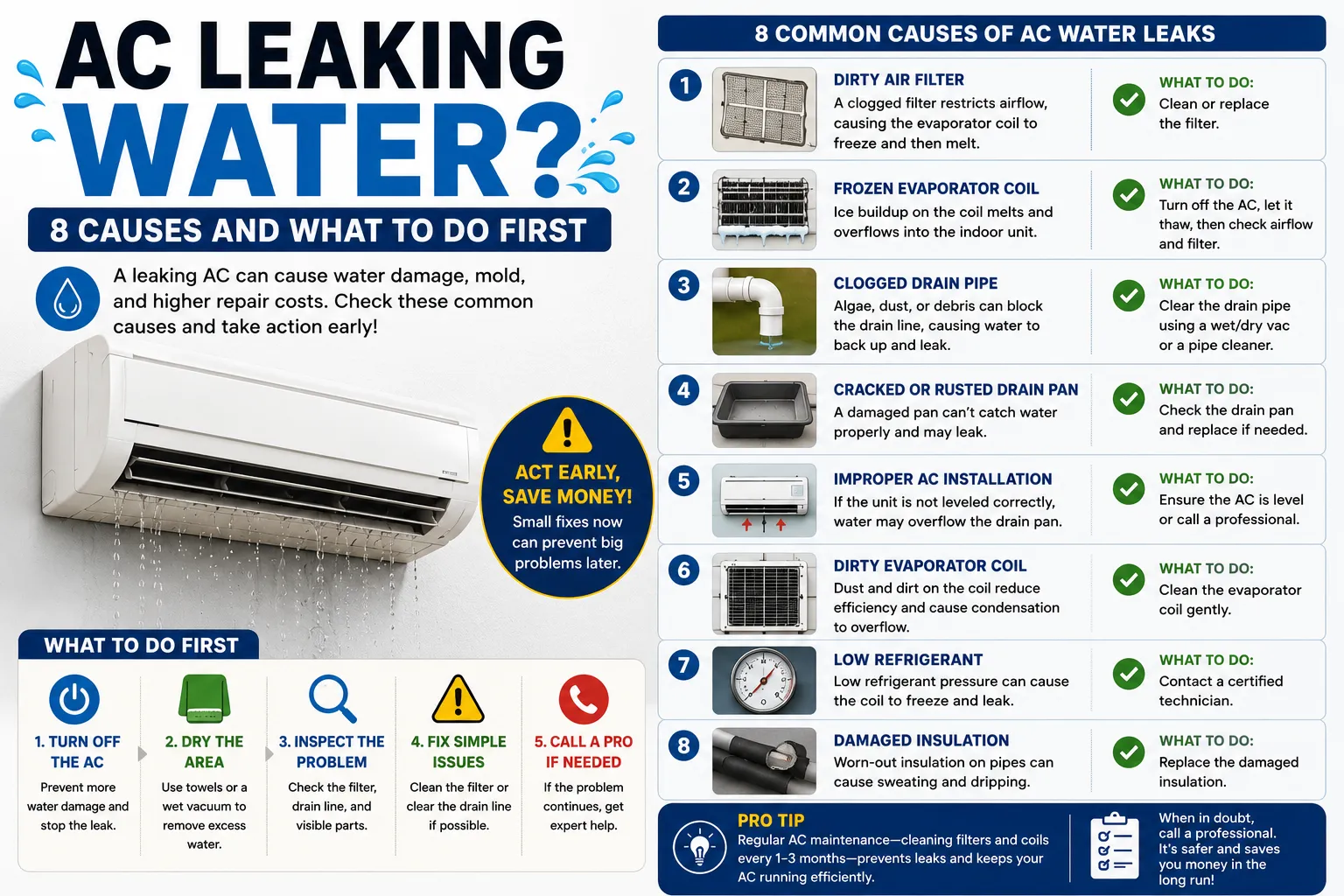
Water around an indoor air-conditioning unit should never be ignored. The cause may be as simple as a clogged condensate drain. It could also indicate a frozen coil, damaged drain pan, failed pump, or installation problem.
Start by protecting the house from water damage. Then use the location and timing of the leak to narrow down the likely cause.
This guide explains what homeowners can safely check—and which repairs should be left to an HVAC professional.

What to Do Immediately When Your AC Is Leaking Water
If water is collecting around the air handler, furnace, ceiling cassette, or indoor mini-split, take these steps first:
- Turn cooling off at the thermostat.
- Place towels or a container where they can safely catch dripping water.
- Move furniture, electronics, boxes, and valuables away from the leak.
- Check whether water is approaching wiring, outlets, or electrical equipment.
- Inspect the air filter and visible drain pan without opening sealed panels.
- Contact an HVAC technician if the leak is substantial or its source is unclear.
If water is entering a ceiling, running through a light fixture, or reaching an electrical panel, keep your distance. Shut off power only when you can do so safely from a dry location and seek professional help.
Important: Do not continue running a leaking system simply because it is still producing cold air. Water can damage ceilings, flooring, insulation, drywall, electrical components, and the air-conditioning equipment itself.
Why Does an Air Conditioner Produce Water?
Water production is a normal part of air conditioning.
Warm indoor air contains water vapor. When that air passes over the cold evaporator coil, moisture condenses into liquid water. The water falls into a drain pan and leaves through a condensate drain line or pump.
A leak develops when the water:
- Cannot flow through the drain
- Misses or overflows the drain pan
- Escapes through a cracked component
- Backs up because a pump has failed
- Forms outside the intended drainage system
- Comes from ice melting off a frozen coil
ENERGY STAR’s HVAC maintenance checklist warns that a plugged condensate drain can cause household water damage and affect indoor humidity levels.
Quick Diagnosis: What Does the Leak Look Like?
| Symptom | Likely Cause | Best Next Step |
|---|---|---|
| Drain pan is full of water | Clogged drain line or failed pump | Turn cooling off and inspect the accessible drain outlet |
| Ice is visible on the coil or copper line | Restricted airflow or refrigerant problem | Turn cooling off and allow the system to thaw |
| Water appears only while the AC runs | Condensate drainage problem | Inspect the drain pan, line, and pump |
| Water continues when the AC is off | Plumbing, roof, appliance, or unrelated leak | Confirm the source before ordering AC repair |
| Water drips from a ceiling vent | Condensation on ductwork, overflowing attic unit, or roof leak | Turn off the AC and protect the ceiling |
| Mini-split drips from the indoor head | Blocked drain, poor drainage slope, dirty coil, or installation issue | Turn the unit off and arrange cleaning or service |
| Leak appears during humid weather | Heavy condensate load, sweating duct, or insulation problem | Inspect insulation and drainage capacity |
| Water is dirty or has an odor | Standing water, microbial growth, or drain buildup | Avoid contact and have the drainage system cleaned |
8 Common Reasons Your AC Is Leaking Water
1. The Condensate Drain Line Is Clogged
A blocked condensate line is one of the most common reasons water collects around an indoor AC unit.
Dust, biological buildup, insects, insulation fragments, or other debris can restrict the pipe. Water then backs up into the drain pan and may overflow.
Common signs include:
- Standing water in the drain pan
- Water near the indoor air handler
- A musty smell when the system runs
- Little or no water exiting the outdoor drain
- Cooling that stops because a float switch has activated
Some systems have an accessible maintenance opening or outdoor drain termination. However, drain layouts vary considerably. Do not cut, disconnect, or pour chemicals into a pipe unless you have positively identified it as the condensate line and the manufacturer permits that procedure.
2. The Evaporator Coil Has Frozen
A frozen evaporator coil can hold a surprising amount of ice. When the system shuts down, that ice melts and may overwhelm the drain pan.
Coils commonly freeze because of:
- A heavily clogged air filter
- Blocked return or supply vents
- A dirty evaporator coil
- A failed or weak blower motor
- Collapsed or obstructed ductwork
- Low refrigerant caused by a leak
If you see ice, change the thermostat from Cool to Off. If the blower is functioning normally, setting the fan to On may help circulate room-temperature air across the coil.
Do not chip, scrape, or heat the ice. Allow it to thaw naturally. If the coil freezes again, schedule professional service.
3. The Air Filter Is Extremely Dirty
A dirty filter can contribute to both water leakage and poor cooling. Reduced airflow makes the evaporator coil colder than intended, increasing the risk of ice formation.
Remove the filter and inspect it under good light. Replace it if it is heavily covered with dust or visibly damaged.
Use the correct dimensions and an efficiency rating compatible with the equipment. Installing a filter that is too restrictive can also reduce airflow.
ENERGY STAR recommends inspecting, cleaning, or changing central HVAC filters monthly. Actual replacement frequency depends on the filter, system runtime, household dust, pets, smoke, and manufacturer guidance.
4. The Drain Pan Is Cracked or Corroded
The drain pan sits beneath the evaporator coil and collects condensation. Metal pans can corrode, while plastic pans may crack or become distorted.
A damaged pan may leak even when the drain line is open.
Signs of drain-pan failure include:
- Water appearing before the pan is full
- Rust around the cabinet
- Visible cracks or corrosion
- Repeated leaks after the drain has been cleared
Secondary pans placed beneath attic equipment can provide limited protection, but they are not a substitute for repairing the primary drainage system.
5. The Condensate Pump Has Failed
Some systems cannot drain by gravity. They use a small pump to move condensation to a suitable drain.
If that pump loses power, becomes clogged, or mechanically fails, its reservoir may overflow. A properly installed safety switch may stop cooling before water escapes, but not every installation provides the same protection.
Check whether the pump is plugged in and whether its reservoir is visibly full. Do not open or rewire it while power is connected.
6. The Drain Line Has the Wrong Slope
Gravity drain lines must slope correctly. A sagging, level, or upward-sloping section can trap water and encourage repeated blockages.
This problem is especially likely when:
- The system has leaked since installation
- The drain clogs repeatedly
- Water remains inside sections of the pipe
- The air handler is not level
- The line has been moved or poorly supported
An HVAC contractor can verify the drainage layout, venting, trap, slope, and equipment position.
7. Uninsulated Ducts or Pipes Are Sweating
Cold ductwork or refrigerant tubing can collect condensation when exposed to warm, humid air. This is commonly called sweating.
The moisture may drip onto insulation, drywall, or ceilings and look like a drain-pan leak.
Possible causes include:
- Missing or damaged duct insulation
- Gaps in the vapor barrier
- Very high attic or indoor humidity
- Air leakage around registers
- Cold surfaces exposed to unconditioned air
Simply adding tape over wet insulation rarely solves the underlying issue. The wet material may need to be removed, the surface dried, and the insulation system properly repaired.
8. It May Not Be an AC Leak
Water found near HVAC equipment does not always come from the air conditioner.
Other possible sources include:
- A leaking furnace humidifier
- A water heater relief or drain connection
- A plumbing supply or waste pipe
- A roof or flashing leak
- A washing machine or refrigerator line
- Groundwater entering a basement
Observe whether the leak appears only while the AC is operating. If water continues to arrive long after cooling is turned off, investigate other sources.
Video: How an AC Drain-Line Clog Is Cleared
The following video demonstrates a common condensate-drain troubleshooting method. Equipment layouts vary, so stop if you cannot positively identify the drain line or safely access it.
Can You Unclog an AC Drain Line Yourself?
Some homeowners can clear a simple obstruction from an accessible outdoor drain termination using a wet/dry vacuum. However, this is appropriate only when the pipe has been correctly identified and the procedure does not conflict with the manufacturer’s instructions.
Basic Safety Rules
- Turn cooling off before inspecting the system
- Keep water away from electrical components
- Do not remove high-voltage access panels
- Do not use compressed air that could separate a pipe joint
- Do not mix drain-cleaning chemicals
- Do not pour bleach into the system unless specifically approved
- Do not attempt refrigerant repairs
Household drain chemicals can damage materials, create dangerous fumes, or push contaminants back toward the equipment. A technician can clean the line while also checking the pan, trap, float switch, and drainage slope.
When an AC Water Leak Is an Emergency
Arrange immediate assistance when:
- Water is flowing through a ceiling or light fixture
- The leak is approaching an outlet or electrical panel
- Drywall is bulging or the ceiling is sagging
- Water is spreading across hardwood or laminate flooring
- The system smells burned or repeatedly trips a breaker
- A large quantity of ice is melting inside the unit
- Water returns soon after the drain is cleared
- The leak involves dirty or contaminated water
Ceiling materials weakened by water can fall without warning. Keep people and pets away from a sagging area.
How Much Does AC Water-Leak Repair Cost?
The final cost depends on the failure, system location, accessibility, local labor rates, and whether water has damaged the building.
| Problem | Typical Repair Scope | Relative Cost |
|---|---|---|
| Blocked drain line | Clear and flush the condensate drain | Usually lower |
| Failed float switch | Test and replace the safety control | Usually lower |
| Failed condensate pump | Clean or replace the pump | Low to moderate |
| Damaged drain pan | Seal or replace the pan, depending on design | Moderate to high |
| Frozen coil caused by airflow | Correct filter, coil, blower, or duct restriction | Varies widely |
| Refrigerant leak | Locate and repair leak, test system, recharge correctly | Moderate to high |
| Water-damaged ceiling | Drying, mold evaluation, insulation and drywall repair | Potentially high |
Be cautious with a diagnosis based only on adding refrigerant. Refrigerant does not normally disappear from a sealed system; low charge may indicate a leak that needs to be located.
How to Prevent Future AC Water Leaks
- Inspect the air filter every month during heavy use
- Replace filters according to manufacturer guidance
- Include condensate drainage in seasonal HVAC maintenance
- Keep supply and return vents unobstructed
- Test condensate pumps and float switches periodically
- Watch for rust, stains, odors, or standing water
- Repair damaged duct and refrigerant-line insulation
- Investigate recurring freeze-ups instead of repeatedly thawing the coil
If your system is also running without lowering the indoor temperature, use our related guide: AC Running but Not Cooling? Checks to Make Before Calling a Technician.
The Bottom Line
Turn off a leaking air conditioner before water causes more damage. Then check the filter, visible ice, drain pan, accessible drain outlet, and condensate pump.
A one-time drain blockage may be straightforward. Recurring water, repeated ice formation, refrigerant symptoms, electrical hazards, or ceiling damage require professional attention.
Fixing the source promptly is usually far less expensive than repairing both the HVAC equipment and a water-damaged home.
Frequently Asked Questions
Is water leaking from an air conditioner dangerous?
The condensate itself is not normally an emergency, but it may contain dust or microbial buildup. The greater dangers are electrical contact, ceiling damage, mold growth, slippery floors, and damage to the AC equipment.
Should I turn off my AC if it is leaking water?
Yes. Turn cooling off until you determine the source, particularly when the drain pan is overflowing, the coil is frozen, or water is near electrical components.
What is the most common cause of an AC leaking water?
A clogged condensate drain is a common cause. Dirty filters, frozen coils, cracked drain pans, failed pumps, and drainage installation problems can produce similar symptoms.
Can a dirty filter cause an AC water leak?
Yes. Restricted airflow can cause the evaporator coil to freeze. When the ice melts, the resulting water may overflow the drain pan.
Why is water dripping from my ceiling vent?
The cause may be condensation on poorly insulated ductwork, an overflowing attic air handler, humid air leaking around the vent, or an unrelated roof or plumbing leak.
Can I pour bleach into my AC drain line?
Do not add bleach or another chemical unless the equipment manufacturer or HVAC professional specifically recommends it for your system. Chemicals may damage components, create fumes, or react with other cleaners.
Why does my mini-split leak water inside?
A mini-split may leak because of a clogged drain, dirty indoor coil, damaged drain pan, incorrect drain slope, loose connection, or an indoor unit that is not level.