
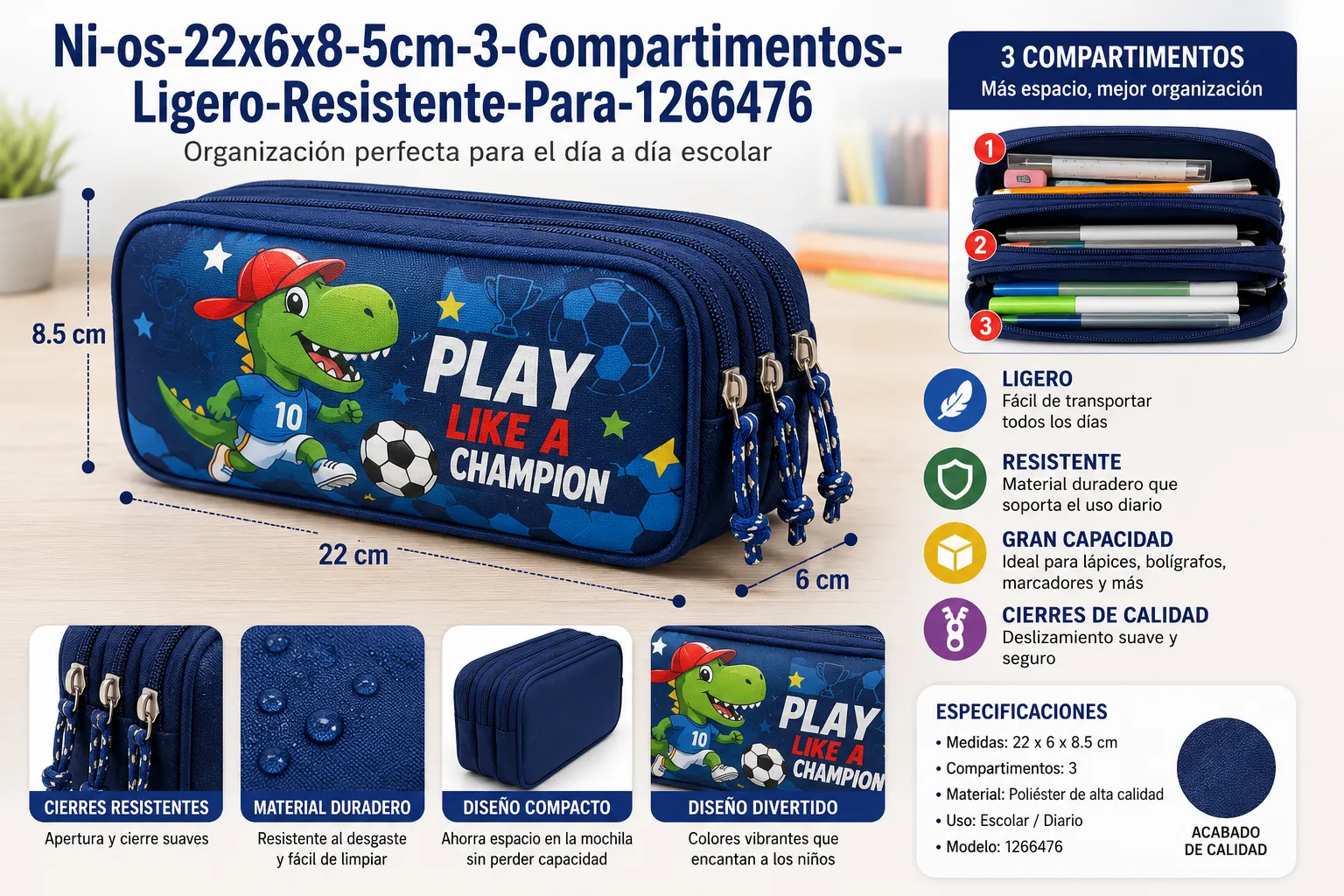
A well-organized pencil case can make everyday schoolwork easier by keeping pens, pencils, markers, erasers, and other small supplies in predictable places. The Niños 22x6x8.5cm 3-Compartment Lightweight and Durable Pencil Case is designed around that idea, combining a compact shape with separate storage areas for better organization.
With dimensions of approximately 22 × 6 × 8.5 cm, the case provides room for common stationery while remaining compact enough for a school bag or backpack. Its three-compartment design is particularly useful for students who want to separate frequently used writing tools from coloring supplies and smaller accessories.
This guide explains practical ways to organize, use, clean, and maintain a three-compartment pencil case.
Why Three Compartments Are Useful
A single large pencil case may hold plenty of stationery, but everything can quickly become mixed together. Pens get buried beneath markers, erasers disappear at the bottom, and finding one item can mean emptying half the case.
Three separate compartments make organization simpler.
Instead of treating the case as one storage space, assign each section a specific purpose. This makes it easier to find supplies during class and helps prevent unnecessary clutter.
For children, having a consistent place for each type of school supply can also make packing a school bag easier.
Best Way to Organize the Three Compartments
The most effective organization system is usually the simplest.
Compartment 1: Everyday Writing Tools
Use the first compartment for items that are needed repeatedly throughout the school day.
Good choices include:
- Pencils
- Blue and black pens
- Mechanical pencils
- One or two commonly used colored pens
Avoid filling this section with rarely used stationery. The purpose is quick access.
If a student needs a pencil several times during a lesson, it should be available immediately rather than hidden beneath markers and accessories.
Compartment 2: Coloring and Highlighting Supplies
The second compartment can hold supplies used for creative work, highlighting, diagrams, or note organization.
Depending on their size, these might include:
- Colored pencils
- Highlighters
- Fineliners
- Markers
- Gel pens
Students who use color-coded notes can organize these supplies further by keeping their most frequently used colors together.
There is no need to carry every color available. Select the ones actually used at school.
Compartment 3: Small Accessories
Reserve the third compartment for smaller supplies that are easy to lose.
Examples include:
- Erasers
- Pencil sharpeners
- Small rulers
- Sticky-note tabs
- Pencil leads
- Paper clips
Keeping small accessories separate prevents them from disappearing beneath larger pens and pencils.
What Can Fit in a 22x6x8.5cm Pencil Case?
At approximately 22 cm long, the case should accommodate many standard-length pens and pencils. The 6 cm and 8.5 cm dimensions provide additional space for organizing stationery across the compartments.
Actual capacity will depend on the internal construction, zipper placement, padding, and the thickness of the supplies being stored.
For example, ten slim pencils occupy much less space than ten thick markers.
Instead of trying to maximize the number of items inside, focus on carrying the stationery needed for a normal school day.
Overpacking defeats the purpose of having separate compartments.
7 Practical Usage Tips
1. Give Every Compartment One Job
Don’t randomly place stationery wherever space is available.
Create a simple system such as:
Writing → Coloring → Accessories
Once the student becomes familiar with this layout, finding and returning supplies becomes much easier.
2. Keep Frequently Used Items Accessible
The items used most often should be placed in the easiest-to-access compartment.
For most students, this means pencils and everyday pens.
Items used only occasionally can go into another section.
3. Don’t Carry Unnecessary Supplies
A large stationery collection does not need to travel to school every day.
A student may own 30 colored pencils, 20 markers, and multiple sets of pens, but carrying all of them adds weight and creates clutter.
Pack according to the day’s needs.
4. Check Pens Before Storing Them
A leaking pen can stain the interior of a pencil case and other supplies.
Before packing, make sure pen caps are properly attached and retractable pens are closed.
Markers should also be capped tightly to reduce the chance of drying out or leaking.
5. Be Careful With Sharp Objects
Compasses, scissors, and freshly sharpened pencils can damage fabric or internal lining if stored carelessly.
If these items are carried, use protective caps or place them where sharp points cannot press against the material.
6. Clean Out the Case Regularly
Small pieces of eraser, broken pencil lead, paper scraps, and sharpening debris gradually accumulate inside pencil cases.
Emptying the case periodically helps keep the compartments clean and makes it easier to see which supplies need replacing.
7. Avoid Overloading the Zippers
If closing a compartment requires significant force, there are probably too many items inside.
Overpacking can place unnecessary stress on:
- Zippers
- Seams
- Internal dividers
- Fabric
- Stored stationery
Remove unnecessary items rather than forcing the case closed.
Using the Pencil Case for School
For everyday school use, a simple setup might include two or three pencils, a couple of pens, an eraser, sharpener, small ruler, several colored pencils, and a few highlighters.
The exact selection depends on the student’s age and classes.
Younger children may need more pencils and coloring supplies, while older students may prefer pens, mechanical pencils, highlighters, and note-taking accessories.
The three compartments make it possible to adapt the organization to different needs.
Using It for Art Supplies
A three-compartment pencil case can also work as a compact art-supply organizer.
One section can hold drawing pencils, another colored pencils or fineliners, and the third small accessories such as erasers and sharpeners.
However, check the dimensions of thicker art markers before assuming they will fit comfortably.
For serious art kits containing dozens of markers or brushes, a dedicated art case may provide better capacity.
Using It Outside School
A pencil case does not have to be limited to classroom supplies.
Its compartments can potentially organize other small everyday items, such as craft supplies, charging cables, USB drives, sticky notes, or small office accessories.
When using it for electronics, avoid placing sharp stationery in the same compartment as cables or small devices.
How to Keep the Pencil Case Organized
Organization usually fails because unnecessary items gradually accumulate.
Once a week, empty the compartments and divide the contents into three groups:
Keep: Items regularly needed.
Replace: Empty pens, tiny pencils, damaged erasers, or dried markers.
Remove: Duplicate or unnecessary items.
Then return everything to its assigned compartment.
This quick routine prevents the case from becoming overloaded.
Cleaning and Care Tips
Cleaning should depend on the actual material and manufacturer’s care instructions.
For many fabric pencil cases, loose debris can first be removed by turning the empty case upside down and gently shaking it.
Minor surface marks may be cleaned with a soft damp cloth if appropriate for the material.
Avoid using harsh chemicals unless the manufacturer specifically recommends them.
Before washing or soaking the entire case, check its care instructions. Internal reinforcement, printed designs, coatings, and zipper materials may react differently to water.
After cleaning, allow the case to dry completely before putting stationery back inside.
Is a Three-Compartment Pencil Case Better Than a Single-Compartment Case?
It depends on how much organization the user wants.
A single-compartment case can be suitable for someone carrying only a few pens and pencils. It is simple and usually quick to pack.
A three-compartment design makes more sense when several types of stationery need to be carried together without mixing everything into one space.
For students carrying writing tools, coloring supplies, and accessories, separate compartments can make everyday organization much easier.
Who Is This Pencil Case Best For?
A lightweight, three-compartment pencil case can be useful for:
- Primary and secondary school students
- Students carrying several types of stationery
- Children who frequently lose small school supplies
- People who prefer separated storage
- Students who use colored pens and highlighters
- Travelers needing a compact stationery organizer
- Home users organizing small craft or office supplies
Its strongest advantage is not simply storage capacity. It is the ability to divide supplies into logical groups.
Frequently Asked Questions
What are the dimensions of this pencil case?
The product title lists dimensions of approximately 22 × 6 × 8.5 cm.
How many compartments does it have?
The product is described as having three compartments, allowing different types of stationery to be separated.
What should I put in each compartment?
A practical arrangement is to keep everyday pens and pencils in the first compartment, coloring or highlighting tools in the second, and smaller accessories in the third.
Is it suitable for children?
The product description indicates a children’s pencil case. Parents should still choose the contents according to the child’s age and avoid unsuitable sharp or small items.
Can it hold markers?
Many standard stationery items may fit based on the listed dimensions, but compatibility depends on the marker’s length and thickness and the case’s actual internal dimensions.
How do I prevent the pencil case from becoming messy?
Assign each compartment a purpose, remove unnecessary supplies weekly, discard empty or damaged stationery, and avoid overpacking.
Can it be used for things other than pencils?
Yes. A compartmentalized case can also organize various small items, provided they fit comfortably and will not damage the case or each other.
Final Thoughts
The Niños 22x6x8.5cm 3-Compartment Lightweight and Durable Pencil Case offers a straightforward way to keep school supplies separated and easier to access.
The three compartments are most useful when each has a defined purpose. Keep everyday writing tools in one section, creative supplies in another, and small accessories in the third.
Avoid treating extra capacity as a reason to carry more stationery. A carefully organized pencil case with only the supplies actually needed will usually be more useful than an overloaded one.
With regular cleaning, sensible packing, and a consistent organization system, a three-compartment pencil case can become a practical part of a student’s everyday school routine.