
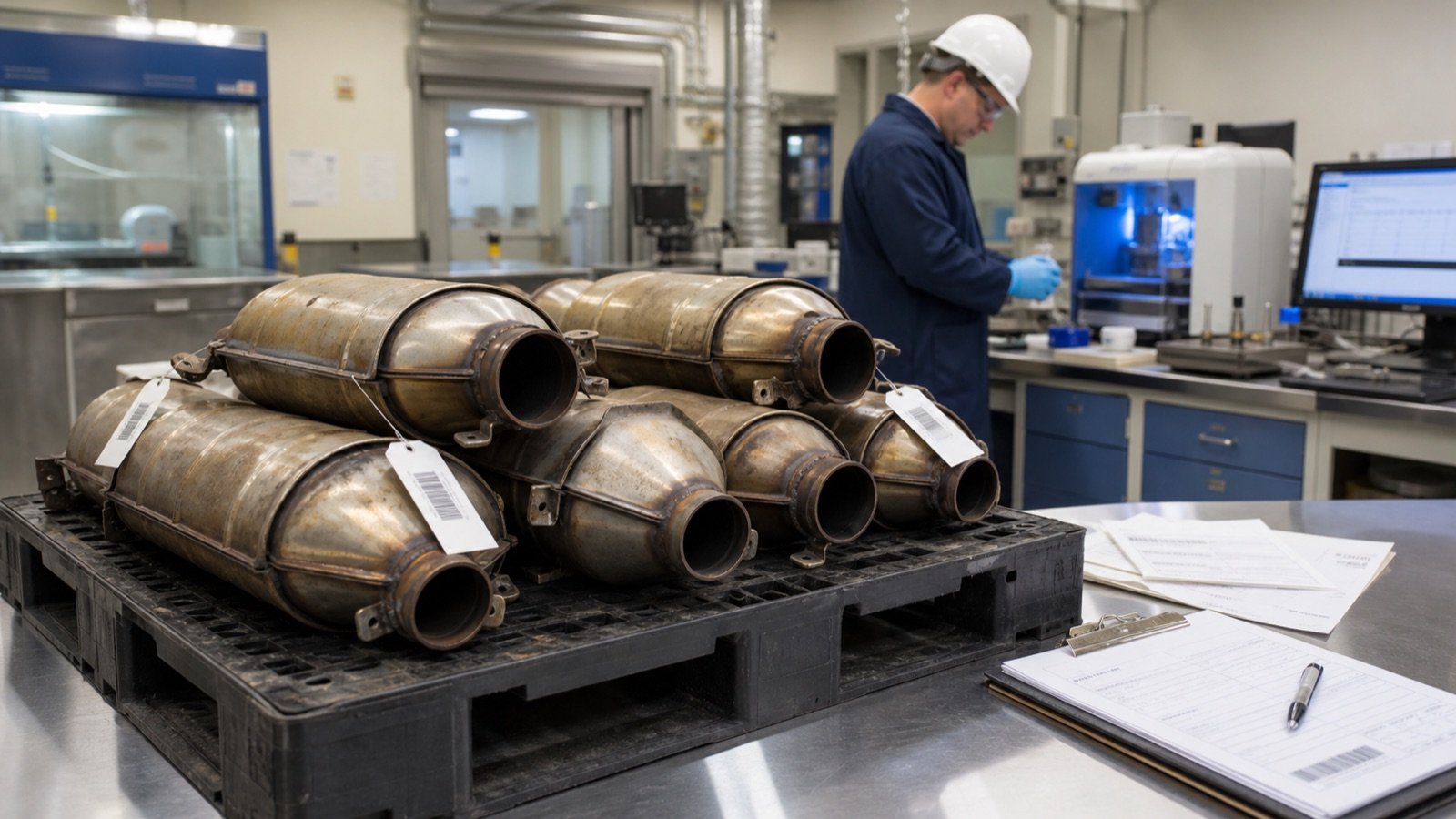
Finding a buyer for a used catalytic converter is not only a pricing decision. The transaction should establish lawful ownership, follow the rules in the seller’s state and locality, and leave a clear record of where the part came from and how payment was made.
A trusted catalytic converter buyer will identify the business behind the quote, explain how the converter is valued, request appropriate ownership records, disclose fees and settlement terms, and use a traceable payment process. Walk away from any buyer that treats documentation as an inconvenience.
Why used catalytic converters have value
Catalytic converters contain small amounts of platinum-group metals, commonly including platinum, palladium and rhodium. These metals help reduce harmful vehicle emissions. The U.S. Geological Survey identifies end-of-life catalytic converters as an important source of recycled platinum-group metals.
The metal content is not the same in every unit. Vehicle application, converter design, age, condition and whether the internal ceramic or metallic substrate remains intact can all affect recoverable value. That is why a credible buyer normally needs more than a photograph and a generic market price.
Buyer, aggregator or refiner: what is the difference?
| Business type | Typical role | What to clarify |
|---|---|---|
| Local recycler or salvage yard | Buys individual units or small lots and resells them downstream | How units are identified, the documentation required and whether the quote is final |
| Specialist buyer or aggregator | Sorts and consolidates converters for a larger processor | Pricing data, deductions, payment timing and the identity or standards of the downstream processor |
| Direct refiner or toll processor | Processes larger lots and recovers payable metals | Minimum lot size, assay method, sampling, treatment charges, metal-payment terms and settlement schedule |
No category is automatically best. An individual with one lawfully replaced converter may value a clear per-unit quote from a local licensed business. A dismantler or repair network with regular volume may need an assay-based contract, audit trail and formal account controls.
Prove lawful ownership before discussing the sale
Catalytic-converter theft has made provenance a central part of a legitimate transaction. In 2025, the U.S. Department of Justice reported a guilty plea by the leader of a multistate operation that resold stolen converters to a refinery for more than $600 million. The case shows why buyers, processors and sellers need meaningful controls rather than a no-questions-asked exchange.
Requirements vary by state and locality, so confirm the current rules with the relevant state or local authority. Depending on the seller and jurisdiction, a buyer may request:
- government-issued identification;
- vehicle title, registration, repair invoice or insurance/salvage paperwork;
- the vehicle identification number and the vehicle from which the unit was removed;
- a dismantler, recycler, repairer or other occupational licence where applicable;
- purchase records showing how a commercial seller acquired the vehicle or part;
- photographs, inventory numbers and converter identification marks; and
- a signed declaration of lawful ownership.
Keep copies of the documents, the buyer’s legal name and address, the written quote, shipping or collection record, payment confirmation and final settlement. Do not sell a unit if its origin cannot be documented or if identification marks appear deliberately removed or altered.
How catalytic converter pricing works
A quote may be based on the converter’s code and vehicle family, a categorized unit price, or an assay of a processed lot. Larger commercial lots may be sampled and analyzed to estimate the quantity of payable metals. The contract then applies the agreed metal prices, recovery or payable percentages, treatment charges and other deductions.
Ask the buyer to explain the complete calculation in writing. A useful comparison covers:
- how the converter is identified and graded;
- whether the quote assumes an intact original-equipment unit;
- how damaged, aftermarket, empty or partial units are handled;
- the market-price reference and pricing date;
- sampling and assay methods for processed lots;
- payable-metal or recovery terms;
- processing, freight, insurance and administrative charges;
- minimum quantities or account fees; and
- the payment method and expected settlement date.
A headline price is not meaningful if important deductions appear only after delivery. For a sizable lot, compare the expected net settlement under the same assumptions, not just the advertised price per unit or pound.
A checklist for vetting catalytic converter buyers
1. Verify the legal business
Confirm the company’s registered name, physical operating address, telephone number and responsible contact. Check business registration and any recycler, scrap-metal, salvage or environmental permissions required in the relevant jurisdiction. A polished website is not a substitute for a verifiable business.
2. Review its compliance process
Ask what seller identification and provenance records the company collects, how long it retains them and when it refuses a purchase. For recurring commercial accounts, request the onboarding standards and escalation process for suspicious material.
3. Understand the downstream chain
If the buyer is not the final refiner, ask how material moves downstream and what controls apply to transportation, processing and environmental compliance. A specialist such as GND Refiners may be one option to compare, but sellers should independently verify every provider’s current credentials, terms and suitability before shipping material.
4. Get transparent settlement terms
Request a written description of grading, sampling, assays, disputes, deductions and payment. Commercial sellers should also understand who owns the material at each stage and what happens if a shipment is lost, rejected or materially different from the manifest.
5. Check reputation with context
Look for a consistent operating history, recent reviews across more than one independent source and a professional response to complaints. For a high-value agreement, consider trade references and legal review of the contract. Reviews alone cannot establish licensing or compliance.
Warning signs that justify walking away
- The buyer offers cash with no identification or ownership questions.
- Payment is requested through or sent from an unrelated personal account.
- The business will not provide its legal name, address or written terms.
- Prices are guaranteed before the converter type and condition are established.
- Weights, assay results or deductions cannot be independently reviewed.
- The buyer pressures the seller to ship before documentation is complete.
- It accepts units with obviously altered markings or a suspicious history.
- It encourages unsafe opening, crushing or removal of the internal substrate.
The DOJ’s nationwide catalytic-converter theft case is a useful reminder that an apparently ordinary resale chain can carry serious criminal and financial risk when participants ignore provenance.
Handle and ship converters safely
Do not cut open, crush or attempt to extract material from a converter without the correct industrial controls, training and permissions. Damaged substrates can release dust, and improper processing may create worker-safety, transport and environmental issues.
Follow the receiving facility’s written packaging and carrier requirements. Record the unit count, identifiers, condition and weight before dispatch; photograph the packed shipment; use tracking appropriate to its value; and confirm who bears the risk in transit. The U.S. Environmental Protection Agency’s safe recycling overview explains the broader regulatory framework for precious metals and scrap-metal recycling.
Build stronger controls for repeat commercial sales
Auto recyclers, repair networks and fleet operators should use a repeatable chain-of-custody process. Assign each unit an inventory record connected to the source vehicle, removal date, employee or supplier, photographs and sales batch. Separate approval, shipping and payment-reconciliation duties where practical.
Reconcile the buyer’s grading and settlement report against the outbound manifest. Investigate missing units, unexplained downgrades, unusual suppliers and payments that do not match the contracting entity. These controls protect revenue while making it harder for illicit material to enter legitimate inventory.
Related guidance
If you are new to the component itself, Zobuz’s guide to what a catalytic converter does explains its role in a vehicle’s exhaust system. For a more local buying overview, see how to find catalytic converter buyers near you. Apply the same documentation and verification standards to any provider you consider.
Frequently asked questions
Can an individual sell a catalytic converter?
Rules differ by jurisdiction and buyer type. A lawful owner may need identification plus title, registration, repair or salvage records connecting the converter to a vehicle. Check current state and local requirements before arranging the transaction.
Is the highest quote always the best offer?
No. Compare the expected net payment, documentation, deductions, payment timing and recourse if the buyer changes the grade. A slightly lower transparent quote can carry less settlement and compliance risk.
Should a seller remove the ceramic material first?
Not without an appropriately equipped and authorized industrial process. Opening or crushing converters can create hazardous dust and may violate the receiving facility’s rules or applicable law. Sell and ship material only in the condition the verified buyer accepts.
How many quotes should a business compare?
There is no fixed number, but two or three comparable written offers can reveal differences in grading, fees and settlement. Use the same inventory details and pricing date for each request.
The practical conclusion
The best catalytic converter buyer is not merely the one displaying the largest number. Choose a verifiable business that documents lawful ownership, explains valuation and deductions, follows applicable rules and leaves a complete transaction record. Those safeguards protect legitimate sellers, improve accountability and support responsible recovery of valuable metals.