
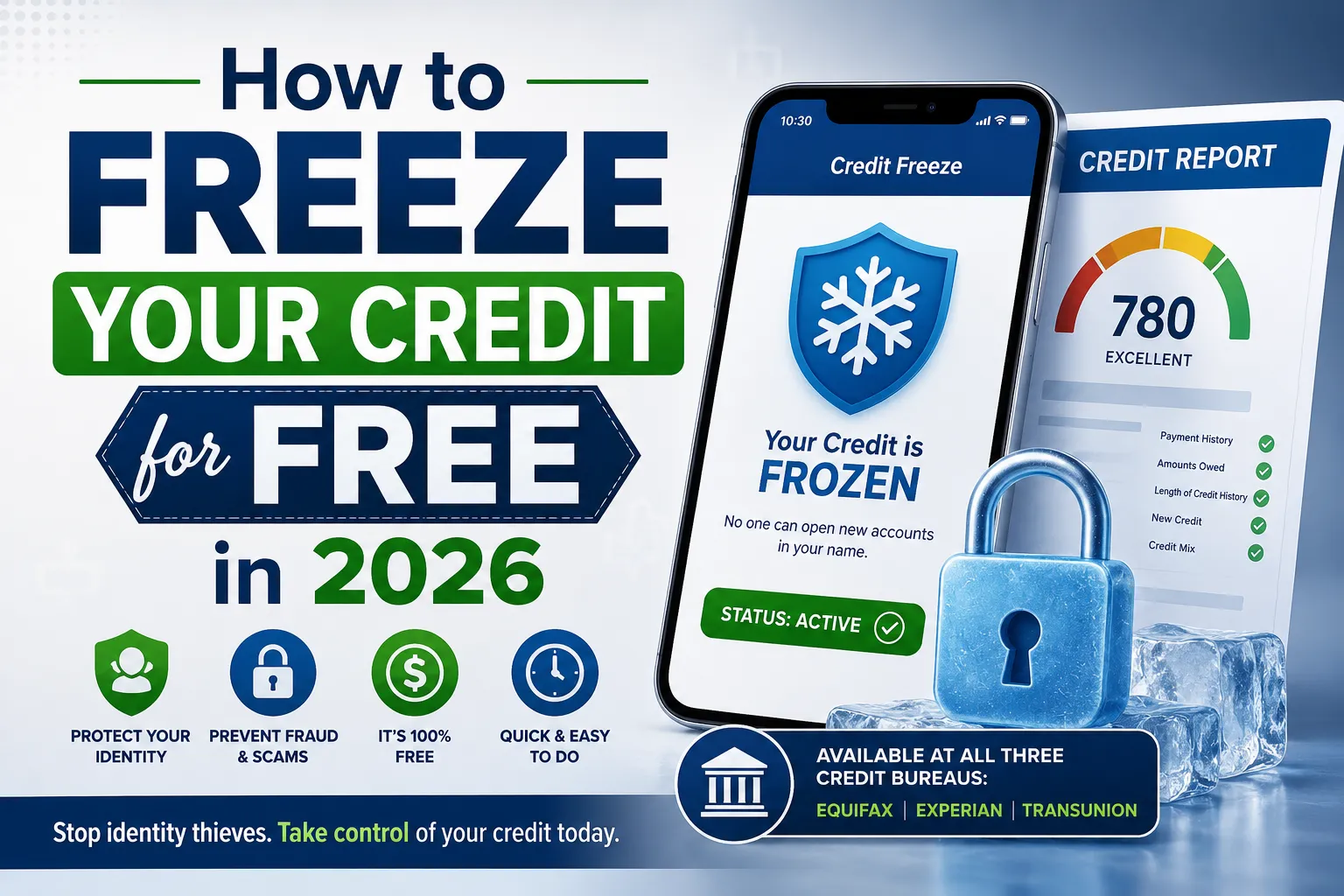
You can freeze your credit for free by contacting Equifax, Experian and TransUnion separately. A freeze restricts access to your credit reports, making it significantly harder for an identity thief to open a new loan or credit card in your name.
Freezing your credit does not lower your credit score. It does not close existing accounts, and you can temporarily lift the freeze whenever a legitimate lender needs access.
Here is exactly how the process works, including the official links you should use.
Credit Freeze: Quick Facts
| Question | Answer |
|---|---|
| How much does a credit freeze cost? | Nothing. Placing, lifting and removing a freeze are free. |
| Does freezing credit hurt your score? | No. A security freeze does not affect your credit score. |
| Which credit bureaus must be contacted? | Equifax, Experian and TransUnion. |
| How long does a freeze last? | Until you lift or permanently remove it. |
| Can existing creditors still see your report? | Yes. Certain existing creditors and authorized organizations may retain access. |
| Can you still check your own report? | Yes. A freeze does not stop you from reviewing your credit reports. |
What Is a Credit Freeze?
A credit freeze, also called a security freeze, prevents most prospective creditors from accessing your credit file.
Lenders generally review at least one credit report before approving a new account. If the report is frozen, the lender may be unable to complete the application. This creates a useful barrier against criminals attempting to borrow money in your name.
A freeze primarily protects against new-account fraud. It does not prevent someone from stealing a credit card number or taking over an existing financial account.
You must continue monitoring bank and credit card statements after freezing your reports.
How to Freeze Your Credit at All Three Bureaus
You must submit a separate request to every nationwide credit bureau. Freezing only one report leaves the other two accessible.
1. Freeze Your Equifax Credit Report
- Online: Visit the official Equifax security-freeze page.
- Phone: Call 1-800-685-1111.
- What to save: Keep your account details and confirmation in a secure password manager.
2. Freeze Your Experian Credit Report
- Online: Use the official Experian freeze center.
- Phone: Call 1-888-397-3742.
- What to save: Store the confirmation email and sign-in information securely.
3. Freeze Your TransUnion Credit Report
- Online: Open the official TransUnion credit-freeze page.
- Phone: Call 1-888-909-8872.
- What to save: Record your confirmation and account-recovery information.
Security warning: Avoid clicking credit-freeze links in unexpected emails or text messages. Visit each bureau’s official website directly to reduce your exposure to phishing pages.

What Information Will You Need?
Each bureau may ask for information that verifies your identity. Be prepared to provide:
- Your full legal name
- Date of birth
- Social Security number
- Current address
- Previous addresses, if you recently moved
- Answers to identity-verification questions
- Copies of identity or address documents when submitting by mail
Use a trusted private internet connection. A public Wi-Fi network is not an ideal place to enter Social Security numbers or other sensitive information.
How Long Does It Take to Freeze Credit?
For requests submitted online or by telephone, a nationwide credit bureau generally must place the freeze within one business day.
Requests submitted by mail generally must be completed within three business days after being received.
The bureau must also provide confirmation and instructions explaining how to lift or remove the freeze. The Consumer Financial Protection Bureau provides additional information about these federal timing requirements.
How to Unfreeze Your Credit
You have two options when a lender needs access:
- Temporary lift: Allow access during a specific date range and automatically restore the freeze afterward.
- Permanent removal: Remove the freeze until you decide to place another one.
A temporary lift is usually the safer choice when applying for a mortgage, auto loan, apartment or credit card.
Ask the lender which credit bureau it plans to check. If it only uses one bureau, you may only need to lift that particular freeze.
When requested online or by telephone, a bureau generally must lift the freeze within one hour. Mail requests can take considerably longer, so plan ahead.
Credit Freeze vs. Credit Lock
| Feature | Credit Freeze | Credit Lock |
|---|---|---|
| Cost | Free under federal law | May require a paid subscription |
| Legal protection | Governed by federal law | Usually governed by the company’s service agreement |
| Credit-score impact | None | None |
| Purpose | Restricts access to a credit report | Restricts access through a commercial product |
| Best choice for most consumers | Usually the free security freeze | Potentially useful if bundled features justify the cost |
Do not assume that paying for a credit lock provides stronger protection. The CFPB notes that paid locks are not necessarily more effective than the security freezes consumers already have a legal right to request for free.
Credit Freeze vs. Fraud Alert
A fraud alert does not block access to your credit report. It instructs businesses to take additional steps to verify your identity before approving new credit.
- Credit freeze: Contact all three bureaus individually.
- Fraud alert: Contact one bureau, which must notify the other two.
- Initial fraud alert: Generally lasts one year and can be renewed.
- Extended fraud alert: May last seven years for qualifying identity-theft victims.
You can have both a fraud alert and credit freezes in place. The Federal Trade Commission comparison can help you decide which protection fits your situation.
When Should You Freeze Your Credit?
A freeze is especially worth considering after:
- A company reports that your Social Security number was exposed
- Your wallet, identification or Social Security card is lost
- You discover an unfamiliar credit inquiry or account
- You receive bills for products you never purchased
- Your mail is unexpectedly redirected
- A lender contacts you about an application you did not submit
- A family member’s personal records are exposed
You do not need to wait for identity theft to occur. Any consumer can place a freeze as a preventive measure.
What a Credit Freeze Does Not Protect
A freeze is powerful, but its protection is limited to certain uses of your credit file. It will not:
- Stop fraudulent charges on an existing credit card
- Prevent someone from accessing a compromised bank account
- Block tax-refund or government-benefit identity theft
- Prevent phishing, malware or password attacks
- Correct inaccurate information already appearing on your report
- Automatically notify you about suspicious transactions
Continue using strong, unique passwords and multifactor authentication. Review financial statements frequently and investigate unfamiliar activity immediately.
What to Do After a Data Breach
If highly sensitive information was exposed, complete these actions in order:
- Change affected passwords immediately.
- Enable multifactor authentication.
- Freeze reports at all three credit bureaus.
- Review reports through AnnualCreditReport.com.
- Dispute accounts or inquiries you do not recognize.
- Place a fraud alert if identity theft is suspected.
- Report confirmed identity theft at IdentityTheft.gov.
- Monitor existing bank, credit card and insurance accounts.
Consumers working on their broader credit health can also read Zobuz’s guide to establishing and maintaining good credit.
Video: What to Do After a Data Breach
Video source: Federal Trade Commission.
The Bottom Line
A credit freeze is one of the strongest free tools available for reducing the risk of new-account identity theft.
Freeze your files with Equifax, Experian and TransUnion separately. Save your account-recovery details securely, and temporarily lift a freeze only when a legitimate lender needs access.
Remember that a freeze does not secure existing accounts. Strong passwords, multifactor authentication and regular statement reviews must remain part of your identity-protection routine.
Frequently Asked Questions
Is freezing your credit free?
Yes. Federal law allows consumers to place, temporarily lift and remove security freezes without paying a fee.
Does a credit freeze lower your credit score?
No. Placing or lifting a security freeze does not affect your credit score.
Do I need to freeze all three credit reports?
Yes. Equifax, Experian and TransUnion do not automatically share freeze requests. Contact each bureau separately for broader protection.
Can I use my existing credit cards after freezing my credit?
Yes. A freeze generally does not prevent you from using existing credit cards, loans or bank accounts.
How quickly can I unfreeze my credit?
A bureau generally must process an online or telephone lift request within one hour. Requests submitted through the mail may take up to three business days after receipt.
Can someone still steal money after I freeze my credit?
Yes. A freeze mainly targets new-account fraud. It does not stop fraudulent transactions involving existing bank or credit card accounts.