
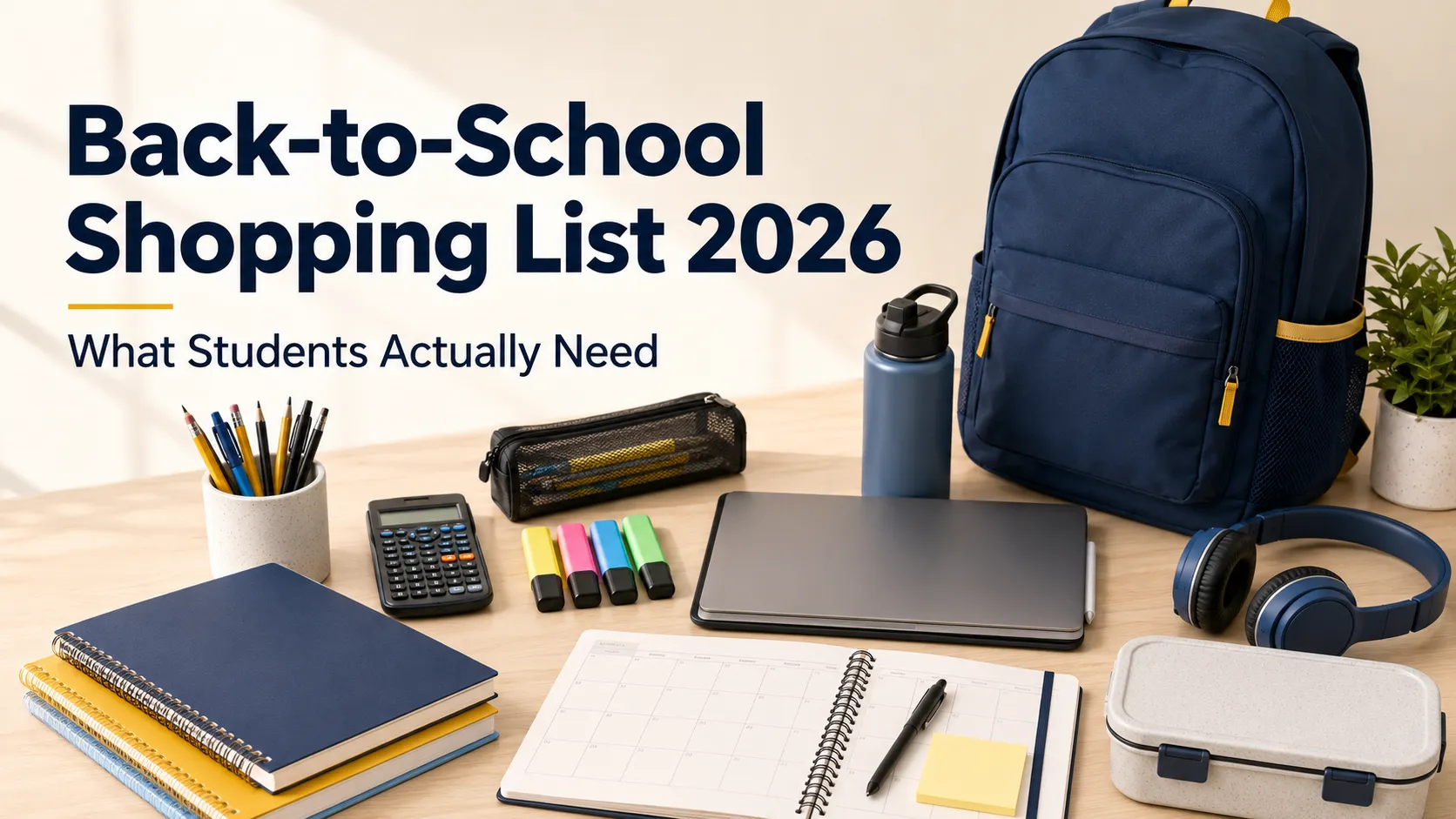
A successful back-to-school shop starts with the school’s official list—not a cart filled with every product labeled “essential.”
Requirements differ by school, teacher, grade and subject. A kindergartner may need washable markers and a change of clothes. A high school student may need subject-specific binders, a scientific calculator and a school-approved laptop.
This 2026 guide helps families buy the basics, reuse what they already own and delay uncertain purchases until teachers confirm them.

Quick Back-to-School Essentials Checklist
Most K–12 students will use some combination of the following:
- Comfortable, properly fitted backpack
- Lunch bag or lunch box, if needed
- Reusable water bottle
- Pencils and erasers
- Blue, black and red pens for older students
- Colored pencils, crayons or washable markers
- Notebooks or loose-leaf paper
- Folders or binders
- Pencil case
- Ruler
- Glue sticks
- Age-appropriate scissors
- Index cards
- Highlighters
- Headphones or earbuds, if requested
- Calculator specified by the school
- School-approved laptop, Chromebook or tablet, if required
- Weather-appropriate clothing and shoes
Do not treat this as a mandatory purchase list. Remove anything already supplied by the school or not included on the teacher’s instructions.
What to Buy Now—and What Should Wait
| Usually Safe to Buy Early | Wait for School Instructions | Reuse Before Replacing |
|---|---|---|
| Pencils and erasers | Calculator model | Backpack |
| Basic pens | Laptop or tablet | Lunch box |
| Loose-leaf paper | Binder sizes and colors | Ruler and scissors |
| Plain folders | Special notebooks | Headphones |
| Glue sticks | Art or laboratory supplies | Pencil case |
| Index cards | Physical-education uniform | Calculator |
| Basic highlighters | Classroom subscription services | Binders in good condition |
Buying a device before receiving the school’s technology requirements can be an expensive mistake. Schools may require a particular operating system, browser, management profile, screen size or testing application.
Preschool and Kindergarten Shopping List
Young students generally need simple, durable products they can open and manage independently.
Core Classroom Supplies
- Large pencils or beginner pencils, if requested
- Washable crayons
- Washable broad-tip markers
- Glue sticks
- Blunt-tip safety scissors
- Two-pocket folders
- Primary-writing notebook
- Large eraser
- Small supply box or zippered pouch
Personal Items
- Small backpack that fits full-size folders
- Lunch box
- Leak-resistant water bottle
- Complete labeled change of clothes
- Comfortable closed-toe shoes
- Rest mat, towel or small blanket only when requested
Label removable clothing, lunch containers and reusable bottles. Follow the school’s labeling policy for classroom supplies because some teachers collect and share materials.
Elementary School Shopping List: Grades 1–5
Writing and Organization
- Two or three dozen No. 2 pencils
- Large pink or white erasers
- Pencil sharpener with a shavings container, if permitted
- Wide-ruled composition notebooks
- Wide-ruled loose-leaf paper
- Two-pocket folders
- One-inch binder, only when requested
- Pencil box or pouch
Art and Math
- Crayons
- Colored pencils
- Washable markers
- Glue sticks
- School-safe scissors
- 12-inch ruler showing inches and centimeters
- Basic calculator only if the teacher requests one
Technology
- Durable wired headphones
- Protective device sleeve if students transport school equipment
- Charging cable only when required
Inexpensive wired headphones are often more practical than premium wireless earbuds for elementary classrooms. They do not require pairing and are less costly to replace.
Middle School Shopping List: Grades 6–8
Middle school usually introduces multiple classrooms, subject-specific materials and greater responsibility for organization.
Essential Supplies
- College-ruled notebooks
- Loose-leaf paper
- Subject folders
- One or more binders in teacher-specified sizes
- Binder dividers
- No. 2 pencils
- Blue, black and red pens
- Highlighters
- Colored pencils
- Index cards
- Sticky notes
- Ruler
- Protractor and compass, if requested
- Planner or digital planning system
Technology and Accessories
- School-compatible headphones or earbuds
- Protective laptop or Chromebook sleeve
- Approved calculator
- USB drive only if the school allows external storage
Avoid buying every binder in the store before receiving class instructions. Some teachers require a separate binder, while others use digital assignments or one shared organizational system.
High School Shopping List: Grades 9–12
High school lists depend heavily on the student’s schedule. Advanced math, laboratory science, art, technical education and music courses can require specialized equipment.
Daily Essentials
- College-ruled notebooks or loose-leaf paper
- Folders or expanding file organizer
- Binders and dividers as specified
- Blue and black pens
- No. 2 pencils and mechanical pencils
- Erasers and lead refills
- Highlighters
- Index cards and sticky notes
- Planner or calendar application
- Headphones or earbuds
Course-Specific Purchases
- Scientific or graphing calculator
- Graph paper
- Geometry set
- Laboratory notebook
- Art sketchbook and approved materials
- Foreign-language dictionary or application
- Physical-education clothing
- Protective equipment supplied or approved by the school
Confirm the exact calculator model before purchase. Standardized tests and advanced courses may restrict which calculators can be used.
Back-to-School Technology Checklist
Technology is often the most expensive category. Separate genuinely required equipment from convenience upgrades.
| Question | Why It Matters |
|---|---|
| Does the school issue a device? | A personal laptop may be unnecessary |
| Which operating systems are supported? | Required software may not run on every device |
| Is offline use required? | Storage and local applications may matter |
| Is a touchscreen or stylus necessary? | Do not pay for features the student will not use |
| How long must the battery last? | Classrooms may have limited outlets |
| What warranty is included? | Accidental damage can be costly |
| Can the device run testing software? | Managed browsers may have strict requirements |
Useful Technology Accessories
- Protective sleeve or case
- Clearly labeled charger
- Surge-protected charging area at home
- Wired headset with microphone, if required
- Screen-cleaning cloth
- Backup system approved by the school
Avoid cheap, unverified replacement chargers. Use a charger compatible with the device’s voltage and power requirements and carrying recognized safety certification.
How to Choose a Safe, Comfortable Backpack
The U.S. Consumer Product Safety Commission advises families to keep student backpacks from becoming too heavy. An overloaded or poorly fitted bag can contribute to discomfort and injuries.
Look for:
- Two wide, padded shoulder straps
- A padded back panel
- Multiple compartments for distributing weight
- A size appropriate for the student’s torso
- Reflective details for visibility
- A chest or waist strap when useful and correctly fitted
- Strong stitching and smooth, functional zippers
Backpack Safety Rules
- Use both shoulder straps
- Place heavier items close to the back
- Remove unnecessary books and equipment daily
- Adjust straps so the bag sits close to the body
- Do not attach long cords or dangling accessories that could catch
- Ask the school about digital textbooks or locker access if the load is excessive
Read the CPSC’s back-to-school safety guidance for additional recommendations.
Lunch Box and Water Bottle Checklist
- Insulated lunch bag that is easy to clean
- Leak-resistant containers
- Reusable utensils, if needed
- Insulated bottle appropriate for the child’s age
- Cold packs for perishable food
- Napkin or washable cloth
- Name label that does not expose unnecessary personal information
Choose containers the student can open independently. A complicated lid is not useful if lunch time is short and the child needs adult assistance.
Video: School Supplies Teachers Consider Essential
This teacher-focused segment discusses which supplies are useful and which products families may be able to leave at the store. The student’s official school list should remain the final authority.
How to Spend Less on School Supplies
According to the National Retail Federation, 62% of 2026 back-to-school shoppers had started buying by early July. Shopping early can spread costs, but purchasing everything before lists are confirmed can create waste.
1. Inventory the House First
Collect existing supplies in one place. Test pens, remove used pages from notebooks and inspect backpacks, calculators, headphones and lunch containers.
2. Divide the List Into Three Groups
- Required now: Confirmed basics needed on the first day
- Required later: Course-specific items awaiting teacher instructions
- Optional: Decorative, trendy or duplicate products
3. Use Tax-Free Shopping Strategically
Several states offer sales tax holidays during late July and August. Eligible categories and price limits vary widely.
Use Zobuz’s complete 2026 Tax-Free Weekend Guide before buying clothing, school supplies or a computer.
4. Compare Unit Prices
A bulk package is only a bargain when the supplies will be used. Compare cost per pencil, notebook or glue stick rather than focusing on package size.
5. Delay Trend-Driven Purchases
Social-media trends can turn ordinary school supplies into expensive accessories. Give students a fixed discretionary amount for personalized items while protecting the essentials budget.
6. Check Community Resources
Schools, libraries, nonprofits, faith organizations and local businesses may offer supply drives, uniform exchanges or device-lending programs.
Suggested Back-to-School Budget
Every household’s situation differs. A percentage-based framework can help prevent one category from consuming the entire budget.
| Category | Suggested Share | Cost-Control Strategy |
|---|---|---|
| Required classroom supplies | 25% | Follow the official list closely |
| Clothing and footwear | 30% | Buy immediate needs, not an entire season |
| Backpack and lunch equipment | 15% | Reuse durable items when possible |
| Technology | 20% | Confirm compatibility before purchase |
| Optional and unexpected items | 10% | Reserve funds for teacher requests |
This is a planning example rather than a rule. Technology costs can change the percentages dramatically. If the school provides a device, more of the budget can remain available for clothing or later classroom requests.
Frequently Forgotten School Items
- Emergency contact information
- Required health and immunization records
- Medication authorization forms
- Updated transportation details
- School identification or access card
- Locker combination practice
- Charged school device
- Labeled charger
- Weather-appropriate outerwear
- Refillable water bottle
- Spare personal-care supplies for older students
Final Shopping Checklist
- Download the latest school or teacher list
- Inventory supplies already at home
- Set a total budget
- Buy confirmed first-day essentials
- Wait on specialized calculators and technology
- Check tax-free weekend rules
- Test backpack fit and comfort
- Label personal belongings
- Save receipts for exchanges
- Reserve money for requests made after school begins
The Bottom Line
The smartest 2026 school-supply list is shorter than most retail displays suggest.
Buy dependable basics. Reuse items that still work. Wait for teacher guidance on binders, calculators, technology and specialized course materials.
This approach reduces waste, protects the family budget and ensures the student arrives with supplies that will actually be used.
Frequently Asked Questions
What school supplies should I buy before receiving the teacher’s list?
Basic pencils, erasers, paper, plain folders and a pencil case are usually low-risk purchases. Wait for instructions before buying specialized binders, calculators, technology or laboratory supplies.
Do students need a new backpack every year?
No. Reuse a backpack when its straps, zippers, stitching and back panel remain secure and it still fits the student comfortably.
What supplies do elementary students need most?
Common items include pencils, erasers, wide-ruled notebooks, folders, crayons, colored pencils, washable markers, glue sticks and age-appropriate scissors.
Should I buy a laptop before school starts?
Only after confirming that the school requires a personal device and checking its operating-system, software, battery, storage and testing requirements.
How can I save money on back-to-school shopping?
Inventory existing supplies, set a budget, buy only confirmed essentials, compare unit prices, use eligible tax-free shopping periods and reserve money for later teacher requests.
Are expensive school supplies better?
Not automatically. Durability and suitability matter more than branding. Spend more where quality affects safety or long-term use, such as backpack fit or a required calculator.
When should I start back-to-school shopping?
Start by inventorying existing items and buying confirmed basics. Time larger purchases around verified promotions or tax holidays, but wait for school specifications before buying specialized equipment.