
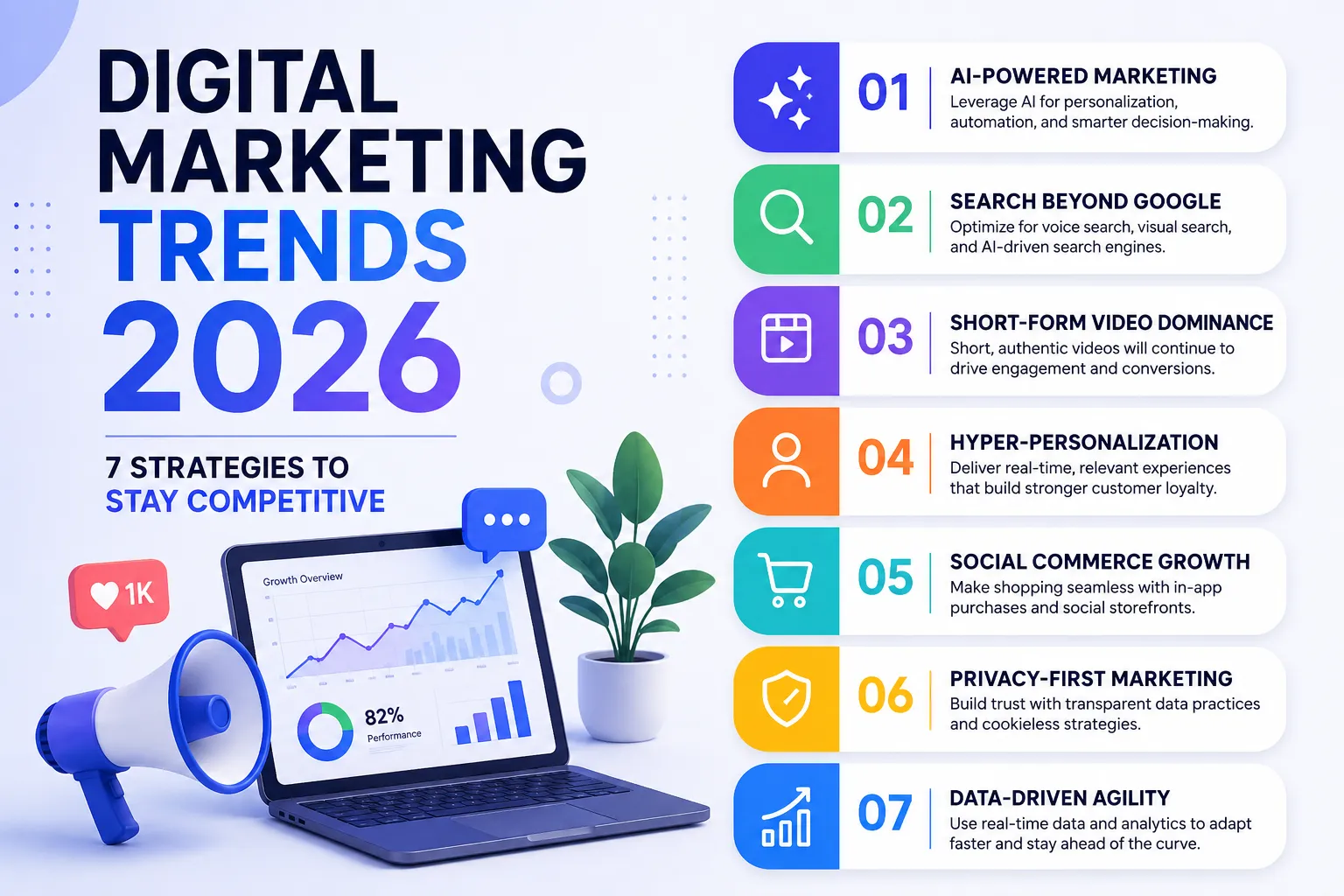
The digital landscape of 2026 is no longer defined by the mere presence of Artificial Intelligence; it is defined by its orchestration. For US businesses and global brands alike, the shift from “search engines” to “answer engines” has fundamentally altered how consumers interact with information. We are moving away from a world of clicking links and toward a world of synthesized solutions. If your current strategy relies on 2024 tactics, you are already behind the curve.
By 2026, the barrier between a consumer’s intent and the final purchase has thinned to the point of invisibility. Marketing is no longer about shouting the loudest; it is about being the most helpful at the exact moment of need. This guide explores the seven pivotal digital marketing trends 2026 that will separate the market leaders from the laggards in a hyper-personalized, privacy-conscious economy.
1. Predictive Analytics: Moving Beyond Reactive Data
In the past, marketing data told you what happened yesterday. In 2026, high-performing teams use predictive analytics to determine what will happen tomorrow. This shift involves using machine learning models to analyze vast sets of first-party data to predict customer churn, lifetime value, and even the likelihood of a specific lead converting before they have ever interacted with a salesperson.
Predictive modeling allows brands to allocate their budgets with surgical precision. Instead of broad-spectrum ad campaigns, businesses are utilizing “propensity modeling” to target only those individuals whose digital fingerprints suggest they are in a high-intent phase. This is particularly vital as the cost per acquisition (CPA) on major platforms continues to rise due to increased competition for finite user attention.
2. Optimizing for Zero-Click Search and AI Overviews
Search engine optimization (SEO) has undergone its most radical transformation since its inception. Google’s AI Overviews and other generative search experiences have made “zero-click” searches the norm. According to industry reports, nearly 65% of searches now end without a user clicking through to a website, as the AI provides the answer directly on the results page.
To thrive in 2026, your SEO strategy must pivot from driving traffic to driving “authority presence.” This means structuring your content so that AI models cite your brand as the definitive source. Focus on high-intent, long-tail queries and ensure your data is accessible via Schema markup. The goal is to be the “citation” in the AI’s answer, ensuring that even if the user doesn’t click, your brand remains the primary authority in their mind.
3. The Rise of Private Data Ecosystems
With the final death of third-party cookies and the tightening of privacy regulations like the CCPA and GDPR, 2026 marks the era of the “Data Garden.” Successful brands are no longer renting audiences from social media giants; they are building their own private data ecosystems. This is achieved through high-value exchanges: consumers provide their data (zero-party data) in exchange for deep personalization or exclusive access.
Building a robust first-party data strategy is essential for effective retargeting. This often involves integrating AI agents for small business to manage and segment this data automatically, ensuring that every email, SMS, and push notification feels uniquely tailored to the recipient’s current context rather than a generic blast.
4. Immersive and Spatial Commerce
As hardware like the Apple Vision Pro and Meta Quest 3 become more mainstream, 2026 is seeing the true integration of spatial computing into the marketing mix. “Immersive Commerce” allows users to visualize products in their physical space with photorealistic accuracy. For industries like home decor, fashion, and automotive, this is no longer a gimmick—it is a conversion requirement.
Marketers are now creating 3D assets instead of just 2D images. Interactive AR (Augmented Reality) filters that allow for virtual “try-ons” or furniture placement have shown to reduce return rates by up to 30%. In this environment, the brand that provides the most frictionless immersive experience wins the customer’s trust and their wallet.
5. Creator-Led Brands and Long-Term Partnerships
The era of the one-off “influencer shoutout” is dead. In 2026, the most successful brands are those that foster long-term, multi-year partnerships with creators who align with their core values. We are seeing a move toward “Creator-Led Brands,” where influencers are not just promoters but stakeholders in the product development process.
This trend is closely tied to the evolution of social commerce strategy 2026, where the entire shopping journey—from discovery to checkout—happens within the creator’s content. Consumers trust people, not logos. By embedding your brand within the trusted narrative of a consistent creator, you bypass the skepticism often associated with traditional digital advertising.
6. Video-First and Short-Form Mastery
While short-form video dominated the early 2020s, 2026 focuses on “Video Intelligence.” AI tools now allow brands to automatically repurpose long-form content into dozens of optimized short-form clips, each tailored for different platform algorithms. However, the sheer volume of video content means that quality and emotional resonance have become the primary differentiators.
Live-stream shopping has also matured in the US market, moving from a niche trend to a multi-billion dollar pillar of digital retail. Brands that master the art of “edutainment”—educating the consumer through entertaining video content—are seeing significantly higher engagement rates than those sticking to static imagery or text-heavy campaigns.
7. Ethical Marketing and AI Transparency
As consumers become more savvy about AI-generated content, transparency has become a brand-defining value. In 2026, marketing ethics are at the forefront of consumer consciousness. Watermarking AI-generated imagery and clearly disclosing when a chatbot or AI agent is interacting with a customer is no longer just a legal recommendation; it is a matter of brand integrity.
Brands that lean into “Radical Authenticity”—using real human stories and unedited behind-the-scenes content—are finding success as a counter-movement to the polished, AI-perfected aesthetic. Balancing the efficiency of AI with the irreplaceable touch of human empathy is the ultimate challenge for the 2026 marketer.
Comparing 2024 vs. 2026 Marketing Tactics
The following table outlines the fundamental shifts in strategy that businesses must implement to remain relevant in the 2026 landscape.
| Marketing Pillar | 2024 Approach | 2026 Strategy |
|---|---|---|
| Search Strategy | Keyword-focused SEO for clicks. | Entity-based Answer Engine Optimization (AEO). |
| Data Usage | Third-party cookies and broad targeting. | First-party data gardens and predictive modeling. |
| Content Creation | High-volume blog and social posts. | AI-orchestrated, hyper-personalized video/AR. |
| Customer Interaction | Reactive customer support bots. | Proactive, agentic AI brand ambassadors. |
| Influencer Marketing | Transactional campaign shoutouts. | Long-term partnerships and creator-led products. |
2026 Marketing Readiness Checklist
- Verify AI Transparency: Are all AI-generated assets clearly disclosed to your audience?
- Audit for AEO: Is your website content structured in a way that AI search engines can easily synthesize?
- Build Your Data Garden: Do you have a direct-to-consumer data collection method that doesn’t rely on third parties?
- Invest in 3D Assets: Have you begun converting your top-selling products into AR-ready models?
- Predictive Budgeting: Are you using machine learning to forecast campaign performance before launching?
The evolution of digital marketing in 2026 is characterized by a paradox: as our tools become more automated and artificial, our connection to the consumer must become more genuine and human. According to recent insights from McKinsey & Company, the brands that successfully bridge this gap will capture the majority of market growth over the next decade.
As noted in the latest Google Marketing Live 2026 announcements, the future belongs to those who view AI not as a replacement for strategy, but as the engine that powers a more relevant, more empathetic customer journey. By focusing on predictive intelligence, immersive experiences, and radical transparency, you can ensure your brand doesn’t just survive the changes of 2026, but leads them.
For more on how to implement these technologies locally, see our guide on Top AI Tools for 2026. The window to adapt is closing; the time to build your 2026 strategy is today.
Watch: A Helpful Video Guide
https://www.youtube.com/watch?v=Fq_u0eC70vM
Frequently Asked Questions
What is the biggest shift in SEO for 2026?
The biggest shift is the move from keyword-based link clicks to Answer Engine Optimization (AEO). Marketers must structure content so AI Overviews can synthesize and cite their brand directly in the search results.
How can small businesses afford predictive analytics in 2026?
Advancements in accessible AI agents and cloud-based marketing platforms have democratized predictive analytics, allowing small businesses to use pre-built machine learning models to forecast customer behavior without needing an in-house data science team.
What is a ‘Data Garden’ in digital marketing?
A Data Garden is a private ecosystem where a brand collects first-party and zero-party data directly from consumers through value-driven interactions, reducing reliance on third-party tracking and cookies.
Why is transparency important in AI marketing?
Transparency builds consumer trust. As AI becomes more prevalent, customers prioritize brands that are honest about their use of AI-generated content, deepfakes, and automated interaction systems.