If I ask you to test a product, all you would need is the product itself first before going deep down into what needs to be tested. Well, this was exactly what every company used to do few years back. They had to try it in the real world.
That meant spending huge amounts of money, using the resources, as well as taking risks. If things did not go as expected, the losses were significant. But today, things are different, as organizations are using simulation technologies for the same.
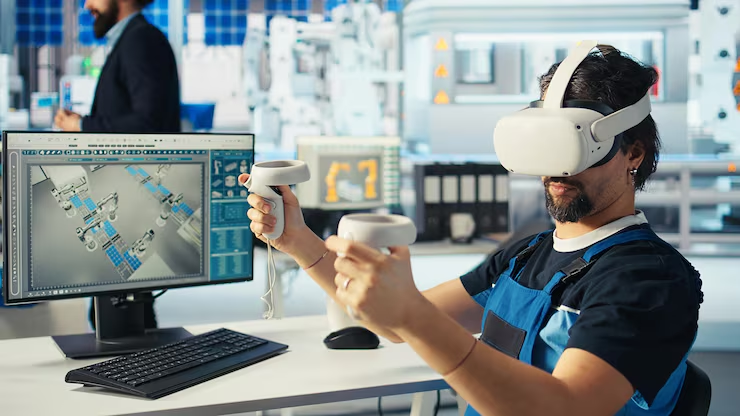
Organizations can now test ideas, products, and operations in a virtual environment. This is possible through simulation technologies. Any industry you talk about, from manufacturing and healthcare to logistics and construction, businesses are using simulations.
Using Unreal Engine Solutions for simulation technologies, businesses get better clarity on the outcomes before they happen, benefiting in the short-term as well as long-term.
This article talks about the reasons why organizations are investing in simulation technologies, including cost saving, better planning and more.
What Are Simulation Technologies?
In simple terms, simulation technologies create virtual models of real-world systems, environments, or processes.
These models help organizations study different situations and predict what might happen under specific conditions.
For example:
- A factory can test changes in its production line without stopping actual operations.
- A city planner can study traffic flow before building new roads.
- A healthcare provider can examine patient movement within a hospital to improve services.
The goal is simple.
Test first. Act later.
Why Businesses Are Turning to Simulation
There are many reasons behind the growing interest in simulation technologies. Let’s check them out below.
1. Cost Savings
Physical testing is slow. It can also burn a deep hole in your pocket. Building a real prototype of a car engine, a hospital layout, or a factory floor takes time and resources. If it does not work as desired, you end up burning cash.
Using simulation, teams test ideas in a virtual space first. You only build the real thing once you know and are satisfied with its functioning.
Let’s understand better with a few examples:
- A car company tests crash safety by running thousands of virtual crashes, not real ones.
- A hospital plans its emergency room layout before breaking ground.
- A factory checks how robots will move around the factory floor or any other space before placing a single machine.
- A logistics company tests a new delivery route without putting itself at risk of fuel costs or delays.
The savings are huge as you completely drop the failed prototypes. Less rework. Fewer wasted materials. Faster time to market.
2. Better Planning
Simulation helps teams plan before anything goes wrong. As a result, companies can avoid making mistakes in the first place.
Teams test different scenarios and compare results side by side. This makes it easier to pick the best option before committing real resources.
Benefits of simulation-based planning include:
- Test multiple versions of a design at the same time.
- Identify weak or breaking points in a system before launch.
- Predict how changes will affect performance.
- Reduce the number of costly revisions later on.
This is especially useful in large projects where one wrong decision early on can have cascading effects.
3. Better Decision Making
It’s not about planning ahead using simulation. But, in fact, it’s also about making informed decisions in the moment.
For example: When a city connects its roads, traffic signals, sensors, and related data to a live simulation model, operators can see exactly what is happening right now and predict what will happen next.
This kind of live, connected model is often called a digital twin solution. Think of it as a mirror image of something real, but inside a computer. It updates in real time as the real-world version changes.
Digital twin solutions are now used in:
- Smart cities to manage traffic and utilities.
- Power plants to monitor equipment health.
- Hospitals to track bed availability and staff flow.
- Supply chains to spot delays before they happen.
- Construction sites to track progress and catch issues early.
4. Training Without Risk
Some jobs are too dangerous to train for in real life.
A new pilot cannot learn by crashing real planes. A surgeon cannot practice on real patients. A firefighter cannot train inside a real burning building every time.
Simulation fills this gap. Teams train in a safe and realistic environment; therefore, mistakes do not cost lives or money.
Key benefits of simulation-based training:
- Repeatable scenarios that can be run as many times as needed.
- Safe environment to practice high-risk situations.
- Consistent training quality across all team members.
- Faster skill development compared to on-the-job learning.
- Easy tracking of trainee performance and progress.
Industries using simulation for training include:
- Military and defense
- Aviation
- Healthcare and surgery
- Oil and gas operations
- Emergency response teams
5. Building Complex Systems Before They Exist
What if you want to build something new, something that has never existed before?
That used to mean years of guessing and testing. Now, teams create highly detailed, interactive virtual environments before anything physical is built.
Let’s consider these examples:
- Architects walk clients through a building that has not been constructed yet.
- Game studios build entire fictional worlds with realistic physics.
- Car companies let designers sit inside a car interior that only exists on a screen.
What these environments can simulate:
- Light and shadow at different times of day.
- Sound and acoustics inside a space.
- Physical forces like wind, heat, and pressure.
- Human movement and behavior patterns.
- Equipment performance under different conditions.
Teams can find problems and fix them early, when changes are cheap. This makes building complex systems far more practical.
6. Reducing Risks
Risk is a part of every business decision. Simulation does not remove risk, but it makes risk much easier to manage.
Some examples where organizations use simulation to reduce risk include:
- Test new products without building physical versions
- Model what happens during a supply chain disruption
- Run emergency response drills in a virtual environment
- Check if a new factory layout meets safety requirements
- Simulate cyberattack scenarios to test security systems
The ability to “fail safely” inside a simulation means fewer surprises in the real world.
7. Sustainability and Smarter Resource Use
There is a much greater awareness of the need for sustainability today than there was a decade ago.
Simulation helps organizations become more efficient with resources. This is important for businesses that want to reduce waste and meet sustainability goals.
Ways simulation supports sustainability:
- Reduce the number of physical prototypes that get thrown away.
- Optimize energy use in buildings and factories.
- Plan logistics routes that use less fuel.
- Test green building designs before construction begins.
- Cut down on material waste during product development.
Industries Driving the Adoption of Simulation Technologies
Simulation technology is growing fast across many fields:
- Manufacturing
- Healthcare
- Transportation
- Construction
- Energy
- Defense
- Smart cities
- Education
- Retail
The Bottom Line
Organizations are not investing in simulation just because it looks impressive. They are doing it because these technologies work and help save time, resources, and costs.
As technology becomes more accessible, simulation is moving from a specialized tool to a common part of business planning.
The question is no longer whether simulation technology makes sense. For most organizations, the real question is: how quickly can they get started?