
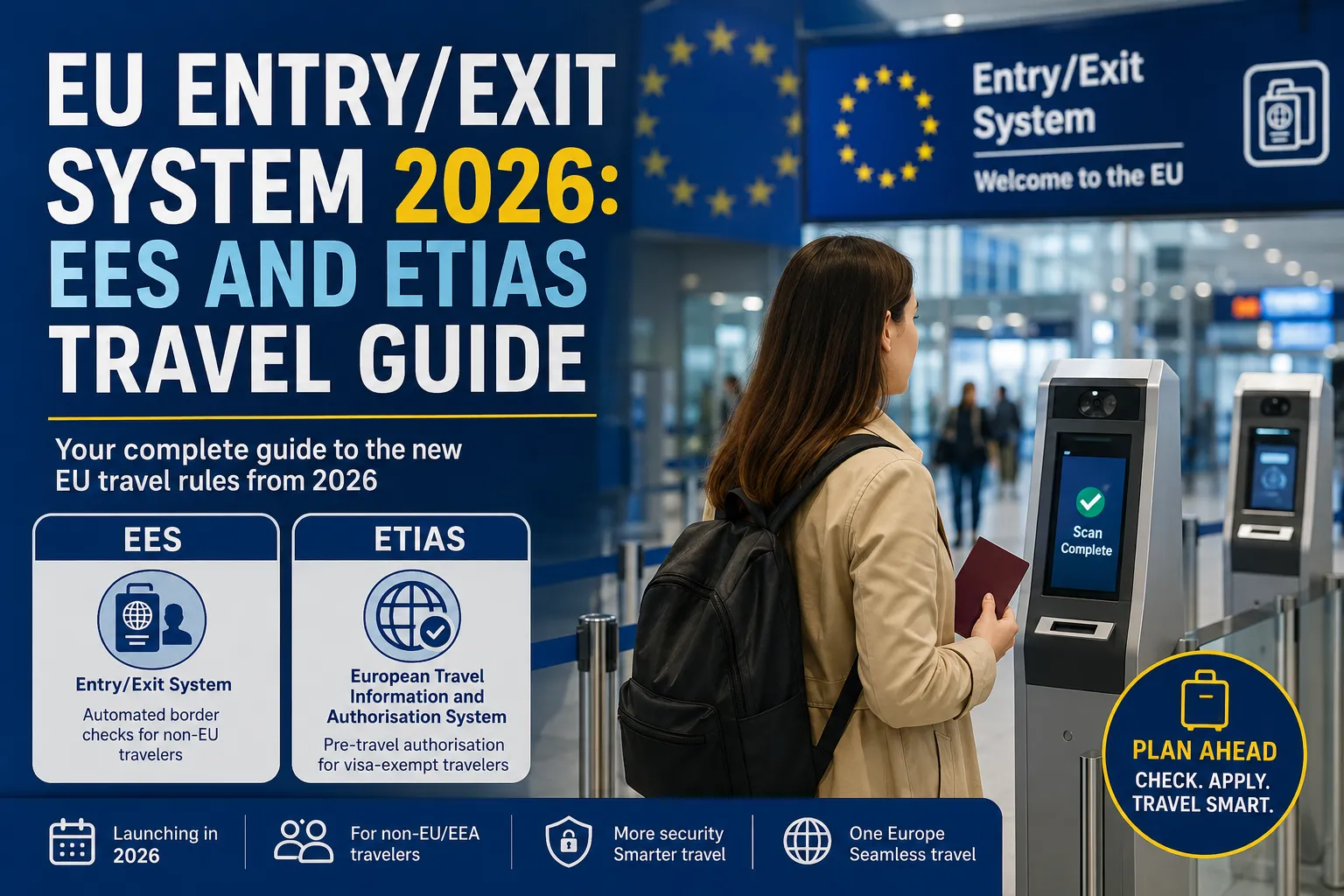
Europe’s Entry/Exit System became fully operational on April 10, 2026. It replaces manual passport stamping with digital entry and exit records for most non-EU nationals making short visits to participating European countries.
The system records passport details, travel dates and biometric information. Travellers may need to provide a facial image and fingerprints when crossing an external border.
EES is already operating. ETIAS is different and is not yet accepting applications. The European Union currently expects ETIAS to begin in the last quarter of 2026, with the exact date to be announced officially.

In This Guide
- What changed in 2026
- How EES works
- Who must use EES
- What happens at the border
- EES versus ETIAS
- Rules for Pakistani travellers
- Pre-travel checklist
- Frequently asked questions
What Changed for European Travel in 2026?
As of April 10, 2026, the European Entry/Exit System is fully operational at the external borders of the participating countries.
For affected travellers, passport stamps have been replaced by digital records showing:
- When the person entered
- Where the person entered
- When the person departed
- Where the person departed
- Whether entry was refused
The system also uses biometric information to confirm identity and detect the use of fraudulent or multiple identities.
Important distinction: EES registration happens at the border. Travellers do not submit an EES application or pay an EES application fee before departure.
What Is the EU Entry/Exit System?
The Entry/Exit System, commonly called EES, is an automated border-management system for registering non-EU nationals travelling for a short stay.
A short stay generally means no more than 90 days within any 180-day period. The system applies whether the traveller holds a short-stay visa or comes from a country whose citizens are exempt from short-stay visa requirements.
According to the European Commission, EES records:
- The traveller’s name
- Passport or travel-document details
- Facial images
- Fingerprints where required
- Dates and locations of entry and exit
- Refusals of entry
Why Was EES Introduced?
The system is intended to make external border management more accurate and efficient.
Its main objectives include:
- Replacing manual passport stamps with digital records
- Calculating permitted stays more consistently
- Identifying people who overstay
- Detecting identity and document fraud
- Supporting automated and self-service border controls
- Improving security at Europe’s external borders
During the progressive rollout that began in October 2025, the European Commission reported that millions of border crossings were registered before the system became fully operational.
Who Must Register Under EES?
EES generally applies to non-EU nationals entering participating European countries for a short stay.
It covers two broad groups:
- Travellers who require a short-stay Schengen visa
- Travellers who are exempt from short-stay visa requirements
The rules apply at external borders when travelling by air, sea, train or road.
Who Is Generally Not Registered?
Exemptions can apply to certain travellers, including some:
- Citizens of participating European countries
- Eligible family members holding specific residence documents
- Long-stay visa holders
- Residence-permit holders
- Diplomatic or specially protected travellers
- Cross-border workers covered by particular arrangements
- People covered by certain international agreements
Exemptions depend on nationality, immigration status and travel documents. Travellers should confirm their individual position through the official EES website.
Which European Countries Use EES?
EES operates across 29 European countries participating in the system. This includes most EU countries as well as associated Schengen states.
The participating countries include:
- Austria
- Belgium
- Bulgaria
- Croatia
- Czechia
- Denmark
- Estonia
- Finland
- France
- Germany
- Greece
- Hungary
- Iceland
- Italy
- Latvia
- Liechtenstein
- Lithuania
- Luxembourg
- Malta
- Netherlands
- Norway
- Poland
- Portugal
- Romania
- Slovakia
- Slovenia
- Spain
- Sweden
- Switzerland
Ireland does not operate EES. Cyprus has separate border arrangements and continues manual passport stamping under the present framework.
The United Kingdom is also outside EES, although its transport terminals may contain juxtaposed European border controls for certain routes.
What Happens at the Border?
Your first EES registration will normally take longer than a conventional passport check because the border authority must create or complete your digital record.
First Entry After Full Implementation
A border officer or self-service system may:
- Scan your passport.
- Record information from the travel document.
- Capture a live facial image.
- Collect fingerprints where applicable.
- Ask standard questions about your journey.
- Record the entry decision digitally.
Subsequent Trips
On a later visit, the system can compare your live biometric information with the existing EES record. This may make verification faster, although border officers retain the authority to conduct additional checks.
Questions You May Still Be Asked
EES does not remove normal entry requirements. A border officer may still request:
- Proof of accommodation
- A return or onward ticket
- Evidence of sufficient funds
- Travel insurance where required
- An invitation letter
- Information about the purpose of the visit
A valid visa or ETIAS authorization does not create an unconditional right of entry. The final decision remains with the border authorities.
Video: Europe’s Entry/Exit System Explained
This video explains how travellers are processed under Europe’s digital Entry/Exit System.
EES vs. ETIAS: What Is the Difference?
EES and ETIAS are frequently confused, but they perform different functions.
| Feature | EES | ETIAS |
|---|---|---|
| Full name | Entry/Exit System | European Travel Information and Authorisation System |
| Main purpose | Digitally records border crossings | Pre-travel authorization for eligible visa-exempt visitors |
| Status in July 2026 | Fully operational | Not yet operational |
| Expected ETIAS launch | Not applicable | Last quarter of 2026, with the exact date still to be announced |
| Who completes it? | Most non-EU short-stay travellers at the border | Eligible visa-exempt travellers before departure |
| Advance application | No | Yes, once operational |
| Biometric registration | Yes, subject to applicable rules | Not an in-person biometric border registration |
| Application fee | No traveller application fee | €20 under the announced fee structure, with exemptions for certain applicants |
Is ETIAS Accepting Applications?
No. The official EU website states that ETIAS is not currently operational and no applications are being collected.
The EU expects ETIAS to begin in the final quarter of 2026, but the exact start date will be announced several months before launch.
Travellers should consult the official ETIAS website and avoid unofficial websites claiming that an application is currently required.
Who Will Need ETIAS?
Once operational, ETIAS will apply to eligible nationals who can currently visit participating European countries for a short stay without obtaining a visa.
It will not replace a Schengen visa. People from visa-required countries will continue using the relevant visa process.
What Does EES Mean for Pakistani Travellers?
Pakistani citizens generally require a Schengen visa for a short visit. EES does not remove or replace that visa requirement.
A Pakistani traveller making a covered short visit should expect two distinct stages:
- Before travel: Obtain the required visa and prepare supporting documents.
- At the external border: Complete the EES registration or verification process.
ETIAS generally concerns visa-exempt nationalities. Therefore, a Pakistani passport holder who requires a Schengen visa would not normally apply for ETIAS.
Example: Travelling From Pakistan to France
A visitor flying from Islamabad to Paris would normally:
- Apply for the appropriate Schengen visa before departure.
- Present the passport and supporting documents to the airline.
- Complete EES registration at the first participating external border.
- Provide passport details and required biometric information.
- Have the arrival recorded digitally rather than through a conventional passport stamp.
Example: Connecting Through Another Schengen Country
If the traveller flies from Pakistan to Spain through Germany, the external Schengen border is normally crossed in Germany.
EES processing would usually occur there rather than at the final destination in Spain. Travellers should therefore allow sufficient connection time at the first Schengen airport.
Does EES Change the 90/180-Day Rule?
No. EES changes how short stays are recorded and calculated; it does not create a longer visitor allowance.
Under the general rule, an eligible traveller may spend up to 90 days during any rolling 180-day period in the relevant area.
This is not simply “three months per trip” or “90 days every calendar year.” The calculation looks backward over the preceding 180 days on each day of a stay.
Why Digital Records Matter
Manual passport stamps could be difficult to interpret when travellers had frequent trips, replacement passports or unclear stamps.
EES makes the calculation more systematic by using recorded entry and exit dates. Overstays may therefore be identified more consistently.
Travellers should continue maintaining their own travel history. Keep boarding passes, tickets and accommodation records in case an entry or departure needs to be verified.
How Long Will EES Border Registration Take?
There is no single processing time for every traveller or location.
Waiting times can be affected by:
- The number of arriving passengers
- Whether it is the traveller’s first EES registration
- The availability of self-service kiosks
- Biometric capture quality
- Staffing at the border
- Additional document checks
- Technical or operational interruptions
First-time registration is likely to take longer than a later verification. Travellers should avoid tight connections, especially when entering the participating area through a major airport during a busy period.
What If Your Fingerprints Cannot Be Collected?
Border authorities have procedures for situations in which fingerprint collection is temporarily or physically impossible. The exact handling depends on the traveller’s circumstances and applicable rules.
Children below the applicable fingerprinting age and people for whom fingerprinting is physically impossible may be treated differently.
A traveller should not attempt to interpret an exemption independently at the border. Follow the officer’s instructions and explain any relevant medical or physical condition clearly.
How Is EES Data Used?
EES information is used for border management, immigration control, identity verification and specified law-enforcement purposes under EU rules.
The system is designed to help authorities:
- Confirm a traveller’s identity
- Verify entry and departure history
- Calculate the authorized period of stay
- Identify overstayers
- Record refusals of entry
- Detect document and identity fraud
Travellers have data-protection rights, including routes for requesting access, correction or deletion where the legal conditions are met.
If you believe your EES record is incorrect, follow the official procedure for the country responsible for the record rather than relying on an unofficial immigration agent.
Common EES and ETIAS Scams to Avoid
Major travel-rule changes create opportunities for misleading websites and fraudulent services.
Fake EES Registration Fees
Travellers do not submit a paid EES application before travelling. Be cautious if a website requests payment to “activate” or “approve” an EES account.
Premature ETIAS Applications
ETIAS is not currently collecting applications. A website claiming to provide an approved ETIAS before the official launch should not be trusted.
Imitation Government Websites
Scammers may copy EU branding and use web addresses that resemble official portals.
Use the official domain:
Guaranteed Entry Claims
No private agent can guarantee admission at the border. A visa or future ETIAS approval allows a traveller to request entry, but border authorities make the final decision.
European Travel Checklist for 2026
Several Weeks Before Departure
- Confirm whether your nationality requires a visa.
- Check passport validity and blank-page requirements.
- Verify the permitted length of stay.
- Arrange travel insurance where required.
- Keep accommodation and transport confirmations available.
- Check the official EES and ETIAS websites for updates.
Before Going to the Airport
- Carry the passport linked to your visa or authorization.
- Download copies of important reservations.
- Keep proof of funds accessible.
- Know the address and telephone number of your accommodation.
- Allow extra time for check-in and border processing.
- Use a longer connection at your first Schengen entry point.
At the Border
- Follow signs for non-EU or non-EEA travellers.
- Use a self-service kiosk if instructed.
- Remove glasses or face coverings when requested for facial capture.
- Answer questions accurately and briefly.
- Provide supporting documents when requested.
- Confirm that your passport is returned before leaving the desk.
After Returning Home
- Retain boarding passes and travel confirmations.
- Record the dates spent in the participating area.
- Review your remaining allowance before planning another trip.
- Report any suspected error through an official authority.
Practical Advice for Families
Every family member should travel with the correct individual document. Parents should not assume that a child is excluded from EES simply because the child is too young for fingerprint collection.
Prepare children for:
- Having their photograph taken
- Waiting at a kiosk or border desk
- Following instructions from border staff
- Keeping their face visible during identity checks
Carry documents showing parental responsibility or permission to travel when required, particularly if a child is travelling with one parent or another adult.
Final Takeaway
EES is now part of normal border processing for most non-EU short-stay visitors entering participating European countries. Travellers should expect digital registration, facial-image capture and, where required, fingerprint collection.
ETIAS remains separate. It is expected to launch in the last quarter of 2026, but it is not currently accepting applications.
The most practical response is simple: use official EU information, prepare documents in advance and allow extra time at the first external border.
For more destination updates and planning advice, visit the ZOBUZ travel section and explore the latest Europe travel guides.
Entry requirements can vary by nationality, residence status and travel purpose. Always confirm current rules with the relevant government, embassy or official EU portal before departure.
Frequently Asked Questions
Is the EU Entry/Exit System operating in 2026?
Yes. EES became fully operational at the external borders of participating countries on April 10, 2026.
Do travellers need to apply for EES before departure?
No. EES is a border-registration system, not a pre-travel authorization. Registration or verification occurs when the traveller crosses an external border.
Is ETIAS currently accepting applications?
No. The EU states that ETIAS is not yet operational. It is expected to begin in the last quarter of 2026, with the exact launch date to be announced.
Do Pakistani citizens need ETIAS?
Pakistani citizens generally require a Schengen visa for short visits and therefore would not normally use ETIAS. They may still be registered in EES when crossing a participating external border.
Will passports still be stamped under EES?
EES replaces conventional passport stamping for covered travellers at participating borders. Separate arrangements may continue in countries that do not operate EES.
Does EES change the 90-day rule?
No. It digitizes the recording and calculation of short stays. The general limit remains 90 days within any rolling 180-day period.
Is there an EES application fee?
No traveller application fee is required because there is no advance EES application. Be cautious of websites charging for an EES authorization.
What information does EES collect?
EES can record passport details, facial images, fingerprints, entry and exit dates, border locations and refusals of entry.