
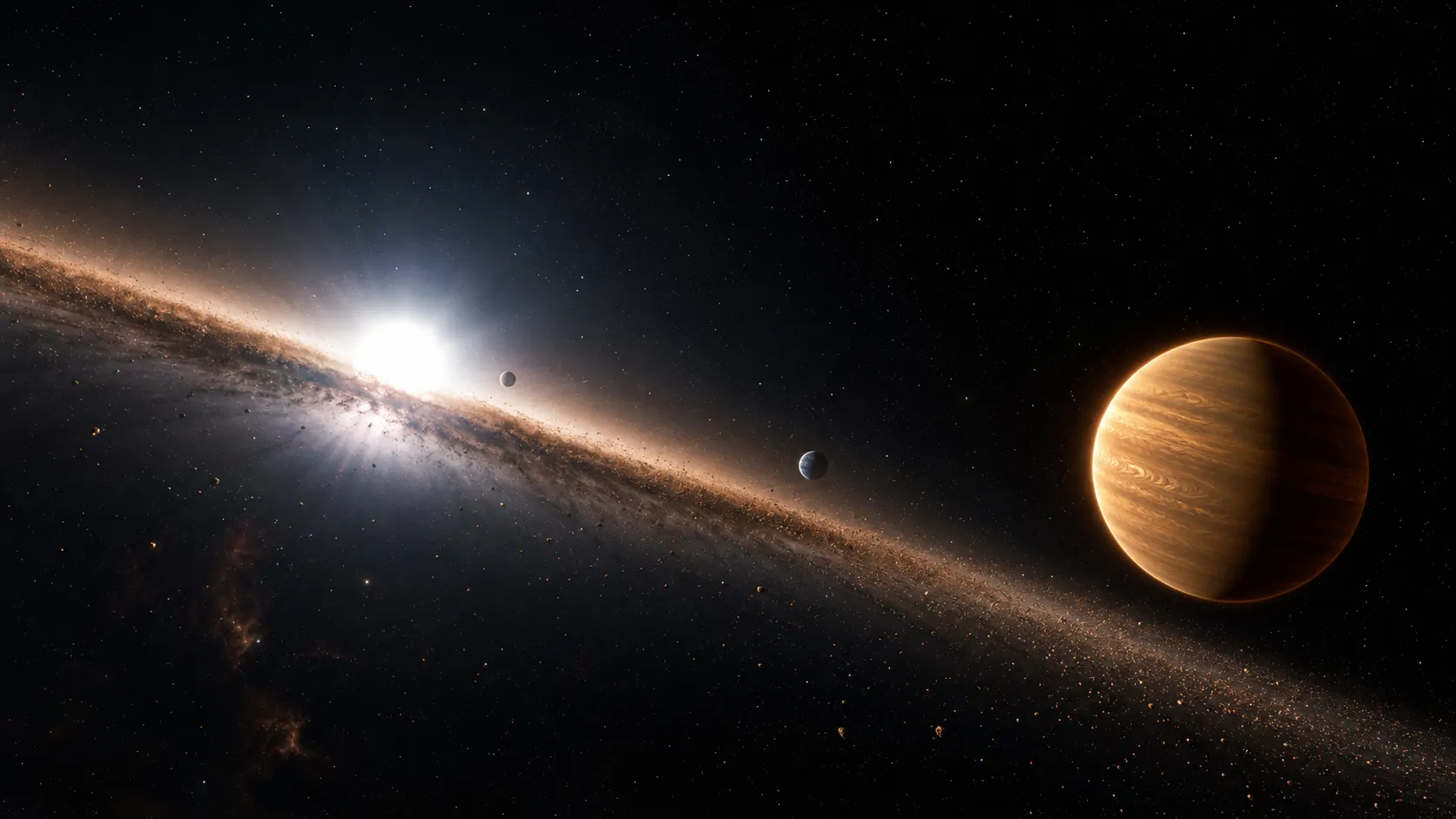
Astronomers have discovered a third giant planet orbiting Beta Pictoris, a young star 63 light-years from Earth. The newly identified world, Beta Pictoris d, was independently detected with NASA’s James Webb Space Telescope and the European Southern Observatory’s Very Large Telescope. Its importance goes beyond the planet itself: one team found it through the chemical fingerprint of its atmosphere, showing how spectroscopy can reveal worlds that ordinary imaging struggles to separate from surrounding dust.
What was discovered?
Beta Pictoris d is a young gas giant orbiting within the bright debris disk around Beta Pictoris. Researchers estimate that it has at least twice Jupiter’s mass. A separate analysis of ground-based infrared observations places it at roughly 2.4 Jupiter masses.
Models indicate that the planet travels about 30 astronomical units from its star—approximately the region occupied by Neptune in our solar system. It is the widest-orbiting of the three known planets in the system, although it remains inside the debris disk’s inner edge.
The discovery makes Beta Pictoris only the second planetary system known to contain at least three directly imaged planets, according to NASA’s account of the findings. The other two, Beta Pictoris b and c, were already familiar targets for astronomers studying how planets form and evolve.
Yet Beta Pictoris d had remained concealed in one of the most closely observed young systems in the Milky Way. The reason was not simply distance. The planet sits amid a bright disk of dust and debris whose scattered light can resemble or overwhelm the faint signal of a planet.
Two teams reached the same answer in different ways
The scientific case is unusually strong because two independent teams identified the same object with complementary techniques.
One group, led by Aidan Gibbs of the University of California, San Diego, was using Webb’s Near-Infrared Spectrograph, or NIRSpec, to study the already known Beta Pictoris b. NIRSpec’s Integral Field Unit records an image and a spectrum for every pixel in its field of view. The researchers noticed an unexpected signal where they had expected relatively smooth light scattered by dust, a result detailed in the team’s Astrophysical Journal Letters study.
The pattern was a set of carbon-monoxide absorption lines—the kind of molecular “barcode” expected in the atmosphere of a giant planet. Because a spectrum also encodes motion, the team measured a radial velocity consistent with an object orbiting Beta Pictoris rather than a background star or brown dwarf.
Follow-up observations using Webb’s Mid-Infrared Instrument, MIRI, detected water vapor and methane through an approved JWST Director’s Discretionary Time program. Those additional atmospheric signatures strengthened the identification and began characterizing the planet at the same time.
Separately, a team co-led by Ben Sutlieff of the University of Edinburgh and Markus Bonse used the ERIS instrument on ESO’s Very Large Telescope in Chile to image the planet. After the detection, the researchers traced Beta Pictoris d through archival observations from Webb and the VLT’s SPHERE instrument extending back to 2014. ESO has published the processed VLT observation and technical image details.
That ground-based work found the planet to be about 100 times fainter than Beta Pictoris b and among the least massive exoplanets directly imaged from Earth. The older observations also showed the object moving around the star over more than a decade, adding independent evidence that it is a bound planet.
Why spectroscopy changed the search
Directly imaging an exoplanet is difficult because a host star can be millions or billions of times brighter than an orbiting world. Instruments called coronagraphs suppress the star’s glare, while careful image processing attempts to separate a planet from instrumental artifacts and circumstellar material. The reliance on precisely controlled light also reflects the broader importance of optical technology in modern computing and scientific infrastructure.
Beta Pictoris presents an extra complication: its edge-on debris disk is exceptionally bright. Dust scatters starlight into spatial structures that can masquerade as a faint companion. A suspicious bright spot is therefore not enough.
The Webb team’s approach filtered the scene by chemistry. Dust may create a confusing glow, but it does not reproduce the narrow sequence of carbon-monoxide absorption features expected from a planetary atmosphere. The method effectively asked not only “Is there a point of light here?” but “Does this light carry the molecular and velocity signature of a planet?”
NASA describes Beta Pictoris d as the first directly imaged planet discovered primarily through moderate-resolution spectroscopy. That distinction could be consequential. Spectroscopic searches may uncover planets embedded in debris disks or other complex environments where conventional imaging produces ambiguous shapes.
There is also an efficiency advantage. A spectrum can confirm that an object is planetary while immediately revealing information about its atmospheric chemistry, temperature and motion. Discovery and characterization no longer have to be entirely separate stages.
A young system that acts as a planetary laboratory
Beta Pictoris is about 23 million years old, compared with the Sun’s age of roughly 4.6 billion years. Its youth gives astronomers a view of giant planets while they are still hot from formation and interacting with the leftover material around their star. Readers interested in a closer-to-home example of orbital alignment can also explore Zobuz’s explanation of how a total lunar eclipse produces a “Blood Moon”.
The system’s debris disk has a sharply defined inner edge and other structures that have challenged researchers. Before Beta Pictoris d was found, dynamical models had suggested that an additional planet at roughly its location could help sculpt those features. Its discovery therefore connects an observed disk shape with a plausible gravitational cause.
This does not mean every feature has been explained. The new planet’s orbit, mass and atmosphere still carry uncertainties, and further observations will be needed to determine how the three giants influence one another and the disk. Researchers plan to refine Beta Pictoris d’s temperature, chemical composition and orbital path using additional Webb data.
The system also offers a rare opportunity to compare multiple giant planets born around the same star. Differences among Beta Pictoris b, c and d may reveal how formation location, mass and later orbital evolution shape planetary atmospheres.
What the discovery does—and does not—mean
Beta Pictoris d is not presented as an Earth-like world or a potential home for life. It is a massive, young gas giant. Its scientific value lies in planetary formation, atmospheric measurement and detection technology.
The discovery also does not establish that spectroscopy will replace direct imaging. The strongest result came from combining methods: Webb supplied molecular and velocity evidence, while the Very Large Telescope and archival data supplied independent images and orbital motion across time.
That combination is the real lesson. Future observatories will produce enormous datasets in crowded and dusty environments. Searching those observations for both spatial signals and chemical fingerprints could reveal planets that are already present in the data but hidden from standard image searches.
Frequently asked questions
What is Beta Pictoris d?
Beta Pictoris d is a newly discovered gas-giant exoplanet orbiting the young star Beta Pictoris, 63 light-years from Earth. Estimates place its mass at roughly two to 2.4 times Jupiter’s mass.
How was Beta Pictoris d found?
One team detected carbon monoxide in the planet’s atmosphere with Webb’s NIRSpec instrument and later found water vapor and methane with MIRI. A separate team imaged it with the Very Large Telescope and identified it in archival observations spanning more than a decade.
Why was the planet hidden for so long?
It lies within a bright debris disk whose scattered light makes faint planets difficult to distinguish with conventional imaging. It is also about 100 times fainter than Beta Pictoris b in the ground-based observations reported by ESO.
Why is the discovery important?
It demonstrates that moderate-resolution spectroscopy can discover a directly imaged planet through atmospheric chemistry and motion, potentially opening a new route to finding worlds in dusty or visually complex systems.
Conclusion
Beta Pictoris d turns a familiar planetary system into a three-planet laboratory and validates a more discriminating way to search for hidden worlds. By reading a molecular fingerprint where an image alone was uncertain—and then matching that signal with independent ground-based observations—astronomers showed how chemistry, motion and archival imaging can work together. The next exoplanet breakthrough may not arrive as a new bright dot. It may already be concealed in a spectrum.