
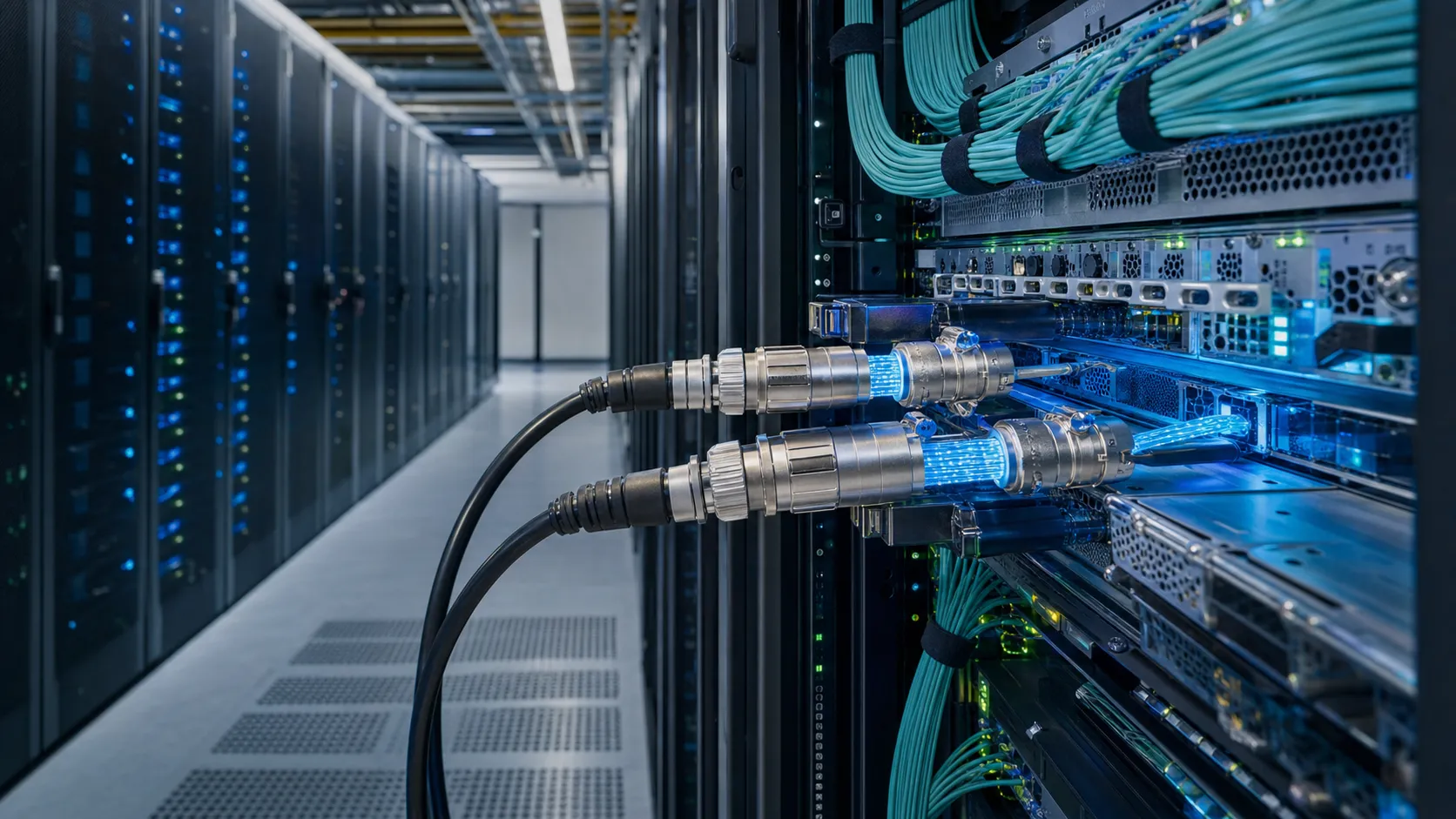
Microsoft and 3M have announced a strategic partnership that brings a less visible part of the artificial-intelligence boom into focus: the physical fiber connections inside hyperscale data centers. Microsoft says its Azure cloud infrastructure will become the first announced hyperscale platform to deploy 3M’s Expanded Beam Optical technology, or EBO, as the companies work to improve the speed, reliability and maintainability of networks supporting AI workloads.
The agreement also extends beyond hardware. 3M plans to use Microsoft’s AI and digital platforms across customer service, finance, sales and marketing. However, the infrastructure element is the more consequential technology story because it addresses a practical constraint that becomes harder to manage as data centers grow denser and more complex.
What Microsoft and 3M Announced
According to the companies’ joint announcement, Microsoft will deploy 3M’s proprietary EBO technology in Azure data centers. The system uses an expanded optical beam at the connector interface instead of relying on the direct physical contact used by conventional fiber connectors.
3M says that design can make fiber links faster to install, more tolerant of contamination and easier to maintain. Microsoft also said its early use of the technology showed potential to shorten network deployment timelines in certain environments and maintain strong signal performance under typical data-center conditions, including dust exposure and routine handling.
Those claims come from the companies rather than an independent benchmark, and the announcement does not disclose deployment locations, financial terms, performance percentages or a detailed rollout schedule. The partnership should therefore be understood as a significant commercial deployment decision, not proof that every data center will achieve the same results.
Why Optical Connections Matter for AI Infrastructure
AI systems depend on far more than advanced processors. Large clusters must move enormous quantities of data among servers, accelerators, storage systems and network switches. As those clusters expand, operators need more fiber connections packed into limited space, and every connection becomes another installation and maintenance point.
Traditional optical connectors can be sensitive to dust and surface contamination because their fiber ends must align and make close contact. A contaminated connector may require cleaning and inspection before technicians can safely place it into service. Repeating that process across a dense hyperscale facility adds time, labor and operational risk.
Expanded-beam designs take a different approach by enlarging and collimating the light at the connection point. In principle, spreading the beam over a wider interface can reduce sensitivity to small particles and handling conditions. That does not eliminate maintenance or guarantee flawless performance, but it can make optical connections more robust in environments where deployment speed and serviceability matter.
The Bigger AI Data Center Bottleneck
The partnership illustrates how the AI infrastructure race is shifting beyond the question of who can acquire the most powerful chips. Computing capacity also depends on power delivery, cooling, construction, optical networking, supply chains and the ability to operate facilities reliably at scale.
This makes materials science and precision manufacturing strategically important. 3M is better known to consumers for everyday products, but its industrial expertise includes optical materials and high-volume manufacturing. The company says it is scaling EBO production as hyperscalers and data-center operators build infrastructure for growing cloud and AI demand.
3M also helped establish an EBO Multi-Source Agreement intended to support common specifications and broader industry adoption. Standardization matters because large operators generally avoid becoming dependent on a single proprietary component when they are planning infrastructure that must be serviceable for years.
Readers following the wider AI ecosystem can also review Zobuz’s guide to the top AI tools of 2026 and its reporting on OpenAI’s proposed screen-free AI device. Those stories cover the software and consumer ends of the market, while the Microsoft–3M agreement highlights the physical layer required to keep AI services running.
3M Will Also Apply Microsoft AI Internally
The companies are simultaneously working on 3M’s enterprise transformation. The announcement says 3M will deploy Microsoft AI and digital tools across several business functions.
One project involves an AI agent-assisted workflow for customer-order management. The system is intended to help with credit checks, delinquency assessments and system updates, while retaining human approvals and a monitoring dashboard. Microsoft and 3M say the goal is to reduce manual work, improve consistency and accelerate processes, although they did not publish measured outcomes.
This part of the partnership reflects a common enterprise pattern: companies are moving from isolated AI experiments toward narrow workflows with defined inputs, human oversight and auditable actions. The operational controls are as important as the model because finance and customer-order processes can create real business consequences when automated decisions are wrong.
What to Watch Next
The most important unanswered questions concern scale and measurable performance. Microsoft has not said how many Azure facilities will receive EBO connections, how the technology compares with existing connector systems over time or when deployment will expand.
Future evidence should include installation time, failure rates, cleaning requirements, signal reliability and total maintenance cost. Wider adoption by additional cloud providers or component manufacturers would also indicate whether expanded-beam optical connections are becoming a durable industry standard rather than a specialized deployment choice.
For now, the announcement is notable because it exposes a critical but often overlooked layer of the AI economy. Better models require better computing systems, and those systems depend on thousands of physical connections working reliably. Microsoft and 3M are betting that a change at the fiber interface can remove friction from the construction and operation of increasingly dense AI data centers.
Featured image is an original conceptual illustration and does not depict a specific Microsoft or 3M installation.