
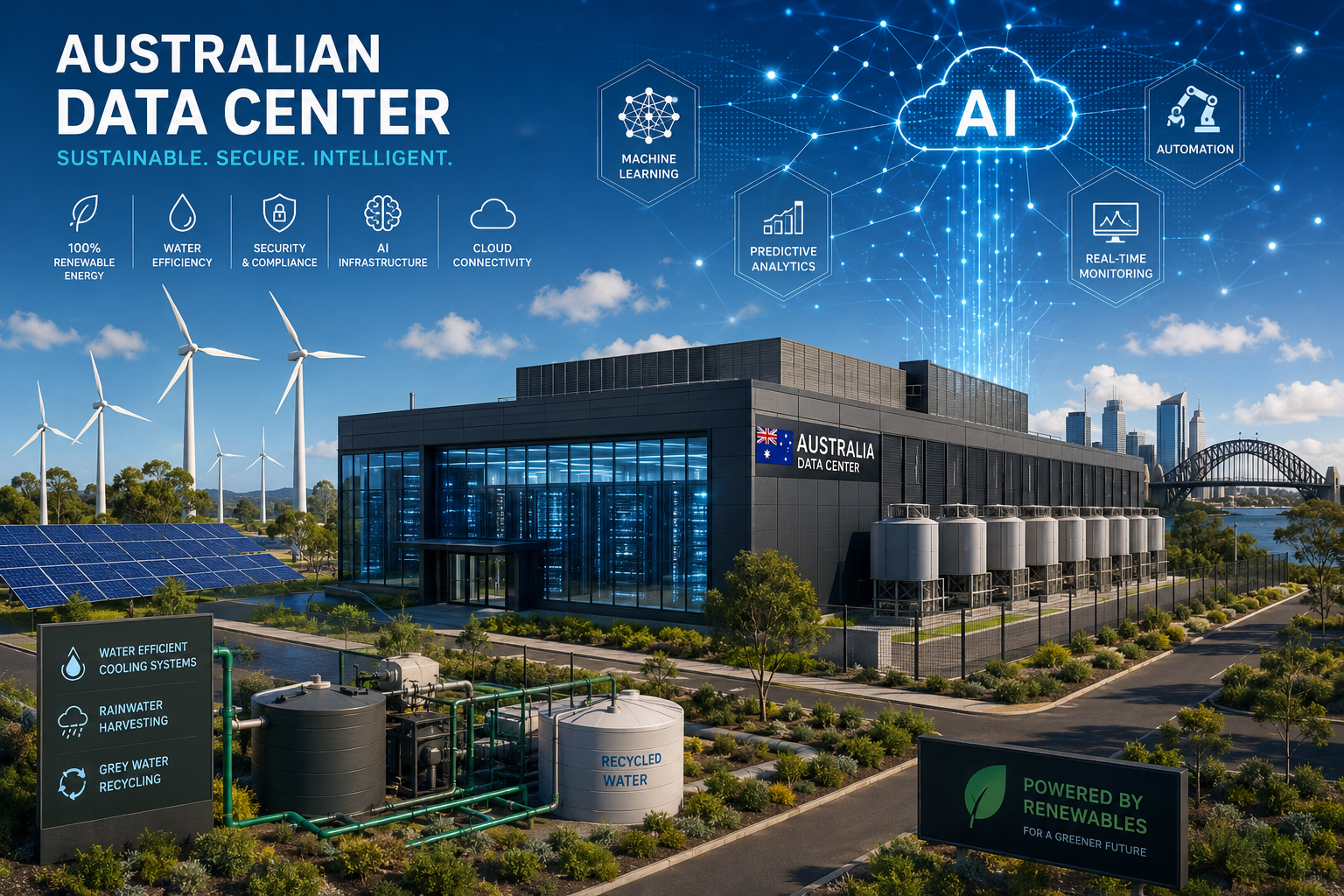
Australia is moving artificial-intelligence regulation beyond algorithms, chatbots and online safety. Its latest policy initiative targets the physical infrastructure required to operate AI systems.
Prime Minister Anthony Albanese has announced an Office of AI within the Department of the Prime Minister and Cabinet. The government is also developing national requirements for large-scale data centers, covering electricity generation, grid-connection costs, energy efficiency, location and water consumption.
The announcement matters because the global AI debate has largely focused on model safety, copyright, privacy and employment. Australia is now placing the power stations, water systems and data centers behind AI under closer scrutiny.
Some headlines have described the requirements as finalized regulations. That is premature. The Office of AI has been established, but important elements of the national data center framework remain proposed and must still pass through consultation, intergovernmental coordination and legislation.
What Has Australia Announced?
The Australian plan contains two connected initiatives:
- Establishing a central Office of AI to coordinate artificial-intelligence policy across the federal government.
- Creating a national framework for large data centers, including mandatory requirements for electricity, water, grid access and infrastructure costs.
According to Reuters , the government wants a more coordinated approach to AI standards while addressing the pressure that expanding data center capacity can place on public infrastructure.
The proposal attempts to balance two competing objectives. Australia wants to attract AI investment, but it does not want households and ordinary businesses to absorb the infrastructure costs created by enormous computing facilities.
What Will the Office of AI Do?
The Office of AI has been placed within the Department of the Prime Minister and Cabinet, giving it a central position rather than attaching it to a single industry regulator.
Its expected responsibilities include:
- Coordinating AI policy across government departments.
- Developing the national framework for large-scale data centers.
- Reducing inconsistent or duplicated regulatory processes.
- Supporting national standards for responsible AI development.
- Examining AI’s impact on jobs, security, infrastructure and public services.
- Coordinating with states, territories and existing regulatory bodies.
Central coordination is necessary because AI does not fit cleanly within one government portfolio. It affects energy, water, privacy, copyright, employment, competition, education, defense and national security.
A dedicated office can improve coordination. It can also become another layer of bureaucracy if its authority overlaps with existing agencies. The government will need to clarify how the new office interacts with Australia’s AI Safety Institute and established privacy, competition and sector-specific regulators.
Australia’s Proposed AI Data Center Requirements
The proposed national framework focuses on the resources consumed by large data centers and the infrastructure required to connect them.
A legal analysis published by Gilbert + Tobin identifies several requirements under consideration.
| Policy Area | Proposed Requirement | Why It Matters |
|---|---|---|
| Electricity supply | Underwrite or provide additional power generation | Reduces pressure on existing electricity supply |
| Grid connection | Pay the full cost of new connections | Prevents infrastructure expenses being shifted to consumers |
| Energy efficiency | Meet mandatory efficiency standards | Limits waste across computing and cooling systems |
| Water use | Minimize consumption and fund additional infrastructure | Protects local water supplies and reduces public costs |
| Grid stability | Reduce consumption during periods of system stress | Helps prevent shortages and price spikes |
| Location | Consider community and infrastructure impact | Discourages unsuitable projects near constrained areas |
| Reporting | Provide clearer resource-consumption information | Allows regulators and communities to verify claims |
Will Data Centers Really Become Net Energy Producers?
The phrase “net energy producer” can create the wrong impression. It does not necessarily mean every data center will contain a power plant that continuously sends surplus electricity to the grid.
The practical model may require operators to finance, contract or supply enough new generation to balance the electricity their facilities consume. Firming capacity, storage and arrangements for periods of grid stress may also be required.
The final technical definition matters. A data center could purchase renewable-energy certificates while continuing to increase demand during difficult periods. That would satisfy an accounting target without solving the local grid problem.
Effective regulation must therefore measure when and where power is produced—not merely compare annual consumption with annual renewable-energy purchases.
Why AI Data Centers Consume So Much Electricity
Modern AI workloads require large clusters of specialized processors. These systems use electricity for computation, data storage, networking, cooling, backup power and supporting infrastructure.
Training a large AI model can require substantial computing resources, but daily inference may create the larger long-term demand. Inference occurs whenever users ask an AI service to generate text, images, video, software or analysis.
As AI services gain more users, the same models may process millions of requests every day. Businesses are also deploying agents that remain active inside customer service, software development, finance and operational workflows.
That growth is driving investment throughout the AI supply chain. Zobuz’s coverage of TSMC’s Arizona chip expansion shows how demand for advanced processors is influencing semiconductor investment.
Computing power alone is not sufficient. Data must move quickly between processors, storage systems and network equipment. The Microsoft and 3M optical-networking partnership illustrates how companies are addressing physical connectivity inside increasingly dense AI data centers.
Why Water Consumption Is a Major Issue
Data centers generate heat. Operators must remove that heat to prevent equipment damage, performance loss and outages.
Some cooling systems use significant quantities of water. Actual consumption varies according to climate, technology, facility design, operating load and the source of the electricity.
Water use becomes politically sensitive when a facility is proposed in an area facing drought, population growth or limited supply. The central question is not simply whether a data center uses water. It is whether that use competes with households, agriculture, industry or environmental needs.
Australia is particularly exposed to this debate because many regions already manage water scarcity and extreme heat.
Strong water-efficiency rules should address:
- Total annual water consumption.
- Peak consumption during hot or dry periods.
- Use of potable versus recycled water.
- Local water availability.
- Cooling-system efficiency.
- Wastewater treatment and reuse.
- The indirect water footprint of electricity generation.
A national average would hide local impact. Reporting should therefore be facility-specific and understandable to affected communities.
What the Rules Could Mean for Technology Companies
The proposed requirements will make some data center projects more expensive. Operators may need to finance power generation, grid connections, storage, water infrastructure and efficiency upgrades.
That is intentional. The government’s argument is that private projects should pay for the new capacity they require instead of transferring the cost to electricity customers and taxpayers.
The framework could produce several business effects:
- Higher initial costs for hyperscale data center developments.
- More investment in renewable generation and energy storage.
- Greater demand for efficient processors and cooling technologies.
- Longer planning periods for projects in constrained locations.
- More predictable national approval requirements.
- Competitive advantages for facilities with lower resource consumption.
Regulation does not automatically discourage investment. Fragmented approval systems, unclear expectations and unpredictable community opposition can also delay projects. A consistent national framework may increase upfront obligations while reducing uncertainty.
What the Plan Could Mean for Consumers
Consumers should not assume the policy will immediately reduce electricity or water bills. The rules have not yet been fully implemented, and major infrastructure effects develop over years.
The intended consumer benefits include:
- Reduced risk that data center grid costs are added to household bills.
- Better protection against electricity shortages.
- Lower competition for limited water supplies.
- More transparency about nearby developments.
- Stronger community participation in location decisions.
Whether these benefits materialize will depend on enforcement. Weak reporting, exemptions or vague definitions could allow operators to meet formal requirements without reducing their actual local impact.
AI Copyright Is Part of the Australian Debate
Infrastructure is not the only issue covered by Australia’s evolving AI policy. Copyright protection for writers, musicians, artists, publishers and other creators is also central to the discussion.
AI developers require large volumes of data to train models. Creators argue that their work should not be copied into commercial training datasets without permission or compensation.
The Australian government has indicated that creative works should not simply be treated as freely available training material. However, turning that principle into a workable licensing system will be difficult.
Policymakers must still determine:
- When AI training requires authorization.
- How rights holders can identify the use of their work.
- Whether collective licensing systems are practical.
- How smaller creators can enforce their rights.
- How foreign-developed models will comply.
- What exceptions may apply to research and public-interest uses.
Could Australia’s Model Influence Other Countries?
Other governments are likely to study the Australian approach because data center disputes are appearing in multiple regions.
Communities generally welcome technology investment and employment. Resistance grows when a project consumes scarce water, increases electricity demand, requires expensive grid upgrades or provides fewer permanent jobs than expected.
Australia’s model attempts to resolve that tension by requiring developers to account for infrastructure impact before construction.
If the framework attracts investment while protecting local resources, other jurisdictions may adopt similar requirements. If it becomes slow, inconsistent or excessively expensive, critics will use it as evidence that infrastructure regulation can push projects elsewhere.
Key Questions That Remain Unanswered
The policy direction is clearer than the implementation. Several essential questions remain unresolved:
- What capacity threshold will define a “large-scale” data center?
- Will the rules apply only to new facilities or also to expansions?
- How will net energy production be calculated?
- Will renewable power need to be generated in the same region?
- What water-efficiency targets will operators need to meet?
- Which agency will audit company reporting?
- What penalties will apply for noncompliance?
- How will federal standards interact with state planning laws?
- Will existing projects receive exemptions or transition periods?
These details will decide whether the framework changes industry behavior or becomes a collection of broad promises.
What Businesses Should Do Now
Data center developers, cloud providers and major AI users should not wait for final legislation before assessing their exposure.
Review Energy Commitments
Determine whether planned electricity contracts provide genuinely additional generation and whether supply remains reliable during peak demand.
Measure Water Use Properly
Separate potable, recycled and indirect water consumption. Annual totals are not enough; seasonal and local impacts also matter.
Model Full Infrastructure Costs
Project budgets should include grid connections, power generation, storage, water infrastructure, reporting and community consultation.
Prepare Verifiable Sustainability Data
Unsupported environmental claims will not survive serious regulatory or public scrutiny. Operators need auditable measurements and clearly defined reporting methods.
Engage Communities Early
Announcing a nearly finalized project before consulting local residents creates predictable resistance. Developers should explain noise, traffic, employment, power and water effects before seeking final approval.
The Bottom Line
Australia’s Office of AI signals a shift toward coordinated national oversight. Its proposed data center framework goes further by confronting the physical cost of the AI boom.
The core principle is difficult to dispute: companies building resource-intensive computing facilities should contribute the power, grid and water infrastructure those facilities require.
The harder task is translating that principle into measurable and enforceable rules without creating unnecessary delays or contradictory obligations.
Australia has established the Office of AI, but the data center requirements are not yet a finished regulatory system. The real test will come when the government defines thresholds, measurement standards, enforcement powers and the division of responsibility between federal, state and local authorities.
Frequently Asked Questions
What is Australia’s Office of AI?
Australia’s Office of AI is a central government office established within the Department of the Prime Minister and Cabinet. It is intended to coordinate AI policy and regulatory work across government.
Are Australia’s new data center rules already law?
No. The Office of AI has been established, but major elements of the national data center framework remain proposed. Consultation, coordination with states and territories, and legislation are still required.
Will Australian data centers have to generate their own electricity?
The proposed framework could require large data centers to underwrite or supply enough additional power to cover their consumption. The exact definition and calculation method have not been finalized.
Why do AI data centers use water?
Data centers generate heat and require cooling. Some cooling technologies consume water directly, while electricity generation can create additional indirect water use.
Will the rules increase the cost of AI services?
Compliance could increase infrastructure and development costs. However, clearer national requirements may reduce approval uncertainty, while improved efficiency could lower long-term operating costs.
Why is Australia regulating AI data center infrastructure?
The government wants to attract AI investment without shifting grid, electricity and water infrastructure costs to households, other businesses or taxpayers.